

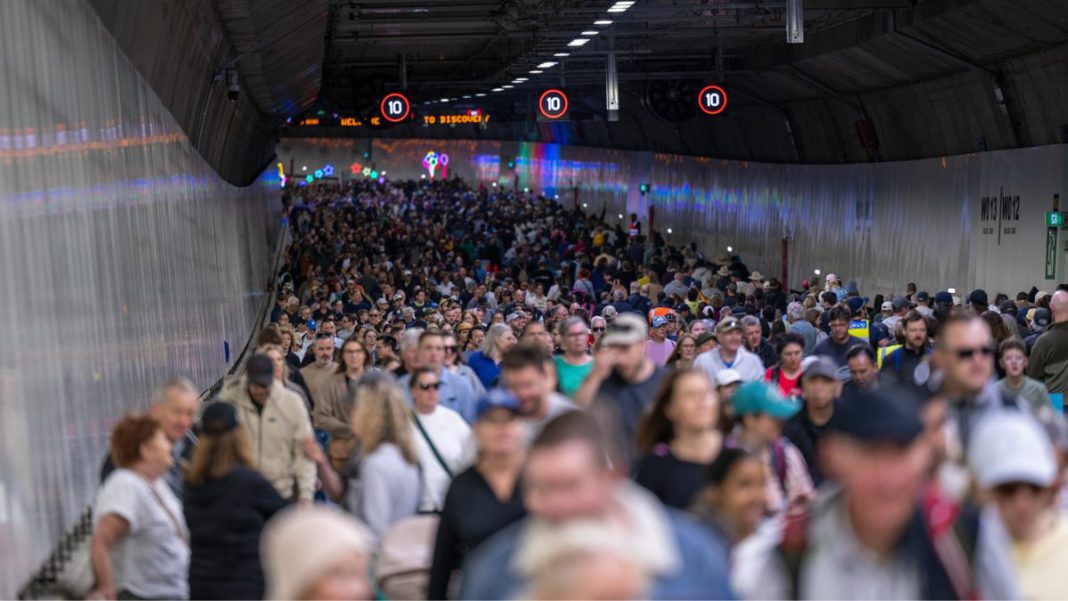
Tens of thousands of Victorians poured into Melbourne’s inner west on Sunday for a rare chance to walk, jog and celebrate inside the West Gate Tunnel before it opens to traffic next month — a community moment that marked one major transport milestone as another is set to arrive a year early.
From first light, more than 50,000 people joined the Allan Labor Government’s West Gate Tunnel Discovery Day, transforming the usually industrial corridor between Footscray and Yarraville into a festival of runners, families, cyclists and curious locals eager to see one of the city’s most ambitious infrastructure projects up close.
Minister for Transport Infrastructure Gabrielle Williams said the turnout reflected the significance of the project for the state. “More than 50,000 Victorians have taken this rare chance to explore the West Gate Tunnel on foot before it starts helping families get to work and back home sooner,” she said, watching runners stream across the new skyroad built above Footscray Road.
The day began just after 7am with an eight-kilometre run offering sweeping views of the skyline, before leading participants toward the tunnel’s entrance. Over at Yarraville Gardens, families gathered for food stalls, live music and a packed schedule of children’s entertainment. Meanwhile, walkers followed a 2.5-kilometre path that wound past newly created wetlands and under a dramatic 38-metre timber net structure before descending into the twin tunnels.
The event was also about giving back. Registration fees raised more than $175,000 for two west-based charities — the Community Bike Hub, which provides bicycle access and education, and West Welcome Wagon, which supports asylum seekers and refugees settling into life in Australia.
Roads and Road Safety Minister Melissa Horne said the Discovery Day symbolised what the project means for everyday travel and the broader community.
“The West Gate Tunnel will deliver safer and more dependable journeys from the west to the city — especially for the freight operators who keep Victoria moving, and for locals who deserve less congestion on their streets.”
Once open, the West Gate Tunnel will offer an alternative to the heavily burdened West Gate Bridge, taking traffic underground from the West Gate Freeway to the Maribyrnong River before linking to a new elevated road above Footscray Road. The route will provide a direct connection to the Port of Melbourne, CityLink, Footscray Road and the extended Wurundjeri Way, easing bottlenecks and removing an estimated 9,000 trucks a day from inner-west neighbourhoods.
Member for Footscray Katie Hall said the long-awaited relief for locals was overdue.
“This is a major win for our community — taking 9,000 trucks a day off local roads and creating safer, quieter neighbourhoods right across the inner west,” she said.
Just hours after the Discovery Day celebrations wrapped up, the state unveiled another historic transport announcement: the Metro Tunnel will open one year ahead of schedule on Sunday, 30 November.
Prime Minister Anthony Albanese joined Premier Jacinta Allan, Minister Gabrielle Williams and Suburban Rail Loop Minister Harriet Shing to confirm the early opening, describing it as a generational shift in how Victorians move around the city. The milestone forms part of the government’s Summer Start program, which will include free public transport every weekend for every Victorian until 1 February.
With full accreditation now approved by the National Rail Safety Regulator, the project is in its final countdown. Drivers are being rostered, shopfronts inside stations are being fitted out and station staff are undergoing final training.
Premier Jacinta Allan said the opening would reshape the city’s transport future. “The Metro Tunnel will open early in November, starting a new era for our city and state,” she said.
“It sets Victoria up for the future — slashing travel times, taking pressure off the City Loop and paving the way for more trains, more often, right across our network.”
When services begin, five new underground stations — Arden, Parkville, State Library, Town Hall and Anzac — will open simultaneously. Sitting up to 40 metres beneath city streets, the stations will act as new portals to hospitals, universities, the arts precinct and key employment zones.
Williams said the Metro Tunnel’s early delivery was proof of Labor’s long-term investment in public transport. “The Metro Tunnel will transform Melbourne, cut congestion and get you to work, uni and home sooner — and it opens later this month, a year ahead of schedule,” she said. “The Liberals called it a hoax, refused to fund it, and said it would never happen. While the Liberals blocked, Labor built — and Victorians will be able to ride the Metro Tunnel in just two weeks.”
Since work began in 2015, crews have carved out 1.8 million cubic metres of rock and soil beneath the CBD, built twin nine-kilometre tunnels and laid 40 kilometres of Australian-made track. High-capacity signalling has also been rolled out across the Cranbourne, Pakenham and Sunbury lines, paving the way for turn-up-and-go services fit for a global city.
Minister Harriet Shing said opening day would be unlike anything Victorians had experienced before. “We’re expecting huge crowds as Victorians step onto the platforms for the very first time — taking in the incredible architecture, the art, the scale and the engineering that brought this project to life.”
From February, the “Big Switch” will fully integrate the Metro Tunnel into the network, sending the Pakenham, Cranbourne and Sunbury lines exclusively through the new tunnels and adding more than 1,000 extra weekly services. Frankston line trains will return to the City Loop under a new statewide timetable for trains, trams, buses and regional services.
For now, though, Melbourne is celebrating — both beneath the west, and beneath the heart of the city — as two of the largest transport projects in the state’s history come to life at once.
Support our Journalism
No-nonsense journalism. No paywalls. Whether you’re in Australia, the UK, Canada, the USA, or India, you can support The Australia Today by taking a paid subscription via Patreon or donating via PayPal — and help keep honest, fearless journalism alive.
