

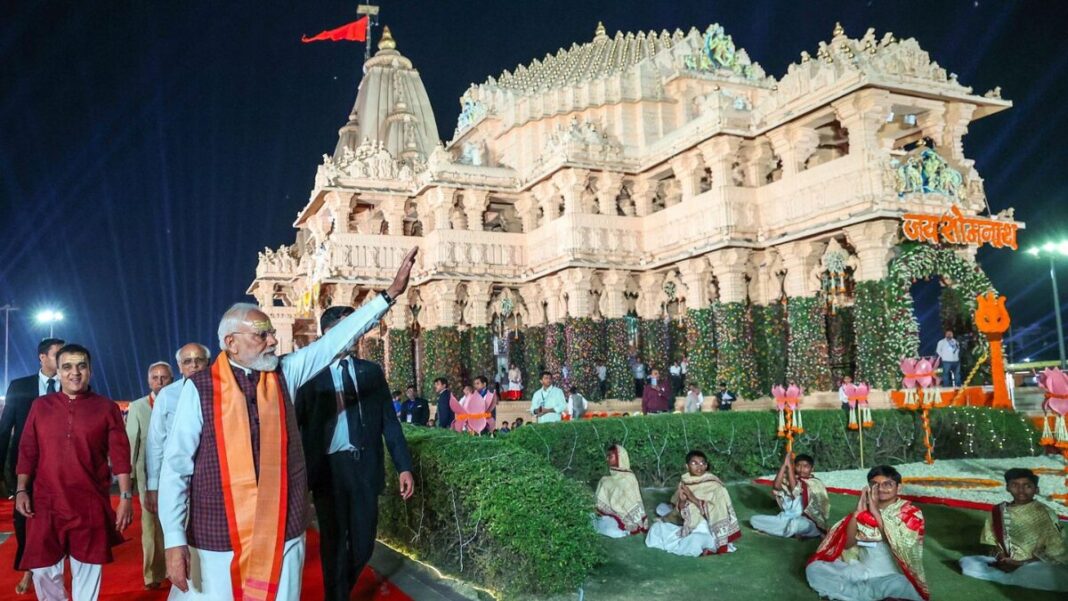
India marked a millennium of one of its most symbolically important religious sites in January, as Prime Minister Narendra Modi led a four-day national observance at the Somnath Temple on the country’s western coast.
Speaking on January 11 at the conclusion of the Somnath Swabhiman Parv (Festival of Self-Respect), Modi reflected on the temple’s turbulent history, describing it as a powerful symbol of continuity despite repeated destruction over centuries. He said Somnath’s survival demonstrated what he called India’s enduring civilisational strength.
The festival commemorated 1,000 years since the first recorded attack on the temple in 1026 by Mahmud of Ghazni, an event that began a long period during which the shrine was damaged and rebuilt several times. Modi said that while invaders believed they had erased Somnath through force, they themselves had faded into history, whereas the temple continued to stand.
Addressing a large gathering of devotees, priests and public representatives, the Prime Minister said generations before them had risked their lives to defend the shrine and their faith. He invited people to imagine the atmosphere at the site a thousand years ago, when defenders fought to protect what they believed was sacred. According to Modi, the ceremonial hoisting of the flag at the temple today symbolised that resilience and survival.
Modi also challenged the view that the attacks on Somnath were merely attempts to loot wealth. He argued that the repeated targeting of the temple and desecration of its deity pointed to deeper religious hostility. Without naming individuals or parties, he criticised what he described as post-Independence efforts to downplay or “whitewash” this history, saying it weakened public understanding of the past.
Earlier on Sunday, Modi led the Shaurya Yatra, a ceremonial procession honouring those who died defending the temple. The procession, part of the festival’s closing events, featured 108 horses from the Gujarat Police Mounted Unit, a traditional symbol of courage and sacrifice. Large crowds lined the route as the Prime Minister acknowledged supporters and participated in rituals, including blowing a conch shell.
During the visit, Modi offered prayers at the temple and paid tribute to historical figures associated with its defence and restoration, including warrior Veer Hamirji Gohil, who died protecting Somnath in the 13th century, and Sardar Vallabhbhai Patel, who spearheaded the temple’s reconstruction after India gained independence. The restored temple was formally opened to devotees in 1951.
The celebrations drew tens of thousands of visitors from across India. Streets leading to the shrine were decorated with flowers, lights and religious symbols, while banners highlighted Somnath’s long history. A large drone show and fireworks display depicted episodes from the temple’s past — including its destruction and rebuilding — and became a major attraction for visitors.
Modi said the Somnath Swabhiman Parv was not focused on past devastation, but on continuity and renewal. He described the temple as a source of cultural confidence and said such heritage sites continued to inspire India as it looked towards future economic and social development.
Located on the shores of the Arabian Sea in Gujarat, the Somnath Temple is one of the 12 jyotirlingas, the most sacred sites dedicated to the Hindu god Shiva. For many Indians, it remains a powerful symbol of faith, identity and resilience — a legacy that, as this year’s commemorations highlighted, has endured for a thousand years.
Support our Journalism
No-nonsense journalism. No paywalls. Whether you’re in Australia, the UK, Canada, the USA, or India, you can support The Australia Today by taking a paid subscription via Patreon or donating via PayPal — and help keep honest, fearless journalism alive.
