

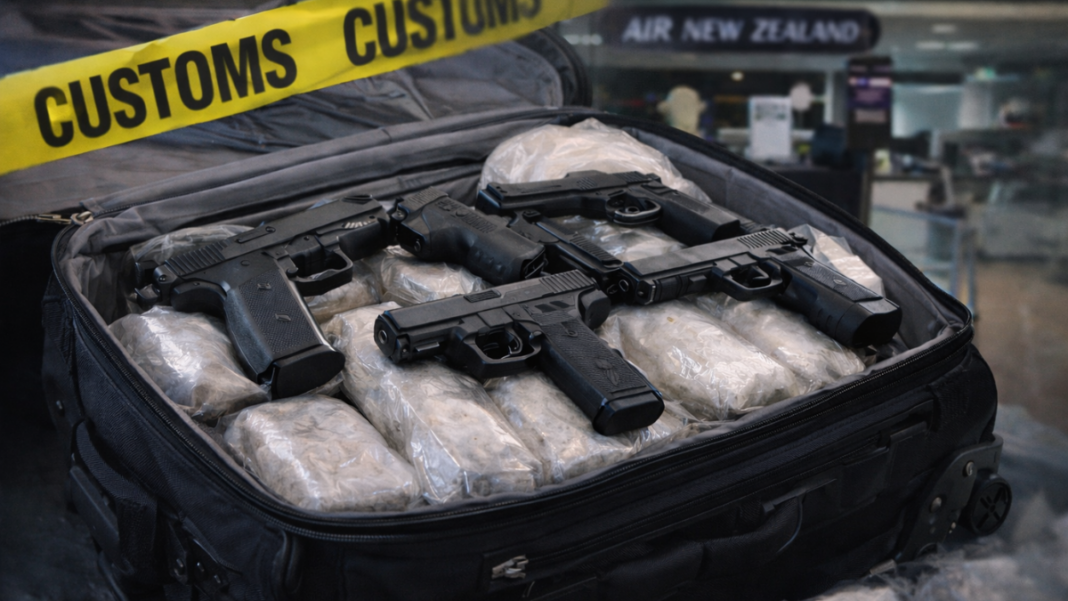
A chance discovery of six handguns in luggage arriving at Auckland Airport has exposed a wider insider smuggling network involving corrupt baggage handlers working within the airport’s operations.
The pistols were found in 2024 in luggage on a flight from the United States, marking one of the rare occasions firearms have been intercepted in baggage linked to organised crime networks attempting to exploit airport staff.
It is reported that this discovery later helped authorities uncover the role of two baggage handlers employed by Air New Zealand, who were subsequently convicted for their involvement in importing Class-A drugs through the airport.
The investigation formed part of Operation Soar, a police and Customs inquiry targeting criminal networks that recruit airport workers to move illegal cargo past border controls.
Authorities told media the scheme relied on baggage handlers using their access to restricted airside areas to intercept suitcases containing drugs before they reached New Zealand Customs Service screening points.
While the firearms were not the primary target of the investigation, officials say their discovery highlighted the escalating risks posed by organised crime groups seeking to import both drugs and weapons.
Last year, customs investigations manager Dominic Adams told media that firearms smuggling was far less common than drug trafficking but remained a serious concern.
“Any attempt to illegally import weapons is treated as extremely serious,” Adams said, warning such activity pointed to a willingness by criminal groups to use intimidation or violence.
It is reported that the firearms seizure came as authorities intensified efforts to dismantle a broader international drug trafficking operation centred on the airport.
A separate investigation, Operation Matata, led by the New Zealand Police National Organised Crime Group, uncovered large-scale attempts to import methamphetamine and cocaine into the country.
During that investigation, officers executed 20 search warrants across the Auckland region and arrested eight associates linked to the Brotherhood 28 MC, including the gang’s president. Those arrested faced more than 170 drug-related charges.
Police told media that the syndicate was responsible for importing major drug consignments, including 630 kilograms of methamphetamine valued at about $220 million and 112 kilograms of cocaine worth more than $50 million.
Detective Inspector Tom Gollan said criminal organisations were increasingly targeting airport workers because of their direct access to baggage systems and secure operational areas.
Investigators found that handlers recruited by gangs would remove suitcases from incoming flights before they reached screening points, allowing drug shipments to bypass border controls entirely.
Since the start of the investigation, authorities have made 43 arrests, including 20 baggage handlers employed by companies operating at Auckland Airport.
Police said the smuggling networks involved cooperation between multiple gangs, including links to the Comancheros Motorcycle Club and the Headhunters Motorcycle Club.
Officials also seized cash, ammunition, jewellery and electronic devices during the raids, with investigators uncovering shoe boxes filled with hundreds of thousands of dollars at some suspects’ homes.
Authorities say the high street value of drugs in New Zealand makes the country an attractive target for international syndicates, which often attempt to infiltrate legitimate supply chains such as airlines, freight companies and airport ground handling operations.
Customs officials say similar insider smuggling tactics have been seen at major airports in Australia, the United Kingdom and the United States, prompting closer international cooperation to identify vulnerabilities in aviation security systems.
Airport officials say they are working with law enforcement agencies and airlines to strengthen security and detect suspicious behaviour among staff, including sudden unexplained wealth or changes in lifestyle that may indicate corruption.
The investigation into airport insider smuggling networks remains ongoing, with authorities warning that organised crime groups will continue seeking new ways to exploit vulnerabilities in global travel and trade systems.
Support our Journalism
No-nonsense journalism. No paywalls. Whether you’re in Australia, the UK, Canada, the USA, or India, you can support The Australia Today by taking a paid subscription via Patreon or donating via PayPal — and help keep honest, fearless journalism alive.
