


By Prakhar Shukla
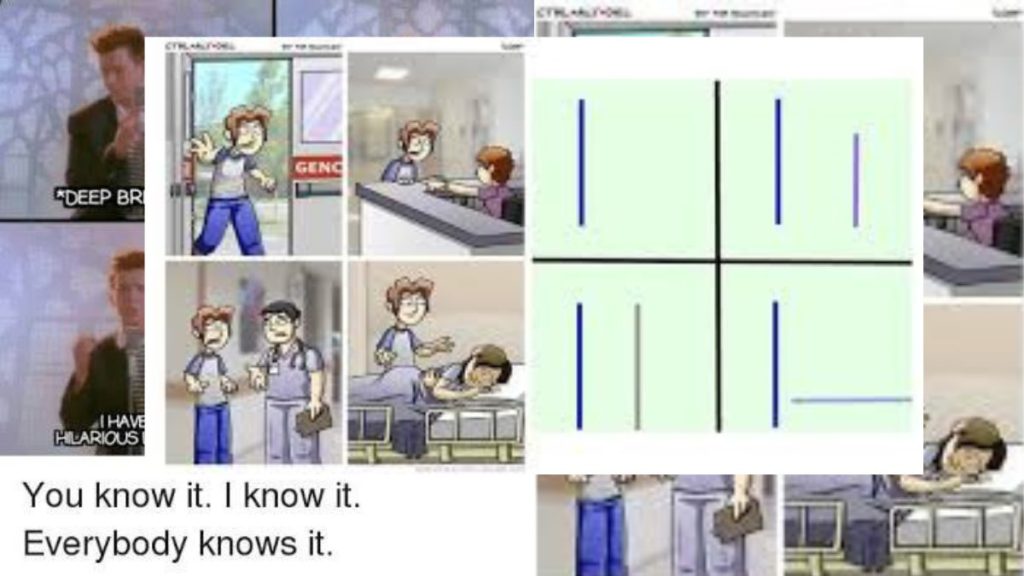
In the sprawling universe of digital culture, few artefacts have captured collective fascination and endurance as completely as Loss (2008), the four-panel strip from Tim Buckley’s webcomic Ctrl+Alt+Del.
Intended as a dramatic narrative shift from Buckley’s usual video game humour, the strip shows Ethan rushing into a hospital, speaking to a receptionist, entering a room and standing beside Lilah, who has suffered a miscarriage.

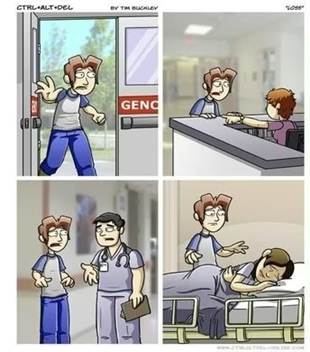
Its sudden gravity felt out of place amid the comic’s established absurdity, and its earnestness soon became a point of mockery. Yet over the years, Loss has outlived its origin as failed melodrama to become something more enduring: a meme that continually reshapes itself, an archetype of form, a modern myth recognised through structure rather than content.
To understand this transformation, it is helpful to turn to Claude Lévi-Strauss’s structuralist conception of myth. In The Structural Study of Myth (1955), Lévi-Strauss argues that myths share deep structural patterns across cultures. Beneath their varied surfaces lie recurring binaries such as life and death, presence and absence, sincerity and irony, held together by mediators who move between these oppositions. Myths, he suggested, operate like language. Their meaning rests not in what is told but in the relations between elements. Variants do not replace one another; they coexist as transformations of a single structure.
Seen through this lens, Loss becomes a myth of digital life. Its countless parodies preserve its skeleton even as they revise its surface. The meme evolves like a tribal story retold through new symbols while maintaining its fundamental pattern.
The Mythic Grammar of Loss
If diagrammed structurally, Loss can be expressed as four units, each forming a component within a mythic sequence:
- Column 1: Entry into hospital (approach, initiation)
- Column 2: Inquiry (dialogue, crossing of public and private)
- Column 3: Revelation (threshold, confrontation with the unseen)
- Column 4: Mourning (death, recognition of loss)
This rhythm of approach, inquiry, revelation and mourning has become the meme’s genetic code. Every parody retains this underlying structure even when presented through different cultural languages.
In one variant, Indiana Jones approaches a golden idol, the panels shifting between his face, his companion, the idol and the final realisation that the idol has fallen.
(Source: https://amp.knowyourmeme.com/memes/loss)
In another, an ape speaks with a strand of DNA, repeating a dialogue about pattern recognition until the sequence itself becomes the revelation that this is Loss.
(Source: https://amp.knowyourmeme.com/memes/loss)
A poetic version translates the structure into seasonal imagery.
(Source: https://amp.knowyourmeme.com/memes/loss)
While a Rick Astley version reenacts the four positions with his hands, merging the Loss meme with the cultural ritual of the Rickroll.

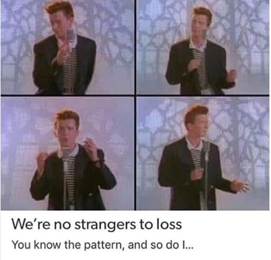
(Source: https://amp.knowyourmeme.com/memes/loss)
What unites these variants is the moment of recognition. The viewer identifies the arrangement of elements and understands that they are witnessing Loss, even when stripped of all narrative content. The meme becomes a ritual of initiation into internet literacy, a symbolic exchange between those who recognise its pattern.
Binary Oppositions in Digital Myth
For Lévi-Strauss, myths arise from the need to reconcile contradictions that cannot be logically resolved. In Loss, the tension lies between tragedy and comedy. The original comic sought tragedy, while the meme’s afterlife transformed it into humour. The meme becomes both death and resurrection: a grief narrative reborn through parody.
The Indiana Jones parody echoes Ethan’s futile rush toward salvation through cinematic suspense. The DNA version frames pattern recognition as evolutionary survival, turning the act of recognising the meme into a metaphor for adaptation. The poetic variant reduces the structure to symbols of creation and decay. The Rick Astley version merges two digital myths, revealing how modern storytelling often relies on layering and intertextual play.
Each variation mediates contradictions central to digital culture: sincerity and irony, presence and abstraction, personal grief and collective performance. In an environment where emotion is flattened into replicable content, Loss survives because it exposes and plays with these contradictions.
The Structure of Recognition
Lévi-Strauss argued that myth transforms historical events into timeless structures. Loss does not explain grief, but its memetic life provides a pattern through which discomfort can be processed. The humour appears not in the tragedy itself but in the recognition of structure, the rhythm of repetition that neutralises emotional weight.
Minimalist recreations, from lines and dots to the iconic “| || || |_”, strip the comic to pure form.

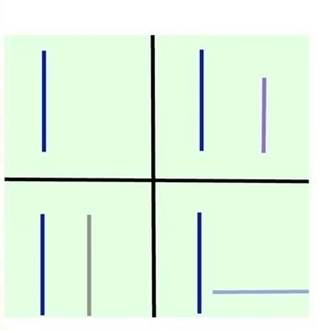
(Source: https://amp.knowyourmeme.com/memes/loss)
Meaning persists even as representation dissolves, showing how contemporary myth-making often relies on abstraction. Just as oral cultures used symbolic shorthand, digital communities use minimal arrangements to evoke shared understanding.
Meta-Humor and the Trickster Principle
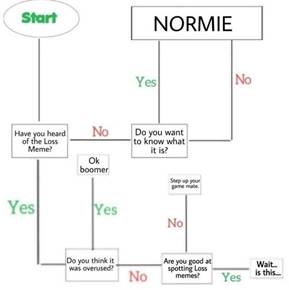
In many mythologies, the trickster moves between opposites, disrupting order through humour. Loss, through its endless parodies, performs a similar function.

(Source: https://amp.knowyourmeme.com/memes/loss)
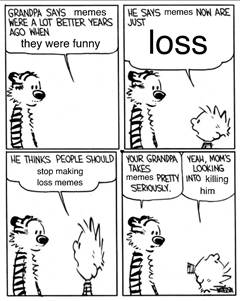
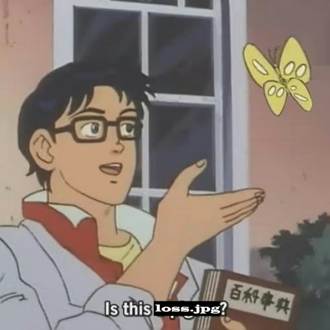
When flow charts, Calvin and Hobbes strips or anime scenes replicate its panel structure, they not only parody the original comic but also the act of pattern recognition itself.

(Source: https://amp.knowyourmeme.com/memes/loss)
Loss becomes a question about how much structure meaning can hold before collapsing into pure form.
From Myth to Meta-Myth
Over time, Loss has evolved from a comic about miscarriage into a meme about its own structure. The phrase “Is this Loss?” marks the moment the meme becomes a pure pattern.

(Source: https://amp.knowyourmeme.com/memes/loss)
Each reinterpretation becomes what Lévi-Strauss called a bundle of relations: coexisting, conflicting, sustaining the myth’s vitality. To freeze Loss would be to destroy it; its power lies in mutability.
Conclusion
For Lévi-Strauss, myth exists to think through contradictions. The Loss meme, in its many transformations, performs this function for the digital age. Every variant repeats the same ritual sequence of approach, inquiry, revelation and mourning, the four beats of human experience translated into internet syntax.
Loss endures because it is good to think with. It speaks to a modern tribe that gathers around screens, telling and retelling a story that survives by changing form. Like myth and language, it lives only through continual use and reinvention.
Support our Journalism
No-nonsense journalism. No paywalls. Whether you’re in Australia, the UK, Canada, the USA, or India, you can support The Australia Today by taking a paid subscription via Patreon or donating via PayPal — and help keep honest, fearless journalism alive.

