

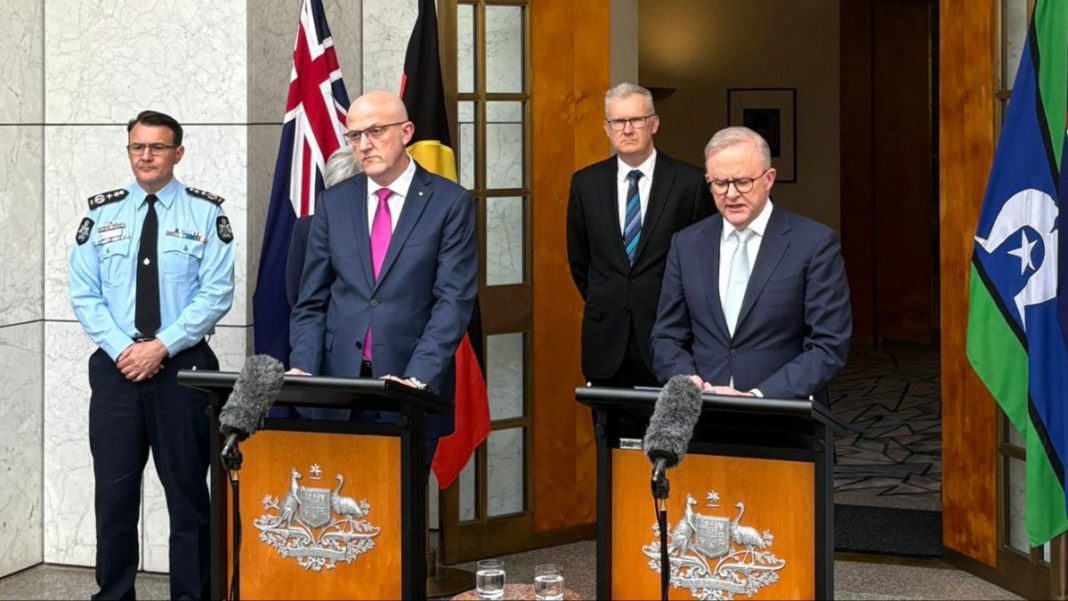
Australia’s domestic spy agency is under intense scrutiny after ASIO director-general Mike Burgess confirmed one of the Bondi Beach gunmen was “known” to the agency before the Hanukkah terror attack that left 16 people dead and dozens injured.
The revelation has triggered a wave of anger from Jewish and multicultural community leaders, civil liberties advocates and some politicians, who argue that public trust in ASIO’s leadership has been badly shaken and are demanding clear accountability — up to and including Burgess’ resignation.
Bondi gunman linked to earlier IS cell
ASIO’s role came under the spotlight when Burgess told reporters that one of the gunmen was on the agency’s radar, though not assessed as an “immediate threat”.
Asked whether either of the Bondi shooters had appeared on ASIO watchlists, Burgess said:
“One of these individuals was known to us, but not in an immediate-threat perspective, so we need to look into what happened here.”
Subsequent reporting has revealed that ASIO examined 24-year-old Naveed Akram six years ago over his close ties to a Sydney-based Islamic State (IS) cell. That investigation began soon after the 2019 arrest of Isaak El Matari, who later admitted planning an IS-inspired insurgency and is now serving a seven-year sentence.
Sources quoted by the ABC say Akram was “closely connected” to El Matari and other men convicted of terrorism offences, yet was ultimately judged not to pose an imminent threat. An IS flag was later found in the Akrams’ vehicle after the Bondi massacre, reinforcing investigators’ belief the attack was ideologically driven.
For many critics, the pattern is depressingly familiar: a major attack followed by the admission that at least one perpetrator had been known to authorities but assessed as low-risk.
‘Known to us’ is not good enough, critics say
Community leaders and some MPs now argue that “known to us” has become an unacceptable refrain from security agencies after mass-casualty attacks.
Jewish representatives say the Bondi shooting — which targeted a Hanukkah celebration and killed Rabbi Eli Schlanger and 14 others — has left families asking whether more could and should have been done to neutralise the threat earlier.
Australian Jewish Association’s CEO Robert Gregory told The Australia Today, “We are concerned by the fact that one of the suspects appears to have been on the radar or intelligence agencies and was not appropriately monitored.”
“We hope that this is an isolated example,” he added
“The Jewish community believes that the Australian government has not taken the threat of Islamic terrorism or Islamist terrorism and anti Semitism seriously enough.
And we hope that the intelligence agencies are reviewing their methods.”
Civil liberties and human-rights advocates, while wary of over-reaction, are also calling for far greater transparency around how ASIO judges when a person moves from “of interest” to “immediate threat”, and what oversight exists when such judgments later prove fatally wrong.
Several federal and state politicians have privately questioned whether Burgess can credibly lead the internal review ASIO has promised, arguing that an independent inquiry, with the powers of a royal commission, is needed.
Some are openly suggesting the director-general should consider his position to help restore public confidence in the system.
Mr Gregory also said,
“By ignoring repeated warnings, the Prime Minister and his senior ministers are responsible for this. The honourable thing would be for them to resign.”
Burgess’ record under the microscope
Mike Burgess, a former ASD (Australian Signals Directorate) executive, was appointed ASIO director-general in 2019. In annual “threat assessment” speeches, he has repeatedly warned that espionage and foreign interference now pose a greater long-term danger to Australia than terrorism, and has overseen a shift in resources to counter those threats.
Under his tenure, ASIO says it has helped disrupt numerous terror plots and has downgraded the national terror threat level from “probable” to “possible” in 2022, reflecting what it described at the time as a reduced likelihood of a terrorist attack in Australia.
Supporters of Burgess point to those disrupted plots and to the legal and practical constraints ASIO operates under. Intelligence agencies cannot detain or charge suspects; they collect information and pass it to police and prosecutors. They must also balance surveillance with civil liberties and finite resources — a constant triage between thousands of people “of interest” and a much smaller subset considered actively dangerous.
But critics argue that the Bondi attack exposes deeper weaknesses: risk-assessment frameworks that failed to recognise the escalation pathway of a man previously linked to a hardened IS cell; an apparent over-confidence in the downward trend of jihadist terrorism; and a lack of visible accountability when those judgments go catastrophically wrong.
A wider pattern of pressure and missed warning signs
The Bondi massacre is not the first time Australian authorities have had to acknowledge that terrorists were on their radar before they struck. The perpetrator of the 2018 Bourke Street knife attack in Melbourne, Hassan Khalif Shire Ali, had been investigated by ASIO in 2015 over possible extremist ties but was later assessed as no longer a significant threat.
Those earlier cases predate Burgess’ time as director-general, but they form part of a longer pattern that critics say should have prompted a more profound overhaul of how “known” individuals are monitored and re-evaluated.
Now, with 15 people dead at Bondi and the director-general again conceding prior awareness of at least one attacker, pressure is building for a fundamental reset — including at the very top of ASIO.
Calls for an independent inquiry – and for Burgess to go
Security experts are divided on whether a change of leadership would materially improve outcomes. Some argue that sacking Burgess could amount to scapegoating one official for systemic problems: legal thresholds for disruption, resourcing limits, and the inherent difficulty of predicting who will move from radical rhetoric to violent action.
Others counter that leadership does matter — in setting priorities, challenging institutional assumptions and fostering a culture of healthy scepticism. They say only a robust, independent inquiry, empowered to examine ASIO’s internal decision-making around Naveed Akram and his associates, can determine whether those standards were met.
What is clear is that a growing number of critics, particularly within affected communities, now see Burgess as the public face of an intelligence system that failed to prevent one of the worst mass shootings in modern Australian history. For them, a change at the top is a necessary step toward rebuilding trust.
A test of transparency and trust
In the coming months, ASIO and the Joint Counter Terrorism Team will piece together how a previously investigated extremist, allegedly inspired by IS, was able to arm himself and carry out a devastating attack on a Jewish festival at one of Australia’s most iconic locations.
Whether Mike Burgess can retain the confidence of victims’ families, the Jewish community and the broader public while leading that process is now a central question.
For some, the answer is simple: only a new director-general, appointed after an independent inquiry, can convince Australians that lessons from Bondi will be learned — and acted upon — rather than simply filed away as another case where a killer was “known” but not stopped.
Support our Journalism
No-nonsense journalism. No paywalls. Whether you’re in Australia, the UK, Canada, the USA, or India, you can support The Australia Today by taking a paid subscription via Patreon or donating via PayPal — and help keep honest, fearless journalism alive.
