


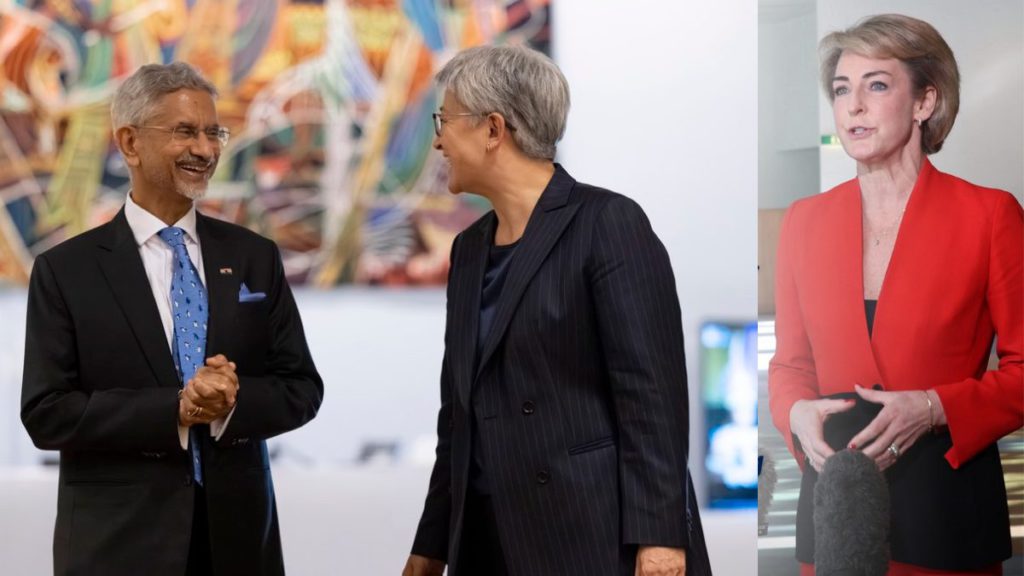
Foreign Minister Senator Penny Wong has firmly rejected calls from the Opposition to sanction Indian oil refineries allegedly processing Russian crude, stressing that Australia values its “very important bilateral relationship” with India.
The debate at Senate estimates on Friday, 10 October 2025, followed concerns raised by Shadow Minister for Foreign Affairs Senator Michaelia Cash over Australia’s reliance on India’s Jamnagar refinery, which supplies roughly 10 per cent of the nation’s imported refined oil products.
“My understanding is they supply about 10 per cent of our imports, but have, as recently as this month, signalled little intention to change course,” Senator Cash said.
“Secretary, can I ask what the government is doing to reduce its reliance on sourcing refined oil products from Jamnagar?”
First Assistant Secretary Sarah Storey noted that Australia imports refined petroleum from two Indian refineries and that discussions with partners and industry suggest “early trends would indicate a diversification away from Russian oil from some of the refineries, and certainly from the two that we import from.”
Senator Wong responded that the government is handling the matter carefully and diplomatically. “Senator, Ms Storey is saying that we have had engagement. The Indian government is aware of our views. These are matters primarily for the resources department,” she said.
“We regard that as a very important bilateral relationship, and we will work through these issues, including our desire that there be diversification in the supply chain with them bilaterally and respectfully.”
Senator Cash pressed further, “So, just in terms of then maybe the question should have been better put to you then, Minister.”
“What is the government doing to reduce our reliance on sourcing refined oil products from Jamnagar, given they have little intention, as the Indian Minister has said, of changing course?”
Senator Wong reiterated that this was primarily a matter for Resources Minister Madeleine King but underlined Australia’s broader sanctions strategy against Russia. “We have increased sanctions, we have lowered the price cap. We are part of the movement of many countries to try and starve the Russian oil regime of revenue,” she said.
“We have increased, we’ve imposed sanctions, I think for the first time on the shadow fleet, which was one of the primary mechanisms for the avoidance of sanctions and is also an indication the fact that the shadow fleet has been such a big part of Mr Putin’s response shows that the sanctions are biting in relation to secondary products, you know, oil products.”
Sentaor Wong acknowledged the limitations of Australia’s reach when it comes to third-country imports. “We are limited in what we can do because the mechanisms don’t exist internationally for those, for that to be traced and therefore to be dealt with. The EU has flagged this, but they do not have any guidelines about this,”Wong said.
“I think we’re all in the same boat about how is it that we can reduce the revenue from Russian oil internationally and that we’ll work with other countries to do that.”
Earlier, The Australia Today reported that Shadow Assistant Minister for Foreign Affairs and Trade Dean Smith had urged the Albanese Government to follow Europe’s lead and sanction Indian oil refineries allegedly processing Russian crude, saying Australia’s current measures were “missing the point.” Speaking on ABC Radio’s Drive program on 8 October 2025, Smith criticised Australia for failing to address the indirect flow of Russian oil revenue.
Speaking on ABC Radio’s Drive program on 8 October 2025, Senator Smith said that while the government had strengthened sanctions against Russia — including targeting 95 “Russian shadow fleet” vessels in September — Australia was not doing enough to address the indirect flow of Russian oil revenue. “I think the government’s approach misses the point,” Senator Smith said.
“Why is it that Australia is not actually doing what the Europeans are doing — an that is sanctioning the refinery itself? There could be a good or interesting reason for this, but it’s not immediately obvious to me.”
When radio host Gary Adshead pressed the issue further, he asked whether the Australian Government had ever considered sanctioning refineries directly — similar to the approach taken by the United States, which has introduced tariffs and other measures to curb the flow of Russian oil through third countries.
“Has that been considered within government at all — the sanctioning of the refineries, like the U.S. has now done, through tariffs and other methods to try and stop this flow of Russian oil?”
Resources Minister Madeleine King, who was also part of the discussion, appeared momentarily uncertain about the target of Smith’s proposed sanctions.
“Well, I’m not sure if Dean’s suggesting we sanction BP’s refinery — or do you mean the ones in India?” she asked.
Senator Smith quickly clarified his position:
“No, no, no — the refineries in India.”
Responding to the broader criticism, a DFAT spokesperson has also noted that Australia had already imposed over 1,500 sanctions in response to Russia’s invasion of Ukraine, including restrictions on oil imports and the “shadow fleet,” designed to cut off Moscow’s revenue. Direct imports of Russian energy products have fallen from $80 million to zero since 2021, though tracking refined oil through third countries remains a challenge.
While the US has imposed tariffs on Indian goods to pressure New Delhi to curb Russian oil purchases, Senator Wong emphasised that Australia will continue to engage with India respectfully, recognising the strategic importance of the bilateral relationship.
Support our Journalism
No-nonsense journalism. No paywalls. Whether you’re in Australia, the UK, Canada, the USA, or India, you can support The Australia Today by taking a paid subscription via Patreon or donating via PayPal — and help keep honest, fearless journalism alive.

