

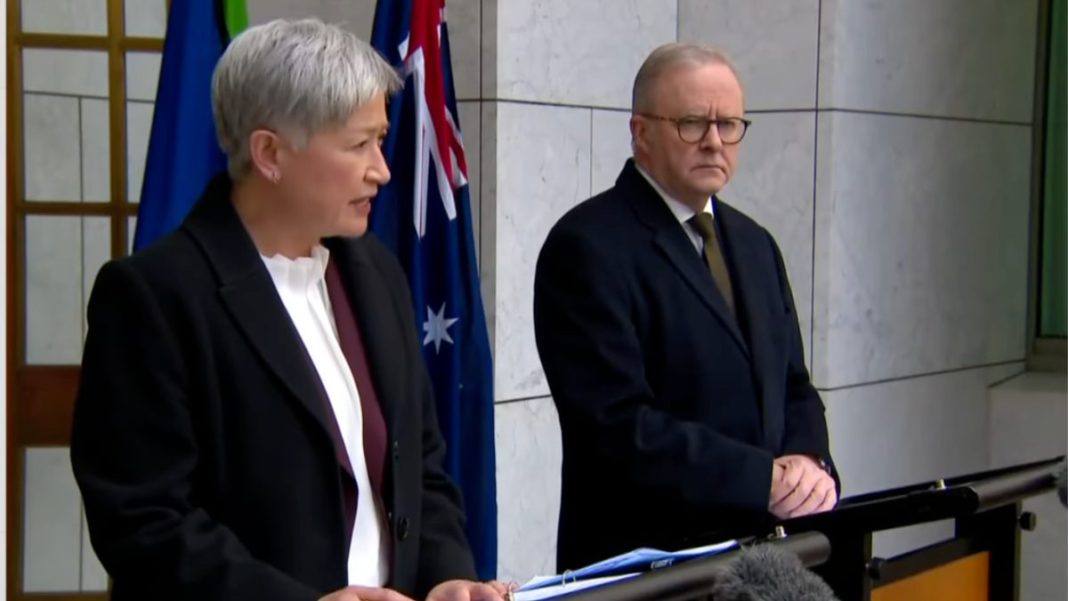
Prime Minister Anthony Albanese says Australia’s decision to recognise the State of Palestine at next month’s United Nations General Assembly is driven by a rare moment of international alignment and the best chance in decades to break the Middle East’s cycle of violence.
“Today, I can confirm that… Australia will recognise the State of Palestine,” PM Albanese said at Parliament House, moments after a Cabinet meeting that sealed the decision.
“Australia will recognise the right of the Palestinian people to a state of their own, predicated on the commitments Australia has received from the Palestinian Authority.”
For the Prime Minister, the move is not a sudden pivot but a continuation of Australia’s historic role in the two-state vision. He reminded Australians that in 1947, Foreign Minister H.V. Evatt chaired the UN committee that recommended the creation of both Israel and a Palestinian state — and that Australia was “the first country to raise its hand” for Resolution 181. “More than 77 years later, the world can no longer wait for the implementation of that Resolution to be negotiated between the parties,” he said.
“This is humanity’s best hope to break the cycle of violence in the Middle East.”
Albanese argues the timing is not only symbolic but strategic. The Palestinian Authority has in recent months made what he called “detailed and significant” commitments: to recognise Israel’s right to exist, demilitarise a future Palestinian state, reform governance and education, end prisoner payments, and hold general elections. “These commitments have been given even greater weight by the Arab League’s unprecedented demand for Hamas to end its rule in Gaza and surrender its weapons,” he said.
“This is an opportunity to isolate Hamas… and drive it out of the region once and for all.”
Foreign Minister Penny Wong, who has been leading much of the behind-the-scenes diplomacy, said the decision followed nearly two years of conversations with international partners. “We would recognise Palestine when it would best contribute momentum to peace. September is that time,” she said.
“The heartbreak, death and destruction must end.”
The Prime Minister’s announcement also carried a pointed rebuke to the Netanyahu Government, which he accused of “extinguishing the prospect of a two-state solution” through rapid settlement expansion, threats of annexation, and defiance of international calls for restraint in Gaza. “The situation… has gone beyond the world’s worst fears,” Albanese said.
“Far too many innocent lives have been lost. The Israeli Government continues to defy international law and deny sufficient aid, food and water to desperate people, including children. Palestinian children deserve a future that looks nothing like their reality today.”
Anticipating criticism that the move is symbolic, Albanese said, “This is a practical contribution towards building momentum… so both Israelis and Palestinians can live in peace and security. This is not Australia acting alone.”
Over the past fortnight, he has discussed the recognition plan with leaders, including UK Prime Minister Keir Starmer, French President Emmanuel Macron, New Zealand Prime Minister Christopher Luxon, and Japanese Prime Minister Shigeru Ishiba, as well as directly with Israeli Prime Minister Benjamin Netanyahu and Palestinian President Mahmoud Abbas. Albanese said he told Netanyahu the arguments against recognition were “very similar to the arguments that he put more than a year ago,” and that “we need a political solution, not a military one, because a military response alone has seen the devastation in Gaza.”
The Prime Minister reaffirmed Australia’s solidarity with Israel following the 7 October 2023 Hamas attacks, calling them “the worst loss of Jewish lives on a single day since the Holocaust.”
He again demanded Hamas release all hostages “immediately, unconditionally and with dignity,” adding:
“There can be no role for Hamas in any future Palestinian state.”
At the same time, he stressed that “Palestinian civilians cannot be made to pay the price of defeating Hamas,” and that both Israelis and Palestinians must have “a secure and prosperous future that respects the aspirations of both peoples.”
Wong said the recognition is “just the beginning” and that practical steps — such as upgrading Australia’s diplomatic presence in Palestine — will be tied to measurable progress on the Palestinian Authority’s commitments. “There is no sustained peace unless we see a two-state solution,” she said.
“Israel and Palestine. Recognition of each other’s right to exist.”
For Albanese, the choice is clear:
“The world cannot wait for success to be guaranteed — that only means waiting for a day that will never come. There is a moment of opportunity here, and Australia will work with the international community to seize it.”
Support our Journalism
No-nonsense journalism. No paywalls. Whether you’re in Australia, the UK, Canada, the USA, or India, you can support The Australia Today by taking a paid subscription via Patreon or donating via PayPal — and help keep honest, fearless journalism alive.
