

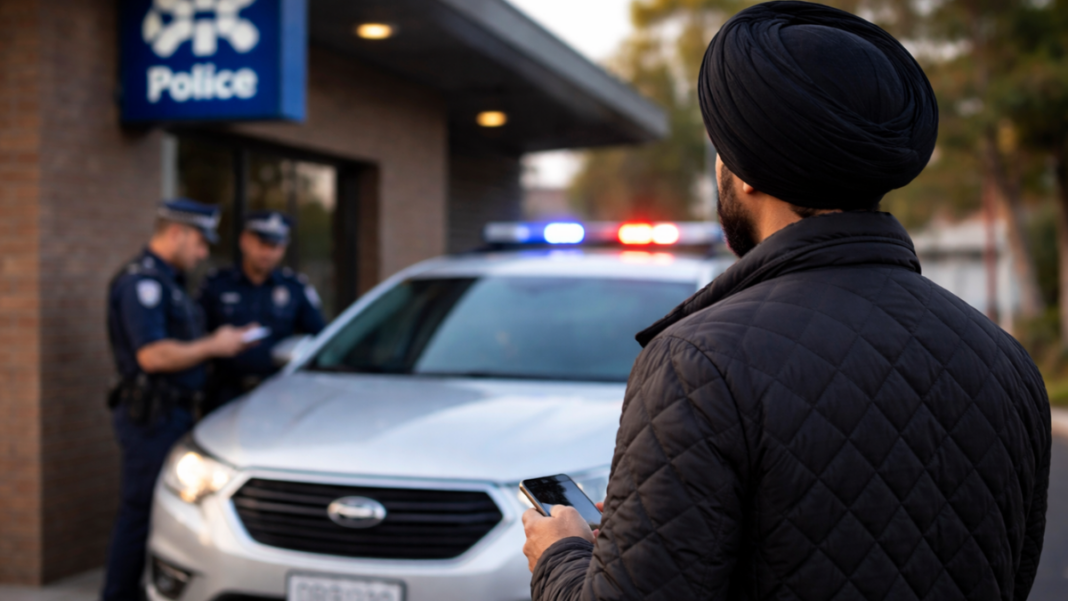
A rideshare driver, Mr Singh, who is of Indian descent, has launched Federal Court action against Queensland Police, alleging he was racially vilified, denied procedural fairness, and wrongfully prosecuted for more than a year over an indecent act allegation that was ultimately withdrawn.
The case centres on a January 2023 incident in Lawnton, north of Brisbane, where police were called after a resident reported seeing the man, identified in court documents as Singh, allegedly masturbating inside his car. Singh denies the allegation and says the police response was tainted from the outset by racial hostility, culminating in a body-worn camera recording in which one officer allegedly referred to Indians in deeply offensive terms.
According to court filings, Singh is seeking $493,488 in compensation, along with aggravated and exemplary damages, claiming negligence and misfeasance in public office. He also alleges the conduct of the police amounted to unlawful racial discrimination.
The matter, first reported in detail by The Guardian Australia, has drawn fresh scrutiny to how police handle complaints involving culturally and linguistically diverse communities, particularly where language barriers, racial stereotyping and prosecutorial discretion intersect.
Alleged incident and arrest response
Police were called to a suburban street in Lawnton on 26 January 2023 after a resident alleged the driver had been committing an indecent act in his vehicle. In his statement of claim, Singh says he had just completed an Uber trip in the area and was speaking to his sister in India at the time.
He alleges he showed officers his phone, including details of the completed rideshare trip and a call log that indicated he had been on the phone to his sister for 59 minutes before police arrived. Singh says he had been gesturing with his hands during the conversation and that this may have been misinterpreted.
The court documents also allege that before police arrived, the complainant abused him with explicitly racist language, including calling him an “Indian dog” and a “paedophile”.
Singh says he has only a basic understanding of English and asked the police for an interpreter during the roadside interaction. He further alleges that requests to speak with a lawyer and to call his sister before answering questions were also refused. He denies the allegation put to him by the police and says he was later issued with a summons to appear in court.
Body-worn camera and alleged racist remark
A central issue in the lawsuit is body-worn camera footage captured after officers left the scene.
According to a transcript referenced in the court claim, one of the officers allegedly discussed another unrelated call-out involving “a fucking Indian guy” before returning to the Lawnton matter. The same officer is then alleged to have said Indians were “a bunch of fucking perverts”.
The significance of that alleged remark grew after the criminal case collapsed. According to a court transcript cited in the claim, magistrate Annette Hennessy later described the comment as “racist”.
Singh argues the statement was not an isolated slur but evidence of racial bias that infected the entire investigation and prosecution. He says the officers’ conduct amounted to racial vilification and contributed to the continuation of a case that should never have proceeded.
Charges escalated, then dropped
The case against Singh changed shape over time.
He was first summoned on a charge of wilful exposure. That was later upgraded by the police prosecutor to the more serious indictable charge of committing an indecent act in a public place. Singh’s legal team says they repeatedly asked for the matter to be discontinued, arguing there was insufficient evidence and that the police conduct at the scene raised serious concerns.
Court records referred to in the claim indicate that in August 2023, prosecutors offered to finalise the matter with an adult caution. Singh refused that outcome, maintaining his innocence.
The following month, a new police prosecutor took over the file and disclosed what the pleadings describe as “capacity concerns” about the complainants. Even so, the prosecution continued to maintain it had a strong case.
In February 2024, the indecent act charge was dropped. A lesser wilful exposure charge was then dismissed at trial after both witnesses declined to give evidence in court.
Alleged failures in the investigation
As part of the Federal Court proceedings, Singh claims police failed to properly test the reliability of the complaint before laying charges and then persisting with the case.
Among the alleged deficiencies identified in the claim are whether the witnesses could clearly see into the vehicle through tinted windows, whether both complainants were reliable, and whether the allegation itself was physically plausible. The claim argues that if Singh’s hands were raised and moving while he was on the phone, as alleged by witnesses, that would be inconsistent with the conduct police accused him of.
His legal team says these issues were never properly resolved before the matter was escalated through the courts.
Personal fallout and fear of deportation
Singh says the impact of the case has been devastating.
In a statement released by his lawyers, he said he felt the plans and hopes he had built after coming to Australia had “vanished before my eyes”. He described the allegation as deeply offensive in any society, and particularly taboo within his own cultural background.
He said he was “robbed of all dignity” and made to feel “dirty and worthless”, adding that he had gone from having a wide circle of friends to none. Even after the charges were withdrawn, he said the stigma had lingered and left him isolated.
His lawyer, Stewart O’Connell, said the prosecution had been “soul-destroying” and argued that Singh came to Australia expecting fairness and tolerance but instead experienced the opposite.
O’Connell said his client was accused of “a disgusting crime”, had his version of events dismissed, and was then prosecuted on what he described as flimsy evidence despite police later being recorded making “outrageously negative views” about Indians.
He also said the financial burden of defending the matter forced Singh to abandon his studies, placing his visa status at risk and leaving him facing possible deportation.
Queensland Police response
In its defence filed in court, Queensland Police denies that the actions of the officers or prosecutor were motivated by Singh’s race, colour or national or ethnic origin. It also denies that Singh was refused access to a lawyer, an interpreter or a phone call to his sister.
The police defence reportedly argues the body-worn camera recording was made accidentally and rejects the allegation that the prosecution was improperly continued because of racial bias.
In a statement provided to The Guardian Australia, a Queensland Police spokesperson said the service was unable to comment on individual matters or legal proceedings for privacy and legal reasons.
The spokesperson said Queensland Police remained focused on delivering professional policing services and pointed to a range of internal programs, policies and complaint systems aimed at supporting ethical and professional conduct. The force also said concerns about policing responses and investigations could be raised at any time.
Broader questions
The case raises broader questions about the treatment of migrants and international residents in the justice system, particularly where there are cultural sensitivities, language barriers and allegations of racism by officials involved in an investigation.
For Singh, the legal action is now about more than the original charge. It is also about what he says was the humiliation of being investigated and prosecuted, while police allegedly expressed racist views about his identity in private.
The Federal Court proceedings are continuing.
This report is based on details first reported by The Guardian Australia.
Support our Journalism
No-nonsense journalism. No paywalls. Whether you’re in Australia, the UK, Canada, the USA, or India, you can support The Australia Today by taking a paid subscription via Patreon or donating via PayPal — and help keep honest, fearless journalism alive.
