

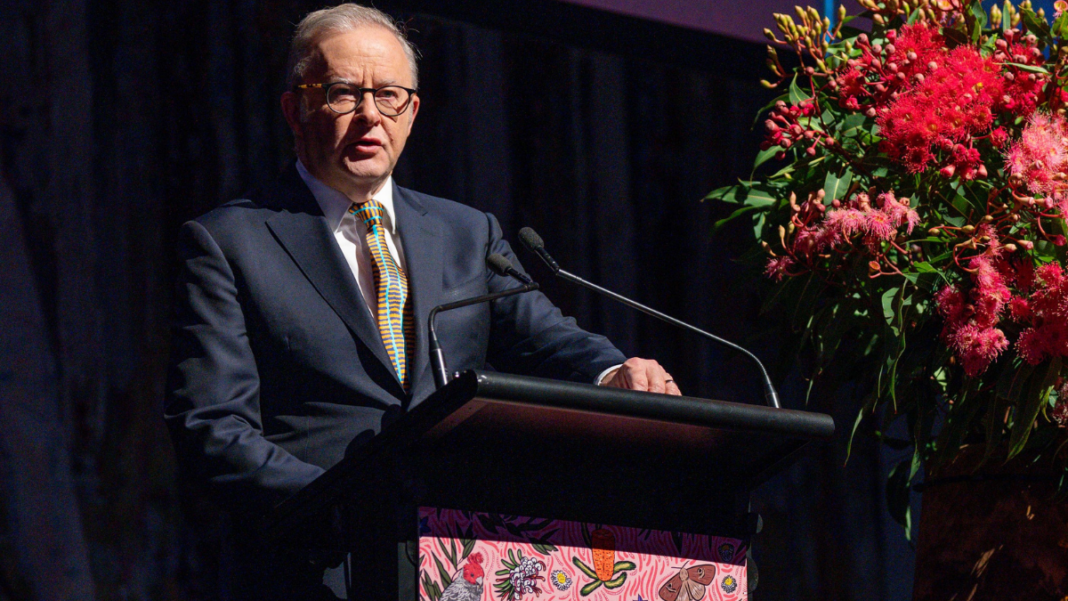
Prime Minister Anthony Albanese has marked the anniversary of the National Apology to the Stolen Generations with a renewed commitment to truth-telling, healing and closing the gap, announcing up to $87 million over four years for specialised support services.
Speaking at the annual anniversary breakfast on Friday, PM Albanese said standing alongside survivors each year remained “one of my greatest honours as Prime Minister”, paying tribute to their strength and resilience.
“Your strength gave us all the chance of a better Australia,” he told those gathered, including survivors and community leaders.
Reflecting on the historic Apology delivered 18 years ago, PM Albanese described it as the fulfilment of a long-overdue promise — one that some had resisted out of fear. He noted that former prime minister John Howard had warned saying sorry would be “calamitous” for the country.
“It was anything but,” PM Albanese said, arguing the nation instead came together in “fundamental decency”.
He recalled the moment in February 2008 when then prime minister Kevin Rudd delivered the Apology in Parliament. Watching from the chamber, PM Albanese said he saw “tears, relief and quiet pride” on the faces of those in the public gallery — particularly survivors who had fought for decades to be heard.
“The Apology was an honest reckoning with our history,” he said, acknowledging that children had been torn from their families and culture, and that “what was broken could not be easily put together”.
He invoked the story of respected Aboriginal leader Lowitja O’Donoghue, who was taken from her mother at the age of two and reunited with her 33 years later. Quoting her biographer Stuart Rintoul, PM Albanese described a reunion marked not by embrace but uncertainty — “they did not know how to be with one another” — underscoring the depth of trauma carried by the Stolen Generations.
While the Apology acknowledged the pain of the past, PM Albanese said it was also a call to action for a “better, fairer, stronger Australia” — one in which Indigenous and non-Indigenous Australians share equal opportunity and power over their own destinies.
He acknowledged the bipartisan support shown at the time, including by former opposition leader Brendan Nelson, saying unity had been essential to the moment.
The Prime Minister also announced up to $87 million over four years for specialised Stolen Generations services, including family tracing and reunification programs aimed at addressing the ongoing and intergenerational impacts of forced removals.
“These services are vital in supporting healing and acknowledging the traumatic impacts of being removed from family, culture and Country,” he said.
With next year marking 30 years since the landmark Bringing Them Home report, PM Albanese returned to the words of its co-author Mick Dodson, who said Indigenous people who gave evidence “just wanted people to know the truth”, not to induce guilt.
“Truth is essential because we can only truly know where we’re going if we know where we’ve been,” the Prime Minister said, acknowledging the presence of Shannan Dodson and her work with the Healing Foundation.
PM Albanese also reflected on attending the 40th anniversary of the handback of Uluru by the Hawke Government, recalling the joy described by traditional owner Aunty Pamela Taylor when the land was finally returned.
Such moments, he said, offered a glimpse of “the even greater Australia we can be”.
However, he cautioned against complacency, noting that while progress had been made under the Closing the Gap framework, there were areas where improvement had stalled.
“It is starkly clear that we have no room for complacency,” he said, adding that racism remained “a real and present danger”, referencing a recent alleged terrorist attack in Perth.
Addressing Aboriginal and Torres Strait Islander people directly, PM Albanese reiterated a message he said he had delivered in Parliament: “We see you. We stand with you.”
He concluded by describing the Apology not as a final word, but as the beginning of a shared national chapter.
“The story of the Apology began when we — as a nation — decided to listen. To open our ears and open our hearts,” he said.
“That is the chapter we continue to write — with determination, with optimism, and above all, with each other.”
Support our Journalism
No-nonsense journalism. No paywalls. Whether you’re in Australia, the UK, Canada, the USA, or India, you can support The Australia Today by taking a paid subscription via Patreon or donating via PayPal — and help keep honest, fearless journalism alive.
