

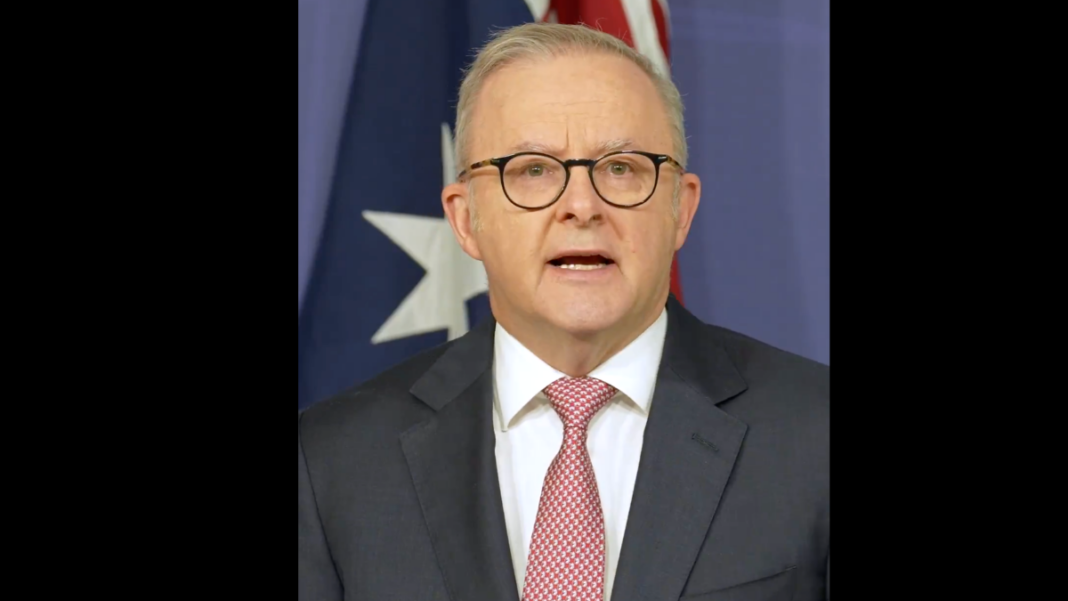
Prime Minister Anthony Albanese has declared Australia stands “with the brave people of Iran” while backing United States action to prevent Tehran from acquiring a nuclear weapon, as fears grow of wider conflict across the Middle East.
Speaking in Sydney on Sunday, Mr Albanese delivered a forceful condemnation of Iran’s leadership, saying Ayatollah Ali Khamenei had overseen ballistic missile and nuclear programs, supported armed proxies and sanctioned repression against the Iranian people.
“His passing will not be mourned,” the Prime Minister said, accusing the regime of orchestrating violence both within Iran and abroad — including on Australian soil.
Alleged attacks in Australia
Mr Albanese said Australians had not been immune from the regime’s actions, citing two alleged attacks in 2024 linked to Iran’s Islamic Revolutionary Guard Corps. Among them was the firebombing of Melbourne’s Adass synagogue, which he described as an attempt to spread fear among Jewish Australians and divide the nation.
In response to those incidents, Australia expelled Iran’s ambassador last year — the first such move since the Second World War — suspended operations at its embassy in Tehran and formally listed the Islamic Revolutionary Guard Corps as a state sponsor of terrorism.
More than 200 Iranian-linked individuals have been sanctioned, including more than 100 connected to the Revolutionary Guard.
Support for US action, concern over escalation
While Australia is not directly involved in the current military strikes, Mr Albanese said the government supported the United States acting to prevent Iran from obtaining a nuclear weapon.
“We have long recognised that Iran’s nuclear program is a threat to global peace and security,” he said, adding that Australia had worked alongside partners including the US and the G7 in urging Tehran to respect human rights and international norms.
However, the Prime Minister warned of the risk of regional escalation and called for the protection of civilians.
“Iran has made the decision to take aggressive action,” he said, referring to reported strikes on areas of Dubai.
“This is an aggression and an escalation by Iran that is consistent with the nature of the regime.”
Travel warnings upgraded
The Department of Foreign Affairs and Trade has upgraded travel advice for Israel, Lebanon, Bahrain, Kuwait, Qatar and the United Arab Emirates to “Do Not Travel”, urging Australians in those countries to leave if it is safe to do so.
Australians have been advised not to travel to Iran since 2020 and are being urged to depart as soon as possible if conditions allow. Consular assistance in Iran remains “extremely limited” following the closure of Australia’s embassy in Tehran.
DFAT has opened a registration portal for Australians seeking help to leave Israel and Iran, with officials closely monitoring developments as transport hubs across the region face closures and flight disruptions.
The Prime Minister said the government’s top priority remained the safety of Australians.
“The days ahead are going to be difficult. They are uncertain,” he said.
“My Government will do all we can to keep Australians safe and protect our personnel who are there in the region as well.”
Democracy ‘a matter for the Iranian people’
Asked whether there was a moral case for intervention to support pro-democracy resistance inside Iran, Mr Albanese said the future of the country lay in the hands of its people.
“That is a matter for the Iranian people,” he said. “But we stand with the Iranian people in standing up for their human rights.”
He pointed to what he described as brutal crackdowns by security forces against demonstrators, particularly women, saying thousands had been killed or imprisoned during recent protests.
On the legality of the US strike, the Prime Minister declined to make a judgment, saying that it was a matter for Washington. However, he argued that Iran’s alleged actions abroad demonstrated a clear threat to international peace and security.
As diplomatic engagement continues with the United States and regional partners, Mr Albanese said Australia would always favour a swift resolution and diplomatic solutions where possible — but would remain vigilant as the crisis unfolds.
Support our Journalism
No-nonsense journalism. No paywalls. Whether you’re in Australia, the UK, Canada, the USA, or India, you can support The Australia Today by taking a paid subscription via Patreon or donating via PayPal — and help keep honest, fearless journalism alive.
