

By Gordon Peake
“Would the world be in the mess it is if we were loyal to love and not to countries?” asked Graham Greene in Our Man in Havana, a theme in the novel being the onerous burdens governments and bureaucracies impose on their foot soldiers.
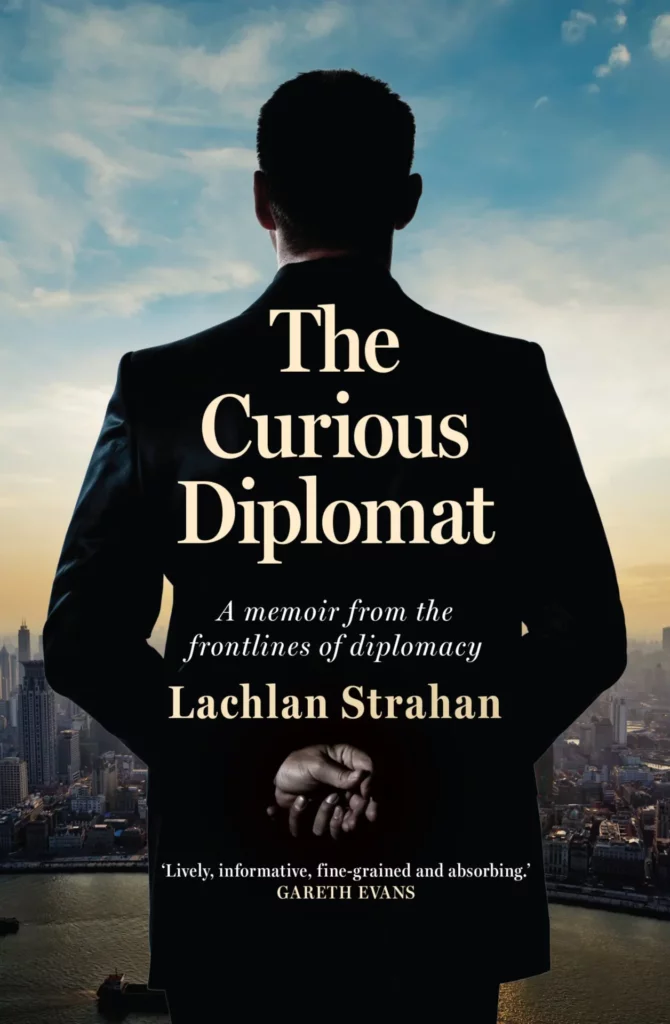

I thought of Greene’s observation often while reading Lachlan Strahan’s engaging The Curious Diplomat which recounts his thirty years as one of Australia’s loyal servants, posted to Germany, South Korea, India and Solomon Islands as well as various bureaucratic garrisons in Canberra. Strahan is an amiable storyteller and his book a good read. At nearly 600 pages, the book is intimidatingly compendious yet reading it never feels like a chore.
The book is insightful. It gives us a peek behind the bureaucratic curtain to show how diplomacy works as well as showing the conservative institutional culture and conformist mores of the Department of Foreign Affairs and Trade (DFAT).
Readers of this blog — many in the business of seeking DFAT’s favour, winning their contracts or keeping in their bureaucrats’ good books — would do well to read the book and consider whether their present efforts are effective. Strahan is clearly learned, yet reading the book made me wonder if the present toolkit of strategies used to sway diplomats, such as research papers, blogs, results frameworks, evaluations and reviews, learning dialogues and opinion polls, have much impact at all. Strahan certainly doesn’t mention any of them, except right at the end when he recalls a colleague warning him to be wary of development consultants submitting wordy reports (“charging by weight”).
Three themes are woven deeply through the book’s tapestry. The first is how being indirect and oblique is part of the job’s description. “Being too direct might have provoked a backlash,” he writes about an article on China he had to pen at one point, but it struck me also as being the guiding mantra of his entire career.
Another theme is the rigid structure of the Australian public service. Everything to be said in the service of the state must be cleared, and at each layer of the hierarchy anything even modestly penetrating gets sanded down or excised. The book extinguishes the myth that the primary role of the public servant is to provide frank and fearless advice. Diplomats emerge instead as ventriloquists of “his or her masters voice”, the masters being the bureaucrats immediately above them or the foreign minister of the time.
The third is the moral conundrums bound up in what Strahan calls impartiality. The book shows how much diplomats must check their personal opinions at the door as the price of entry (and promotion). Strahan’s views on climate change and the Uluru Voice from the Heart are as spot-on and as Canberran as my own, but both had to be subordinated to the contrary policy of the (conservative) governments of the day. And so, even though he himself seems a thoughtful, historically grounded kind of fellow, he advocates for Australian governments that dragged their feet on climate change during the 1990s, a stance he looks back on now as a “total policy failure”. As per Greene, would we be in the environmental mess we are in today if we were less loyal to countries?


Of the keenest interest to the readership of this blog will be what Strahan has to say about aid and the Pacific. On aid, he doesn’t say much, which in and of itself is revealing. When it is mentioned, aid is filtered through the prism of diplomatic calculations. He jets off in the mid-2010s on a lobbying trip as part of some terribly important but now-forgotten scheme to get Australia a seat on the United Nations Human Rights Council where governments chide him for being part of a government that gave up on aid. Penny Wong has “somewhat restored our aid budget”, he writes.
In Solomon Islands, Strahan serves as our man in Honiara, an experience he describes as testing. This is the section of the book where Strahan gives freest rein to the thinking going on in his own head. I read these sections after returning from a short trip to Honiara, a Greene-land of a place with its languor, intrigue and tragi-comic levels of competition playing out between Australia and China. He knows the city better than I do, but his observations about the cramped-with-risk-of-dissipation feel to expatriate life there chimed with my own. On several occasions, Strahan reminds his staff to keep their boozing under control; on one occasion the DFAT Secretary checked in with him during the Covid pandemic to ensure he too was tippling in moderation.
Strahan is empathetic to the everyday pressures weighing on Solomon Islands’ leaders; Sogavare emerges as a well-rounded and legible figure, not the firebreather of tabloid myth. He writes affectionately about the country and its people. He writes with humanity about the development challenges he sees. There’s an intriguing page where Strahan recounts losing his rag with a venal recipient of funding from DFAT’s locally-run small grants scheme after finding the scoundrel had used the grant to improve himself. He writes briefly, but compellingly, about the effect of being in the Honiara hothouse on his mental health.
Strahan is, for want of a better word, diplomatic about the fellow Aussie toilers in the engine room of statecraft whom he met throughout his career. This punch-pulling is a good strategy for getting colleagues to show up to your book launch but less so for anyone wanting to get a sense of the relational crosscurrents that must swirl in this as every organisation. Surely, he must have had one decent spat with someone, I thought.
He has a few soft jabs at politicians including a volcanically-tempered Malcolm Turnbull and an ideologically fervent Tony Abbot, but shows their more positive aspects too. Marise Payne emerges as more likeable than I thought. Penny Wong impresses him. Ex-Secretary Katherine Campbell doesn’t — she “lacked the requisite background and proved unsuitable”. Her predecessor and successor fared better: Frances Adamson was “canny” and Jan Adams “seasoned”. There’s a droll anecdote about Gareth Evans upbraiding a Russian tour guide for his imperfect knowledge of Dostoevsky that’s almost worth the price of the book itself.
Diplomacy emerges from this thoughtful book as a conservative profession requiring monkish levels of self-restraint, with its practitioners deserving of a grudging respect. An excellent Christmas read for diplomats and those seeking to understand what makes them tick.
This oped was first published on the Devpolicy Blog and is republished here with the kind permission of the editor(s). The Devpolicy Blog is based at the Development Policy Centre, Crawford School of Public Policy, College of Law, Governance and Policy, The Australian National University. Posts on the Devpolicy Blog are licensed under a Creative Commons Attribution-NonCommercial-ShareAlike 4.0 International License unless otherwise noted.
Contributing Author: Gordon Peake is a writer, podcaster and consultant, and a campus visitor at the Development Policy Centre. His first book was an award-winning memoir of life in Timor-Leste, his second was on the would-be nation of Bougainville.
Support our Journalism
No-nonsense journalism. No paywalls. Whether you’re in Australia, the UK, Canada, the USA, or India, you can support The Australia Today by taking a paid subscription via Patreon or donating via PayPal — and help keep honest, fearless journalism alive.

