

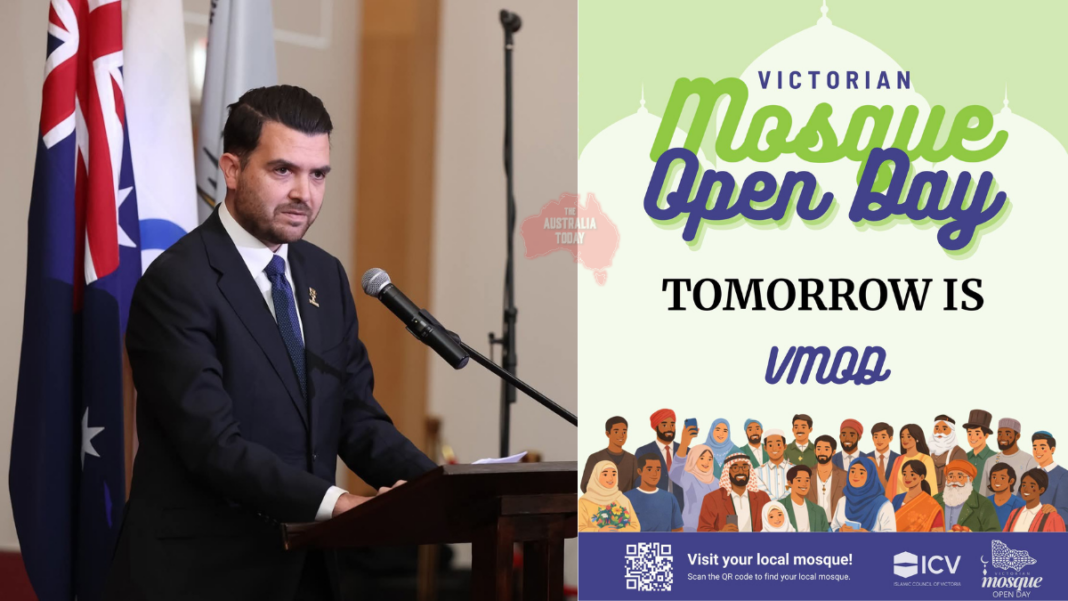
Relations between Victoria’s Liberal leadership and the Islamic Council of Victoria (ICV) have descended into open conflict, with critics and political analysts warning that the state’s flagship interfaith initiative, Open Mosque Day, risks becoming a “selectively open” and politically aligned event rather than a genuine exercise in community unity.
The controversy erupted after the ICV withdrew an invitation to Shadow Minister for Multicultural and Multifaith Affairs Evan Mulholland to attend and speak at the 2026 Open Mosque Day, an annual initiative designed to foster understanding between Muslim communities and the broader public.
The decision followed parliamentary speeches by Mulholland and other Liberal MPs responding to the Bondi terrorist attack, in which they warned against extremist rhetoric and antisemitism while reaffirming their support for multicultural communities.
The fallout has triggered accusations of political bias, legal tensions, and broader concerns about whether taxpayer-funded multicultural programs are being administered impartially.
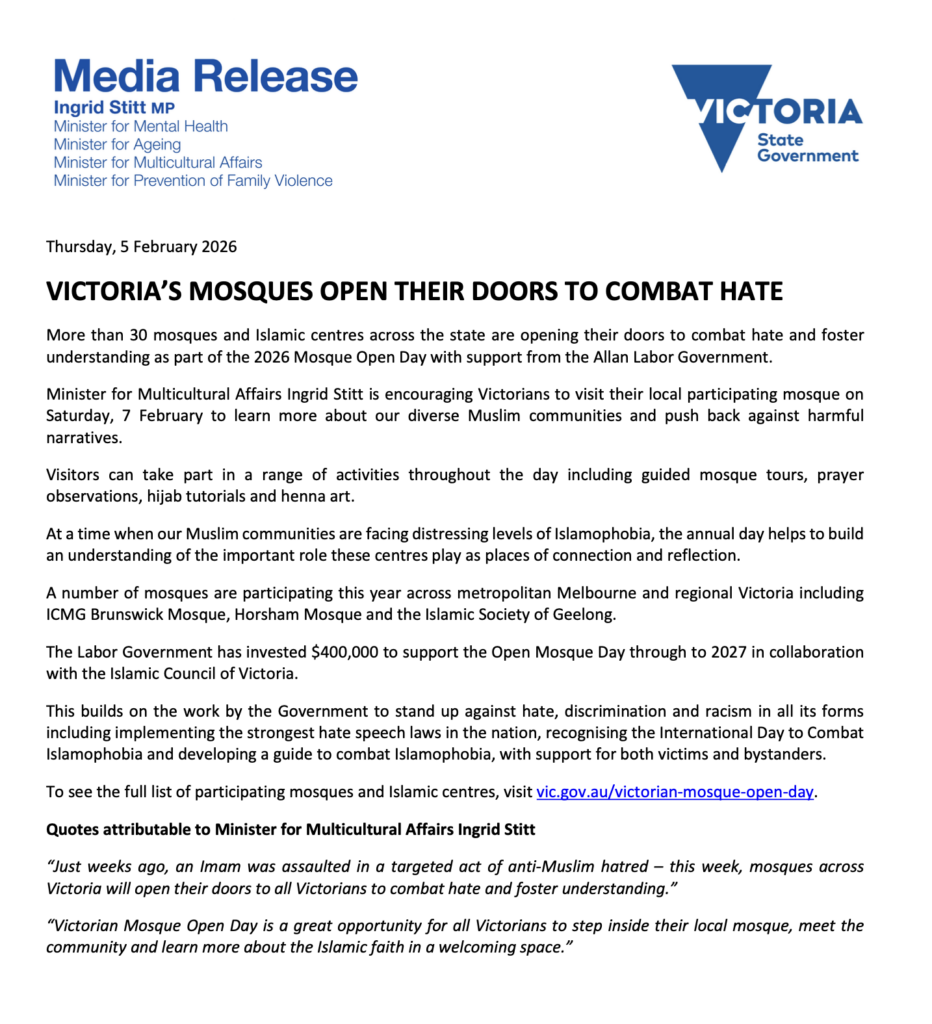
At the centre of the dispute is the Victorian Government’s decision to allocate $400,000 in public funding to support Open Mosque Day through to 2027, in partnership with the Islamic Council of Victoria.
While the Allan Labor Government has promoted the event as an opportunity to “combat hate and foster understanding,” critics argue the exclusion of elected opposition representatives undermines its credibility as a non-partisan interfaith initiative.
Political analysts say the decision to disinvite Mulholland, despite his role as Shadow Minister responsible for multicultural affairs, risks transforming what was intended as a bridge-building exercise into a politically selective event.
“When taxpayer funds support community engagement programs, there is an expectation that those programs remain politically neutral and inclusive,” one Melbourne-based political analyst, Helena*, said, who doesn’t want her name to be published.
“The exclusion of senior elected representatives based on political disagreement raises legitimate questions about whether this remains an open community event or has become a partisan platform.”
Invitation withdrawn amid escalating tensions
The ICV withdrew Mulholland’s invitation after parliamentary condolence speeches addressing the Bondi terrorist attack, which killed 15 people celebrating Hanukkah.
In his address, Mulholland praised multicultural communities while warning against extremist rhetoric.
“Our multicultural community is made up of fantastic citizens. But as members of parliament, it is our duty to know where the line is,” he said.
Mulholland referred to inflammatory remarks previously made by an unnamed religious figure targeting Jewish people, warning that extremist rhetoric could contribute to violence.
“Tragedies like this do not happen out of nowhere. They begin with hateful bile like this,” he told parliament.
He later defended his record of engagement with Muslim communities, stating he had attended numerous community events and advocated for religious freedom.
“Victoria is a place where people of all faiths can and do worship freely. But incitement to harm is not worship, it is hate speech,” he said.
However, the Islamic Council of Victoria accused Liberal MPs of promoting Islamophobic rhetoric and unfairly associating Muslim communities with terrorism.
ICV president Mohamed Mohideen said Muslim communities were already facing rising hostility.
“We expect better from our politicians and leaders,” he said.
Legal tensions and claims of defamation
The situation escalated further when the ICV published a public statement accusing Mulholland and fellow Liberal MPs Matthew Guy and Renee Heath of Islamophobia and falsely linking Muslim institutions to extremist violence.
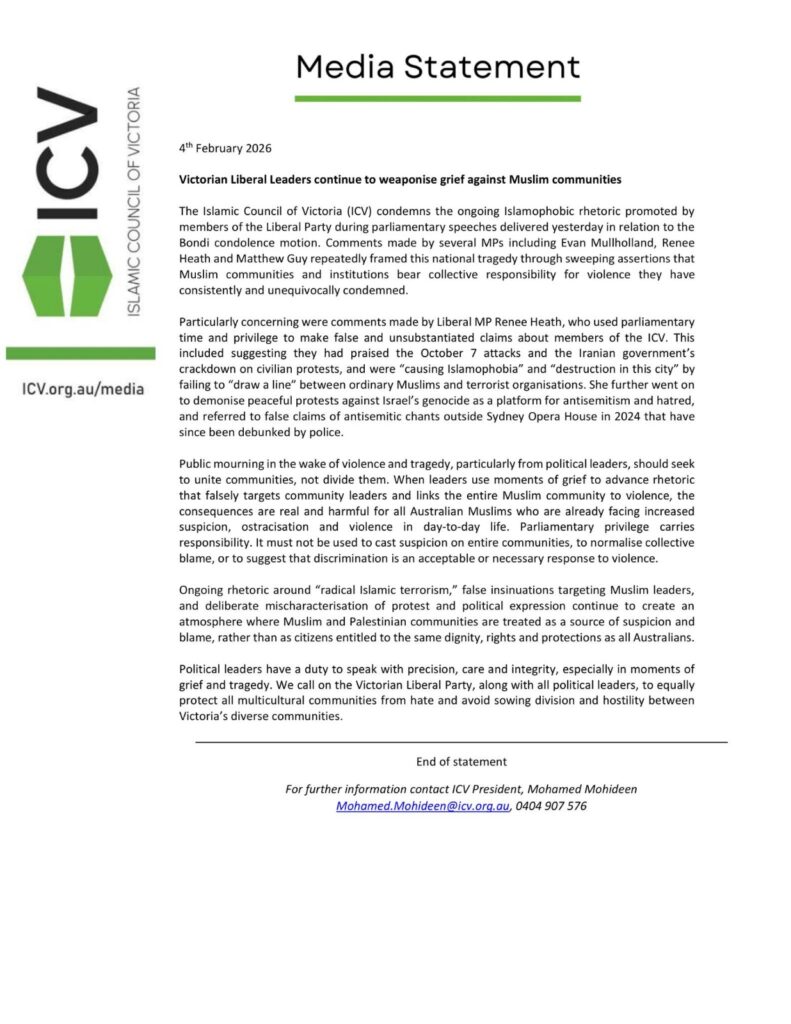
Multiple sources confirmed the Liberal MPs viewed the statement as defamatory and conveyed legal concerns to the council, which subsequently deleted the statement.
Despite removing the allegations, the ICV proceeded with withdrawing Mulholland’s invitation, deepening the political rift.
Opposition figures argue the withdrawal contradicts the stated purpose of Open Mosque Day as a platform for open dialogue and mutual understanding.
Mulholland said his engagement with Muslim communities had always been respectful and constructive.
“My record of engagement with our Muslim community speaks for itself, having attended countless events, Iftar dinners and advocacy on behalf of Muslim Victorians,” he said.
“We continue to call on the Labor Government to legislate its social cohesion pledge so that taxpayer money no longer goes towards associations who have spouted incitement.”
Taxpayer funding raises questions about neutrality
The controversy has intensified scrutiny of the Victorian Government’s financial backing of the initiative.
The Allan Labor Government committed $400,000 to support Open Mosque Day through to 2027, describing the program as part of broader efforts to combat Islamophobia and strengthen social cohesion.
Victorian Multicultural Affairs Minister Ingrid Stitt encouraged Victorians to participate.
“Victorian Mosque Open Day is a great opportunity for all Victorians to step inside their local mosque, meet the community and learn more about the Islamic faith in a welcoming space,” she said.
However, critics argue the withdrawal of opposition representatives undermines the program’s legitimacy as a publicly funded, inclusive initiative.
Some community leaders have also questioned whether the ICV represents the full diversity of Victoria’s Muslim population, noting that only a fraction of mosques across the state participate in the Open Mosque Day program.
Analysts warn of broader implications
Political observers warn the dispute risks damaging trust in multicultural institutions and weakening Victoria’s long-standing reputation as a global model of multicultural harmony.
“Multicultural programs must remain inclusive and politically neutral, especially when funded by taxpayers,” an analyst said.
“If events designed to promote understanding instead exclude elected representatives based on political disagreement, it undermines their purpose.”
The dispute also highlights broader tensions in Australia’s political landscape, as leaders grapple with balancing counter-extremism messaging while preserving community cohesion.
A test for Victoria’s multicultural model
Victoria has long promoted itself as one of the world’s most successful multicultural societies, with strong interfaith engagement and community partnerships.
However, the escalating confrontation between political leaders and Muslim organisations risks exposing deeper divisions.
For many observers, the controversy surrounding Open Mosque Day raises fundamental questions about fairness, accountability and whether publicly funded multicultural initiatives are being administered in a way that reflects the interests of all Victorians.
With political tensions rising and legal threats lingering, Open Mosque Day — once seen as a symbol of unity — has now become a flashpoint in Victoria’s increasingly polarised debate over multiculturalism, extremism, and the role of publicly funded community organisations.
Support our Journalism
No-nonsense journalism. No paywalls. Whether you’re in Australia, the UK, Canada, the USA, or India, you can support The Australia Today by taking a paid subscription via Patreon or donating via PayPal — and help keep honest, fearless journalism alive.
