

By Ila Joshi
Should last year’s dramatic fall of Sheikh Hasina in Dhaka and this week’s political collapse of K. P. Sharma Oli be treated as two isolated incidents, or as warning signals for India? The turmoil unfolding in India’s immediate neighbourhood carries not just political but humanitarian consequences, with clear risks of spillover into the Hindi heartland. For decades, both Bangladesh and Nepal were counted among India’s trusted partners, serving as buffers and security cushions along its borders.
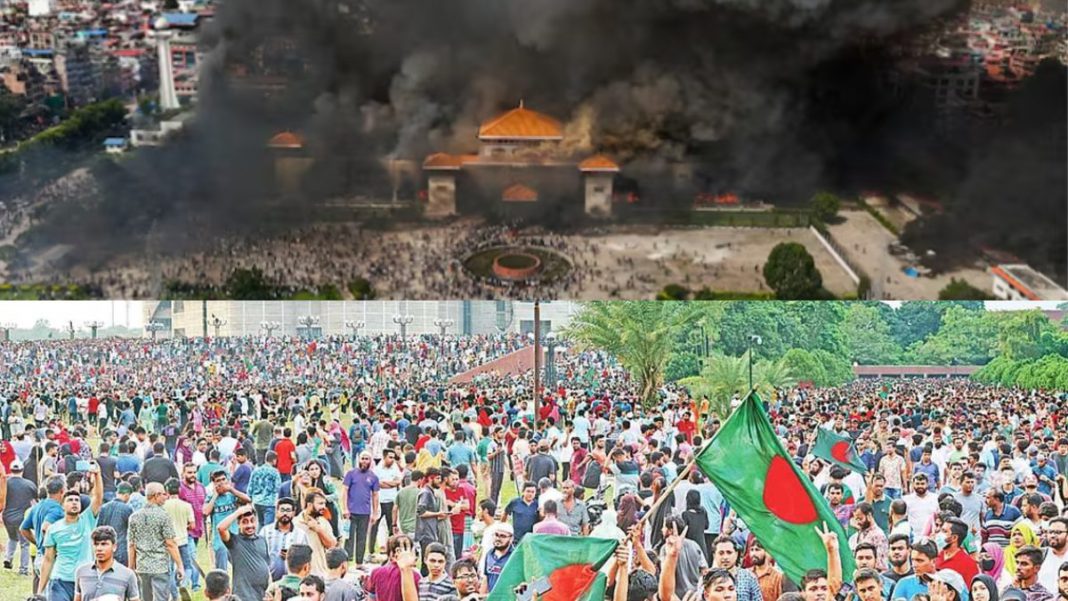
In August 2024, Bangladesh was shaken by student-led protests that spiralled into violence and forced Sheikh Hasina to resign and leave the country. What followed was a political vacuum, quickly filled by groups that often harbour anti-India sentiments. This shift also created space for external players to step in and shape the political landscape with new “development narratives.”
Just a year later, in September 2025, Nepal was convulsed by youth-led protests after the government abruptly banned 26 social media platforms, including Facebook, X, and YouTube. What began as an outburst against censorship soon turned deadly. Police opened fire, killing at least 19 and injuring more than 300. Crowds torched Parliament, the Supreme Court, and Singha Durbar (the administrative centre of the government) and stormed the residences of both the Prime Minister and the President. It was, to put it bluntly, anarchy on the streets. By 9 September, K. P. Sharma Oli was left with no option but to resign, bringing down his government in one of the most dramatic political collapses in Nepal’s recent history.
These upheavals have two immediate implications for India.
First, geography itself magnifies the risk. India shares a 4,096 km border with Bangladesh and a 1,770 km border with Nepal, both long, porous, and difficult to monitor. Instability across these frontiers could spill over quickly. Criminal networks would exploit the vacuum, fuelling insurgency, trafficking, and cross-border migration. Even short-term disruptions would erode intelligence-sharing and strain security forces. Alongside these risks, the humanitarian fallout could place heavy pressure on the already fragile economies of India’s north-eastern states.
Second, the sudden exit of governments in Dhaka and Kathmandu creates fresh opportunities for China and Pakistan to step in. Beijing in particular has been quick to extend economic and political influence in South Asia, and any recalibration in Kathmandu and Dhaka could threaten India’s hard-won projects on connectivity, trade, and transit rights.
Dramatic regime changes in the neighbourhood inevitably trigger strong domestic reactions in India. Nationalist rhetoric may be tempting, but it risks complicating future efforts to rebuild ties. New Delhi will need to strike a careful balance between domestic political pressures and a foreign policy that safeguards stability. The human cost of these upheavals—ranging from displacement, rights violations, hunger, and poverty—must remain at the centre of India’s response.
India cannot afford to remain passive. It must act with urgency by strengthening its multilateral diplomacy, using regional forums such as SAARC and BIMSTEC to call for restraint, the restoration of law and order, and the revival of civilian governance. At the same time, soft-power tools such as cultural exchanges, academic partnerships, and non-partisan technical assistance should be expanded to build trust and resilience at the grassroots level.
Finally, India must resist the temptation to view its neighbours through the simple lens of friend or foe. The unrest in Dhaka reflects genuine grievances over student quotas, while the upheaval in Nepal stems from anger against censorship and corruption. These are domestic crises that demand empathy and steady engagement, not opportunism. Delhi’s response will ultimately be judged by whether it can help protect lives and democratic institutions. Stability abroad is inseparable from stability at home, and for that, New Delhi must stand not for partisan gain but for stability, democracy, and human security. Only then can the neighbourhood remain India’s first line of defence.
Contributing Author: Dr Ila Joshi is an Assistant Professor at the Jaypee Institute of Information Technology, India.
Support our Journalism
No-nonsense journalism. No paywalls. Whether you’re in Australia, the UK, Canada, the USA, or India, you can support The Australia Today by taking a paid subscription via Patreon or donating via PayPal — and help keep honest, fearless journalism alive.
