

By Dr Amit Sarwal and Jitarth Jai Bharadwaj
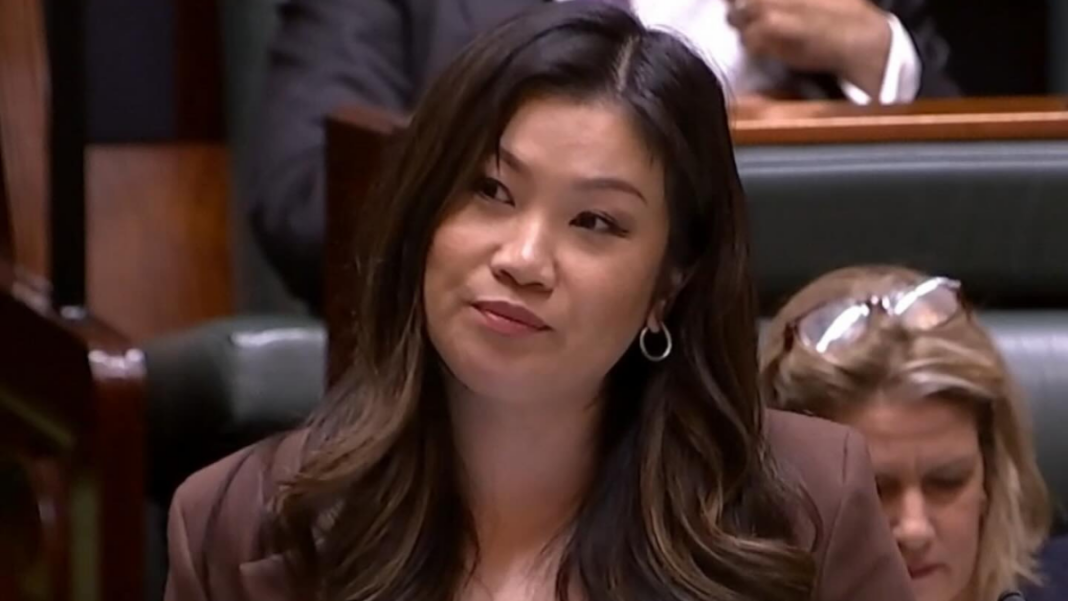
Victorian Liberal MP Nicole Werner has reignited debate about the culture inside Spring Street after alleging she has faced repeated personal abuse in the chamber, including comments she says targeted not only her politics but also her ethnicity, faith and family.
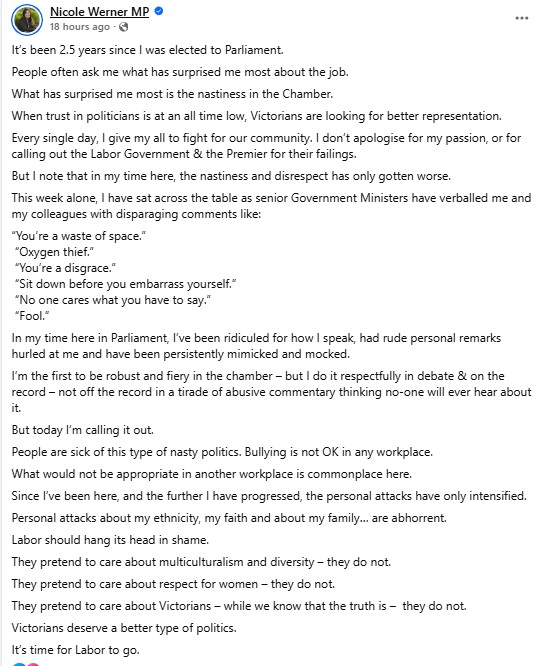
In a public post, Werner said the “nastiness in the Chamber” had been one of the most confronting parts of her first two-and-a-half years in Parliament, and listed insults including “waste of space”, “oxygen thief” and “fool”. She argued that while robust debate is part of politics, bullying and personal degradation should not be normalised in any workplace.
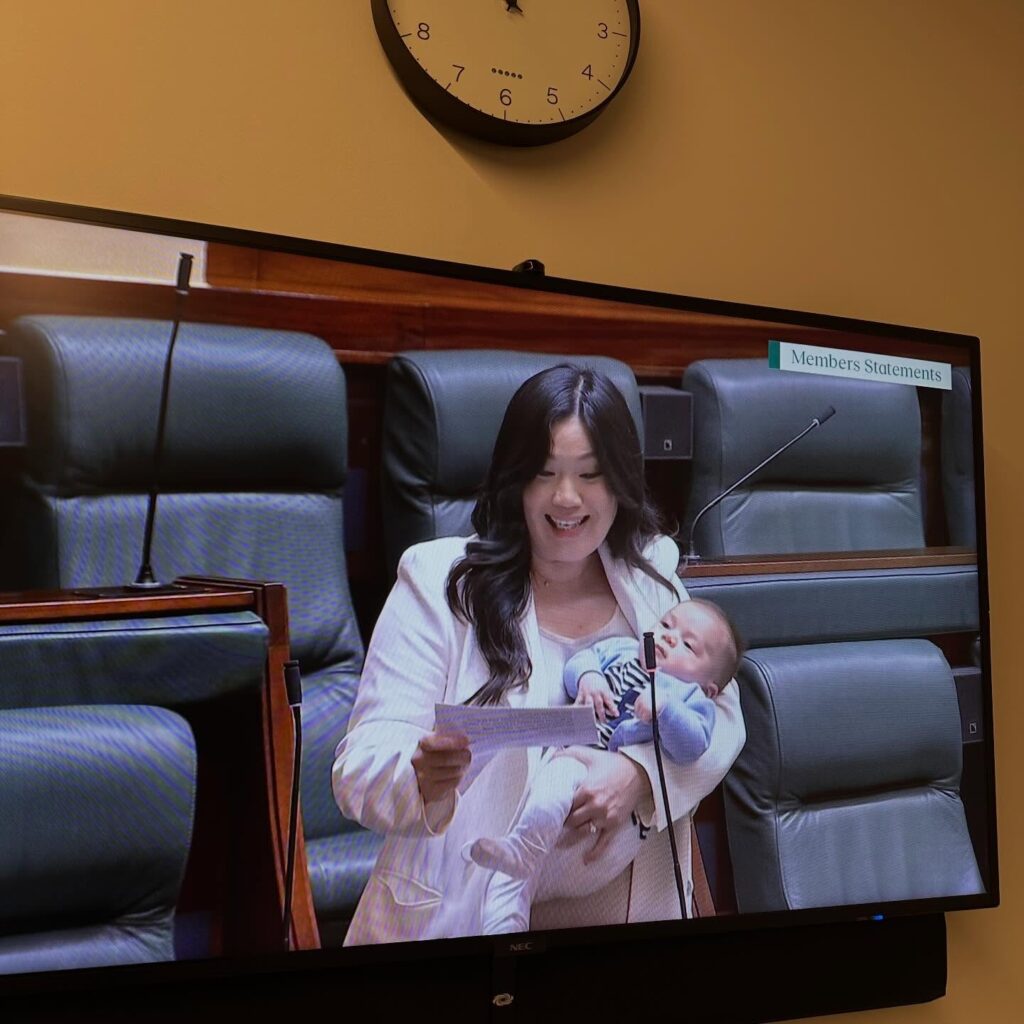
Werner, described the behaviour as increasingly personal and targeted, with attacks on her ethnicity, faith, and family.
“It’s been 2.5 years since I was elected to Parliament. What has surprised me most is the nastiness in the Chamber,” Werner wrote.
“People are sick of this type of nasty politics. Bullying is not OK in any workplace.”
Werner’s criticism lands in a Parliament that, historically, has not exactly been an easy place for women. Victoria was the last Australian state to allow women to stand for Parliament, changing the law only in 1923. Alicia Katz became the first woman to contest a Victorian state election in 1924, but it took another nine years before a woman was actually elected.
Even then, female representation remained sparse for decades. Fanny Brownbill was the sole female MP from 1943 until her death in 1948, and after that Victoria went 29 years before another woman entered Parliament. Dorothy Goble, elected in 1967, was again the only woman in the Parliament for the entirety of her time there.
That history matters because Werner’s complaint is not being made in a vacuum. It speaks to a much longer story in which women have had to fight not only for representation in Victoria’s Parliament, but also for basic respect once they arrived.
Former Victorian MP Prue Leggoe said in 2021 that sexual harassment and sexist treatment in parliamentary life had changed little in 40 years. She recalled that during her maiden speech in the early 1980s, a drunk MP came up behind her and put a walking stick up her skirt, and said women who spoke up risked being punished politically or publicly humiliated.
The pressure for structural reform has grown in recent years as allegations of bullying, harassment and inappropriate conduct have repeatedly surfaced in Victorian politics.
In 2024, the Allan government introduced legislation to create the Parliamentary Workplace Standards and Integrity Commission, acknowledging that MPs sit outside traditional workplace laws and that Parliament had been lagging behind modern expectations of what a safe workplace should look like. Premier Jacinta Allan said at the time the reform was “overdue” and described it as part of bringing Parliament into line with contemporary workplace standards.
That body, now known as the Parliamentary Workplace Standards and Integrity Commission, was formally established on 31 December 2024. It is empowered to receive and investigate allegations of parliamentary misconduct, including bullying, harassment, discrimination, victimisation and occupational violence involving Victorian MPs, ministers and parliamentary secretaries.
The commission says its purpose is to support “a respectful and safe parliamentary workplace”, reflecting the conclusion that informal norms and party discipline alone were not enough to deal with harmful conduct.
Against that backdrop, Werner’s allegations are politically awkward for Labor’s broader public messaging on multiculturalism, inclusion and respect for women. Werner directly challenged that contradiction, saying Victorians deserved more respectful and inclusive representation and accusing Labor of failing to live up to the values it professes.
In a statement to The Australia Today, Speaker Maree Edwards did not comment on Werner’s specific allegations but stressed that concerns raised with her office are treated confidentially.
“Matters raised with me are treated as confidential,” Edwards said.
“I treat any breaches of Standing Orders or conventions of the House with seriousness. The rules of the House are written by a cross-party committee, and I expect members to familiarise themselves with them.
“It is the duty of all members to treat each other with respect. Consequences may apply for any failure to do so,” she added.
That response reflects the institutional tension at the heart of these disputes. Speakers are expected to uphold order and decorum, but many of the most corrosive behaviours alleged by MPs happen in the grey zone between formal breaches of standing orders and a wider workplace culture that can become toxic without always crossing a procedural line.
Werner’s criticism suggests that, for some MPs at least, the formal rules are not enough to address the climate they experience.
Ms Werner emphasised that while she engages robustly and passionately in debate, she does so respectfully and on the record, contrasting it with what she described as off-the-record tirades from government ministers.
Werner’s post also comes amid ongoing public concern over political culture in Victoria, with trust in politicians reportedly at historically low levels. She urged the Labor Government to reconsider its approach, saying Victorians deserve more respectful and inclusive representation.
“Labor should hang its head in shame. They pretend to care about multiculturalism and diversity – they do not. They pretend to care about respect for women – they do not,” she wrote, calling for a change in the tone and conduct of parliamentary debate.
There is also a broader public dimension. Victoria’s Parliament today has reached gender parity in the 60th Parliament, a milestone that would have been almost unimaginable for the women who entered a chamber where they were once alone.
But parity in numbers does not automatically mean parity in treatment. Werner’s account, alongside the earlier experiences described by women such as Leggoe and the need to create a dedicated misconduct commission, suggests that representation and respect have not advanced at the same pace.
Whether Werner’s intervention leads to any formal complaint or disciplinary consequence remains to be seen. But politically, it has already done something important: it has reopened a difficult question for Victorian Parliament itself.
After a century of women fighting first to enter the institution and then to be taken seriously within it, how much has really changed, and how much of the old culture still survives behind the language of modern diversity and inclusion?
Note: The Australia Today has contacted the Premier Allan, we will update the story as and when she rsponds.
Support our Journalism
No-nonsense journalism. No paywalls. Whether you’re in Australia, the UK, Canada, the USA, or India, you can support The Australia Today by taking a paid subscription via Patreon or donating via PayPal — and help keep honest, fearless journalism alive.
