
The port city of Tianjin has become the centre of global attention as leaders from across Asia, the Middle East, and beyond gather for the 2025 Shanghai Cooperation Organization (SCO) Summit — billed by Chinese officials as the grouping’s largest and most ambitious yet.
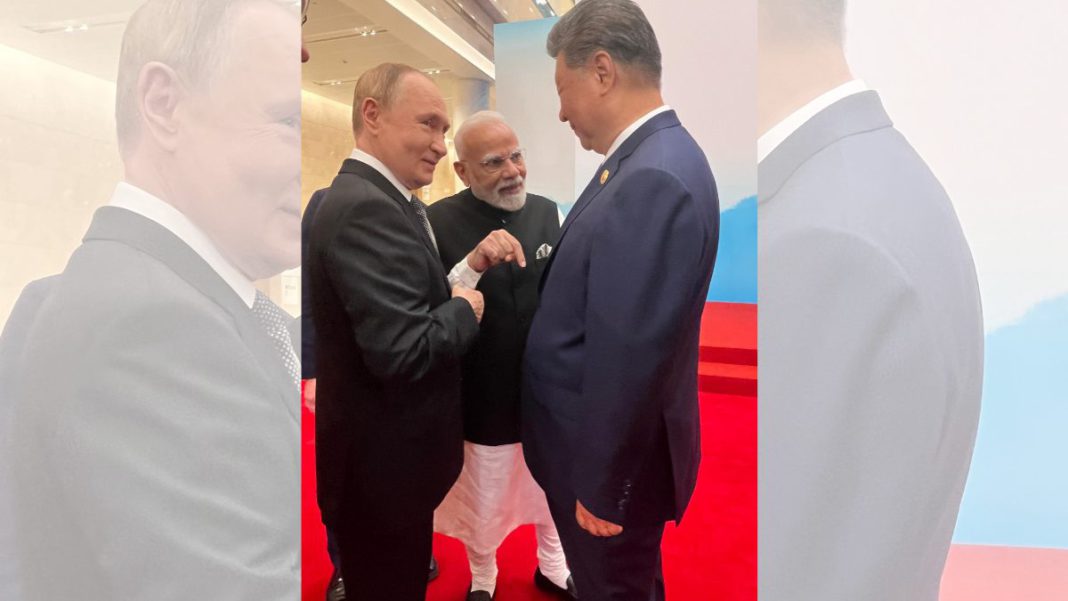
Indian Prime Minister Narendra Modi, Russian President Vladimir Putin, and Chinese President Xi Jinping held high-level discussions on the sidelines of the summit.
PM Modi later posted on social media:
“Interactions in Tianjin continue! Exchanging perspectives with President Putin and President Xi during the SCO Summit.”
PM Modi has described the Pahalgam terror strike as “not only an attack on India, but an open challenge to countries and people believing in humanity.”
Expressing gratitude to nations that stood with India after the attack, PM Modi said terrorism, separatism, and extremism remain major threats to peace, prosperity, and stability worldwide.
He stressed that India has consistently called for unity in the fight against terrorism, warning that “no country and society can feel safe from this scourge.”
The SCO member states expressed “deepest sympathy and condolences to the families of the dead and the wounded” after the attack claimed 26 lives. They emphasised that perpetrators, organisers, and sponsors of such acts must be brought to justice.
Diplomatically, the condemnation of the Pahalgam attack marks a significant win for India, particularly as Pakistan — long accused of backing terrorism on Indian soil — is a member of the bloc and represented by Prime Minister Shehbaz Sharif.
After PM Modi’s speech, SCO leaders also underscored that using terrorist, separatist, or extremist groups for mercenary purposes is unacceptable. The SCO reaffirmed its condemnation of terrorism in all forms and called out “double standards” in the fight against terror, urging the international community to act against cross-border movements of terrorists.
In his first visit to China in seven years, PM Modi told President Jinping that India remains committed to improving relations with its largest trading partner. According to Chinese state media, President Jinping responded by suggesting that China–India ties could become “stable and far-reaching” if both nations focused on partnership over rivalry.
The two countries remain economically intertwined yet geopolitically wary. India’s trade deficit with China hit a record US$99.2 billion this year, while tensions over their disputed Himalayan border have lingered since the deadly 2020 clashes that killed 20 Indian and four Chinese soldiers. A breakthrough meeting between President Xi and PM Modi in Russia last year paved the way for the current thaw, which both leaders reaffirmed in Tianjin.
After his bilateral meeting with President Jinping, PM Modi wrote: “Had a fruitful meeting with President Xi Jinping in Tianjin on the sidelines of the SCO Summit. We reviewed the positive momentum in India-China relations since our last meeting in Kazan.”
“We agreed on the importance of maintaining peace and tranquility in border areas and reaffirmed our commitment to cooperation based on mutual respect, mutual interest and mutual sensitivity.”
PM Modi also posted that he had an “excellent meeting with President Putin on the sidelines of the SCO Summit in Tianjin,” where they explored ways to deepen cooperation across trade, fertilisers, space, security, and culture.
He added that they exchanged views on regional and global developments, including the peaceful resolution of the conflict in Ukraine, and reaffirmed that their “Special and Privileged Strategic Partnership remains a vital pillar of regional and global stability.”
The SCO, founded in 2001, has steadily grown into a powerful bloc that Beijing and Moscow see as a platform to counterbalance Western influence. This year’s summit carries additional weight, as tensions between Washington and Beijing rise, while Moscow continues to defend its invasion of Ukraine.
President Jinping used the opening session to frame the organisation as an antidote to global instability. Without naming the United States, he urged member states to “resist Cold War mentality and bullying practices,” adding that the SCO “has set a model for a new type of international relations” and will oppose all forms of external interference.
For India, PM Modi’s presence in Tianjin is particularly significant. He had skipped last year’s summit in Kazakhstan, but his return comes at a time when New Delhi’s relations with Washington are strained over trade, while ties with Beijing show tentative signs of recovery.
The Tianjin summit has drawn a wide spectrum of leaders, including Turkey’s President Tayyip Erdogan, Iran’s President Masoud Pezeshkian, Pakistan’s Prime Minister Shehbaz Sharif, and UN Secretary-General António Guterres. Leaders from observer and partner states such as Egypt, Saudi Arabia, Cambodia, and the Maldives are also in attendance, highlighting the SCO’s growing reach.
Trade has become a central theme of this year’s summit. Over the past five years, commerce between China and SCO members has surged, reaching a record US$512.4 billion in 2024. Xi is expected to highlight this economic momentum as evidence of China’s growing role as a stabilising force in global affairs.
Support our Journalism
No-nonsense journalism. No paywalls. Whether you’re in Australia, the UK, Canada, the USA, or India, you can support The Australia Today by taking a paid subscription via Patreon or donating via PayPal — and help keep honest, fearless journalism alive.
