

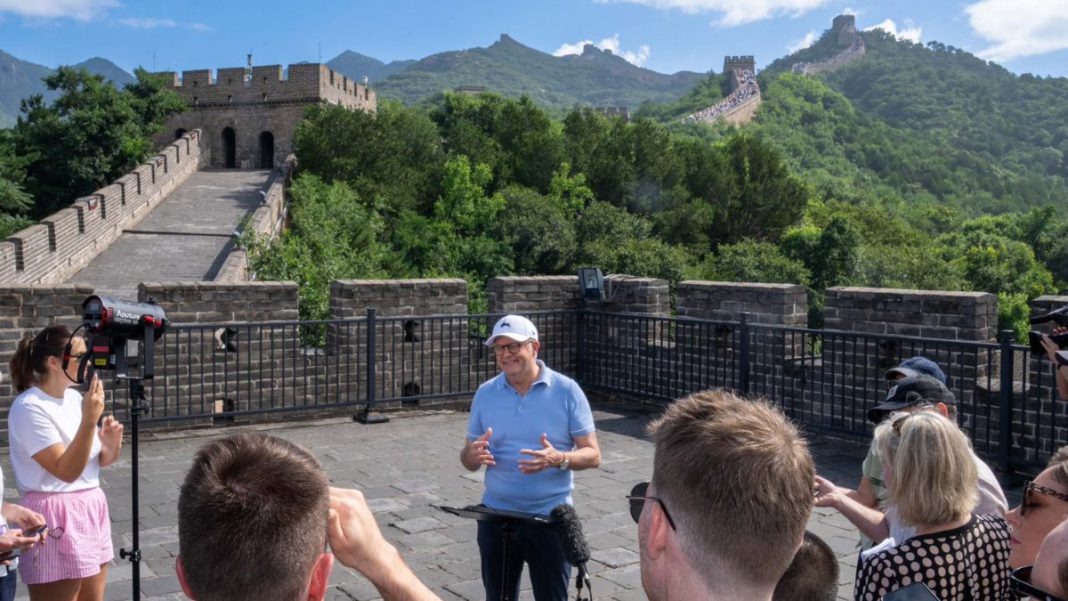
On his China tour, Prime Minister Anthony Albanese was warmly welcomed by the Secretary of the Communist Party of China Sichuan Provincial Committee, Wang Xiahou, and Governor Shi Xiaolin. Marking the first visit by an Australian Prime Minister to Chengdu since Bob Hawke in 1986, Albanese’s trip aimed to deepen economic, cultural and people-to-people ties with the province of Sichuan.
During his opening meeting, Wang hailed Chengdu as a vibrant, culturally rich metropolis and a culinary capital, warmly inviting Albanese to experience its “laid-back charm.”
Prime Minister Albanese reciprocated with gratitude, noting the $5 billion two-way trade between Sichuan and Australia, highlighting shared interests in education, medical technology and tourism.
“I hope that my visit encourages more Australian visitors to Chengdu and Western China.”
Albanese also reflected on the province’s sister-state relationship with Victoria and celebrated the arrival of two new giant pandas in Adelaide, calling them “ambassadors of goodwill.”
Standing atop the historic Great Wall of China, Albanese echoed the legacy of former Prime Minister Gough Whitlam, who established diplomatic relations with China in 1971. “Leaders must deal with the world as it is, not as they wish it to be,” Albanese said, stressing the importance of stable, respectful engagement. He reaffirmed Australia’s support for the One China policy and its stance against unilateral actions over Taiwan.
Addressing media questions on trade, defence and foreign policy, Albanese maintained Australia’s case-by-case approach to foreign investment, noting that his government’s stance is always guided by the national interest. On security matters, including the Port of Darwin and Taiwan, Albanese stood firm, asserting Australia’s sovereignty and long-held bipartisan foreign policy positions.
In a move of sporting diplomacy, the Prime Minister also took part in announcing the return of the Australian Open Asia-Pacific Wildcard Playoffs to Chengdu this November. At the Sichuan International Tennis Centre, Albanese joined Australian tennis legend John Fitzgerald, local officials and rising Chinese stars to reaffirm Australia’s commitment to sports and cultural exchange.
“This sporting event is more than a game – it’s a bridge between our two nations,” Albanese said. He noted the historical connection dating back to Hawke’s 1986 tennis diplomacy and praised the ongoing youth tennis collaborations involving the Kooyong International Tennis Academy and Tennis Australia.
The visit comes amid renewed momentum in Australia-China relations, following a series of high-level meetings in Beijing and a CEO roundtable focused on steel decarbonisation and expanding cooperation in education and technology.
“We’ll cooperate where we can, disagree where we must, but always engage in the national interest,” Albanese said, encapsulating his government’s pragmatic diplomatic posture.
Support our Journalism
No-nonsense journalism. No paywalls. Whether you’re in Australia, the UK, Canada, the USA, or India, you can support The Australia Today by taking a paid subscription via Patreon or donating via PayPal — and help keep honest, fearless journalism alive.
