


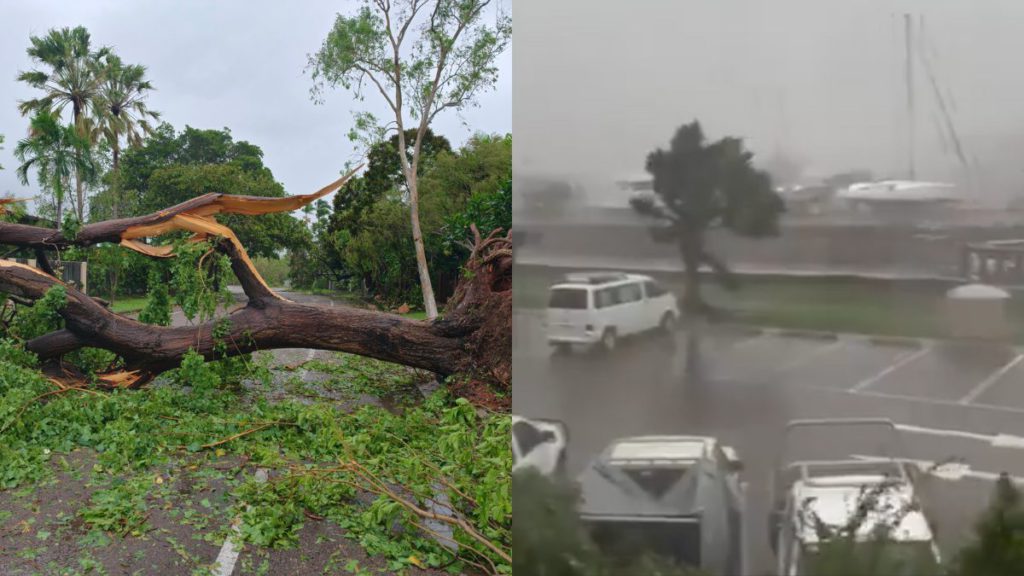
A massive clean-up is underway across the Northern Territory’s Top End after Tropical Cyclone Fina swept between the Tiwi Islands and Darwin, bringing destructive winds, torrential rain and widespread power outages but sparing the region from serious injuries.
The system crossed the coast as a category three cyclone over the weekend, with gusts recorded above 200 km/h in parts of the Tiwi Islands and strong winds rattling Darwin and Palmerston.
Emergency crews and power workers spent Sunday night restoring essential services and clearing debris. By Monday morning, electricity had been restored to about 5,000 homes and businesses, though roughly 14,000 customers were still without power as repair teams worked through fallen trees and damaged lines.
Authorities warned some suburbs could face outages for several more days, urging residents to stay clear of downed cables and unstable structures.
Chief Minister Lia Finocchiaro praised Territorians for preparing early and following safety advice, saying the lack of major injuries showed community readiness had made a real difference. While Darwin avoided the cyclone’s most intense core, it still experienced heavy rain, flash flooding in low-lying areas and damage to trees, fences and roofs. Remote Tiwi communities bore the brunt overnight, with widespread vegetation loss and localised structural damage reported.
Schools and childcare centres were among the most visible disruptions. Multiple public schools in Darwin, Palmerston and on the Tiwi Islands remained closed Monday as safety checks continued and power was restored precinct by precinct.
The NT Department of Education said reopening would occur school-by-school once sites were confirmed safe and operational. Ferry services and some public facilities also stayed suspended while clean-up progressed.
The Bureau of Meteorology said Fina is now tracking away from the Top End and has re-intensified over water, with warnings shifting towards the Joseph Bonaparte Gulf and parts of the Kimberley coast. Forecasters noted that even as wind risks ease for Darwin, lingering rain bands could still bring heavy falls and renewed flooding in some districts.
For many residents, the storm revived memories of Cyclone Tracy, the 1974 disaster that devastated Darwin. Authorities acknowledged those anxieties but said modern forecasting, stronger building standards and early alerts helped limit harm this time. Major Crash and emergency units reported hundreds of call-outs for fallen trees and minor property damage, while hospitals remained open, treating only a small number of people for cuts and storm-related injuries.
With the immediate danger now passing, attention has turned to recovery. Council crews, volunteers and residents are clearing streets, assessing homes and supporting neighbours still without power. The Australian Defence Force remains on standby, should it be requested, and federal disaster assistance is expected to follow once full damage assessments are complete.
Despite the scale of disruption, Top Enders are counting themselves lucky. The sight of chainsaws, skip bins and repair trucks across Darwin and the Tiwi Islands signals the start of a long clean-up, but also a community relieved to have come through a fierce early-season cyclone without loss of life.
Support our Journalism
No-nonsense journalism. No paywalls. Whether you’re in Australia, the UK, Canada, the USA, or India, you can support The Australia Today by taking a paid subscription via Patreon or donating via PayPal — and help keep honest, fearless journalism alive.

