

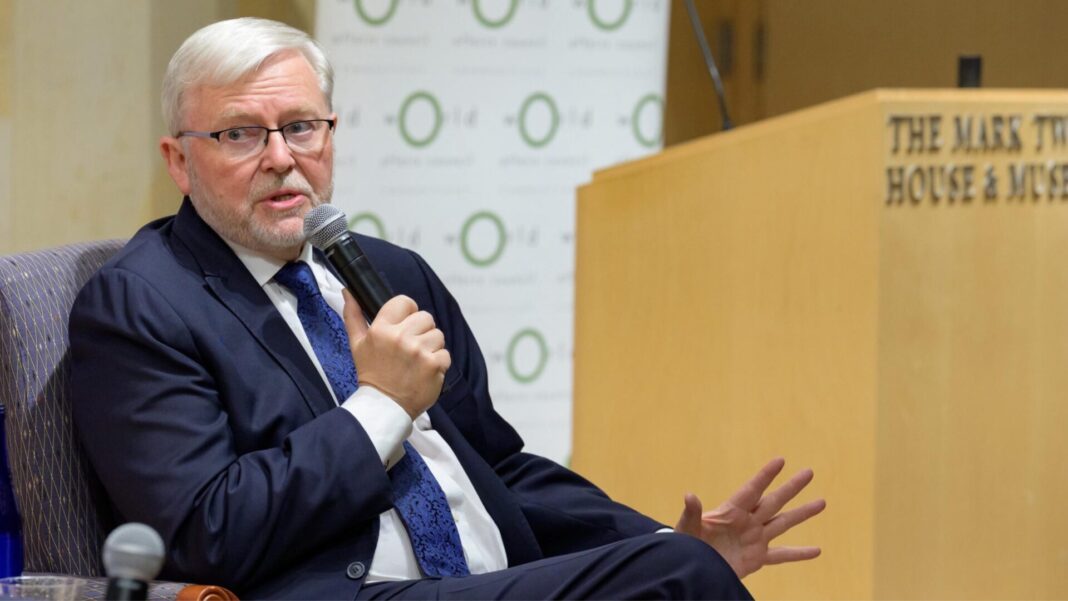
Australia’s ambassador to the United States and former Prime Minister Kevin Rudd has resigned from his post, concluding his Washington posting a year earlier than scheduled.
Prime Minister Anthony Albanese confirmed Mr Rudd will formally step down on March 31, saying the decision was made by the former prime minister himself. The federal government has indicated a replacement will be announced “in due course”.
PM Albanese paid tribute to Mr Rudd’s work in Washington, highlighting his role in advancing the AUKUS security partnership and assisting in diplomatic efforts that led to the release of Julian Assange in 2024.
“On behalf of our nation, we thank Kevin for his service to Australia and for taking forward Australia’s interests with our closest security ally,” Mr Albanese said.
Mr Rudd was appointed ambassador in March 2023, bringing to the role deep experience in foreign policy after serving as Australia’s prime minister from 2007 to 2010 and again briefly in 2013. His tenure spanned a period of political transition in the United States, including the re-election of US President Donald Trump in 2024.
That development prompted scrutiny of Mr Rudd’s past public commentary on Mr Trump, including historical social media posts in which he had labelled the former and current president a “traitor to the West” and “the most destructive president in history”. Those posts were later deleted during his ambassadorship.
Despite the challenges, the Albanese government has credited Mr Rudd with maintaining strong bipartisan relationships in Washington and deepening economic and security ties between the two countries.
“As prime minister, I have visited the United States on no less than seven occasions,” Mr Albanese said in Canberra, alongside Foreign Minister Penny Wong.
“That is because of the productive work that Kevin Rudd has done across the board, including, particularly, advancing the economic relationship between our two nations, but also, of course, ensuring that AUKUS is able to proceed.”
Mr Rudd’s early departure marks the end of a high-profile diplomatic chapter for Australia in Washington at a time of heightened strategic focus on the Indo-Pacific and the future of the Australia-US alliance.
Support our Journalism
No-nonsense journalism. No paywalls. Whether you’re in Australia, the UK, Canada, the USA, or India, you can support The Australia Today by taking a paid subscription via Patreon or donating via PayPal — and help keep honest, fearless journalism alive.
