

By Om Prakash Dwivedi
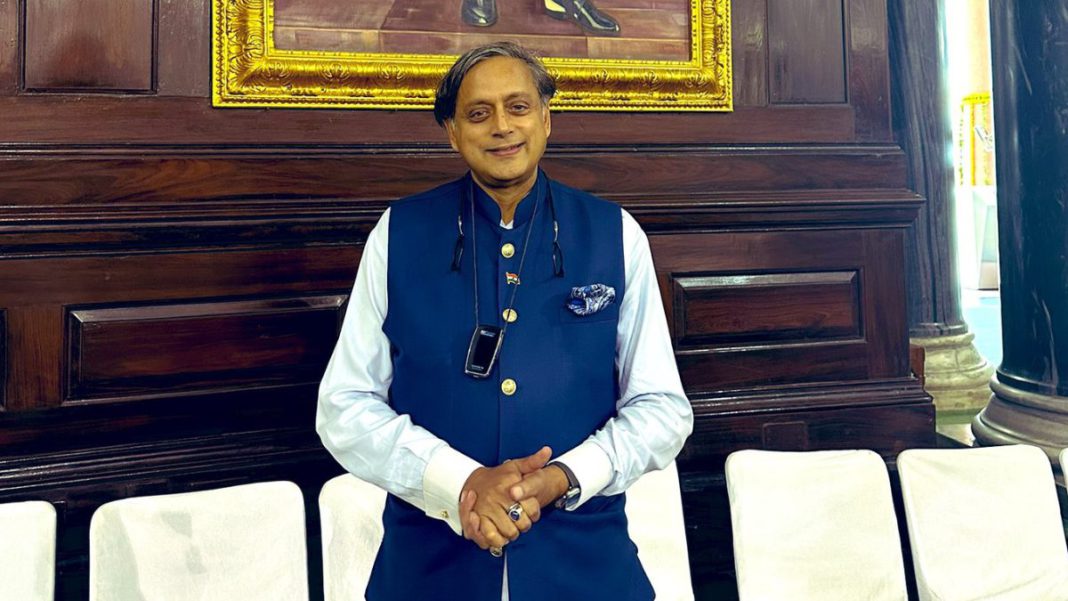
The idea of the ‘Centre’ in our political imagination needs to be remade, rethought, and, with all convincing efforts, reimagined, rewritten, and institutionalised. In the pursuit of this urgent requirement, Dr Shashi Tharoor’s conceptualisation of ‘radical centrism’ is profoundly apt and eclectic in nature.
In his latest column in The Indian Express, published on 9 October 2025, Tharoor offers a broadside against the ideological rigidities that underpin our nation, compellingly advocating for “a reimagined politics that can draw on the strengths of Left and Right without succumbing to their excesses.” He adopts the usage of “Radical Centrism” that “embraces pluralism without erasing identity, pursues growth without abandoning equity, honours our civilisation without resisting openness, and seeks unity without enforcing uniformity.” This evocative application of the term is not only enabling but also teems with a democratic ethos that seems lost in our deeply polarised world, invariably marked by the dichotomy of us/them.
Given the unplumbed depth of such entrenched binaries and prejudices, it has become commonplace to dismiss, vilify, and scandalise anyone who does not tread the ideological path of the centre in power. As such, organised remembrance and selective amnesia have become the order of the day. As we well understand, centrism in our political imaginary is often linked to dominance, coercion, control, authoritarianism, and a fanatical disavowal of the public good. The centrism that we encounter in our quotidian affairs is inundated with spiralling waves of unchecked villainy of power, brutality, violence, and the condemnation of citizens’ rights. This implies that the refusal of centrism ought not to be questioned and its acceptance must be valorised, institutionalised, and adopted as the consummate truth.
Such infectious views not only obfuscate but also erode the popular Rig Veda hymn: “Ekam sat vipra bahudha vadanti,” which translates to “Truth is one, but the learned describe it in many ways.” A similar iteration can also be found in the Chandogya Upanishad: “Tat Tvam Asi” — “Thou art That.”
It is clear that what has been forgotten or deliberately erased from our memories is the postulation of social relations and collective futures. This is what Tharoor’s notion of radical centrism reminds us — that there is a journey to be made between human beings as human beings, which cannot be obtained within the usual positioning of I and You. One needs to remember that there cannot be any ‘I’ in the absence of ‘You’. We are thrust into a bond of deep mutual dependence and therefore must anticipate and recognise the needs of others as well.
It is not the tyranny of a few selective individuals but the pleasantry of collective futures that needs to be reimagined for materialising Tharoor’s formulation of the ‘radical centre’. Arguably, this is the kind of eye that the I of centrism needs to recognise and promote. How can one forget that at the heart of any centrism are — and will continue to be — human beings and the public good? Yet, what our demagogues continue to serve us is a version of reality underpinned by the brutal mutilation and degradation of the public and our social assets. By “social assets”, I mean those institutions that remain central to our social provenance and public good — such as the education system, hospitals, welfare systems, and generative social networks in our everyday lives. As Tharoor emphasises, “economic dignity is as vital as economic opportunity,” thus arguing that the binaries of progress can no longer find a place in the developmental model of India that imagines itself as a superpower by 2047.
The ingenuity of ‘radical centrism’ stems from the fact that this kind of politics demands an uncompromised recognition of ‘weak bodies’. I assign this weakness not to their physical existence, but to the phenomenological ways of their coming into existence — the daily shame, proximity to risk, muted voice, mental trauma, denial of human rights, and vulnerable citizenship. Seen this way, ‘radical centrism’ can also be imagined as a reparative task that our political institutions must consider and practise.
The limit of our authoritarian centrism is not the limit of its imagination, but rather the fear of its realisation — and hence the creation and persistence of its resolute blindness to see anything outside the colour of its ideological lens. The moot point is that if centrism is beholden to any ideological underpinnings, then we are already doomed. That is why Tharoor’s postulation of radical centrism can be seen as a metaphor for life itself.
It is not rocket science to accept that at the centre of this universe, what needs to be protected and celebrated is life. There cannot be any life in the absence of the network of dependency. Life itself is an act of inhalation and exhalation and, therefore, also a matter of balance. It is this balance that ‘radical centrism’ identifies and promotes. Radical centrism can be seen as the eradication of the vulgarity of inhumanity and the language of corporatisation that are so deeply prevalent in our worldly affairs.
Radical centrism is driven by the idea that if the Centre is the branch, then how can one ignore the vitality of its roots — which, in our socio-political parlance, can be seen as the peripheries? Roots need to be protected and nourished if the branch is to survive. To acknowledge, respect, and integrate opinions of seemingly incompatible views is at the forefront of radical centrism. Creativity, after all, is based on the assemblage of different ideas, imaginations, and parts. To think of creativity as a homogeneous exercise is tantamount to a juvenile act — and yet, it is this juvenilism that centrism, as an authoritative category, venerates and legitimises.
To stretch this argument further, it can be said that narratives of authoritarian centrism blur the distinction between ‘smart’ and ‘stupid’ in our everyday socio-political transactions. Even a cursory glance around us is enough to drive home this point, as one can witness stupidity being rewarded at warp speed. This is the very nature of authoritarian centrism — it prioritises and embraces stupidity with open arms. The recent turn of events in the United States can serve as an example. No wonder the famous British neurologist rightly asserted, “I envy those who are able to find meanings — above all, ultimate meanings — from cultural and religious structures, and, in this sense, to ‘believe’ and ‘belong’.”
To push the case for ‘radical centrism’, Tharoor argues in his article that “the idea of India is not static — it is a living, evolving conversation.” It is this conversation that should mark the imperative of the now, because it is in this dialogic continuum that both struggle and freedom can be narrated, scripted, and (re)cognised. Indian civilisation has a long affiliation with this version of democratic samvad-suktas (dialogue hymns), which can be found in abundance in the Rig Veda. Etymologically, samvad is derived from the Sanskrit sam (together, common) and vad (to speak), which literally means ‘speaking together’ or a ‘dialogue’. This essentially points to the fact that social determinism, not self-determinism, needs to be the signatory performance of our radical centrism.
It is not surprising, therefore, to see a lack of critical engagement with the Indian Knowledge Systems (IKS). What started as a movement to revive our glorious past has eventually been hijacked by opportunists focused on self-serving interests.
We must understand the need to see our shared differences as an exercise in democracy — which is where the notion of ‘radical centrism’ must be promoted and institutionalised as a protean category, always welcoming and expanding its ambit for those on the margins. Yet, this is exactly what it continues to deny and abandon. Of late, there has been a global resurgence — even a heightening — of robust national identity and highly centralised power structures, more focused on serving the needs of mercantile and industrial capitalism. It can be convincingly argued that, in the global scenario, the Centre and Capital have been synchronised and citizenries are being coerced to demonstrate a sacrosanct allegiance to this extractive combination — one that is hell-bent on producing and legitimising a perilous lie for humanity, which at times assumes the shape of a national covenant in which all must believe.
In such narratives, there is an implicit rule that fans must turn into fanatics — and no wonder, one sees entire machinery devoted to the creation and rhapsodising of such meticulously scripted narratives. Radical centrism is averse to this everyday practice of converting fans into fanatics.
Just as a genuine writer must not exercise allegiance to any ideology except the ideology of humanity, Tharoor’s notion of radical centrism underscores the need to celebrate and promote the idea of shared humanity and collective futures. After all, what will remain of the Centre in the absence of the margins or peripheries? Will the Centre be able to hold itself? This is a question that must resonate in our political parlance.
Everything that makes the world intelligible, our politics sociable, and our policies equitable forms the blueprint of what Tharoor identifies as radical centrism. It is neither the calculation of profits nor the computational logic of power, but the amplification of humanness that remains central to the notion of radical centrism. It can be seen as akin to Mahatma Gandhi’s blueprint of a constructive programme, which is what Tharoor identifies as “participatory governance.” As we embark on the 2047 mission — should we choose sides or solutions?
Support our Journalism
No-nonsense journalism. No paywalls. Whether you’re in Australia, the UK, Canada, the USA, or India, you can support The Australia Today by taking a paid subscription via Patreon or donating via PayPal — and help keep honest, fearless journalism alive.
