


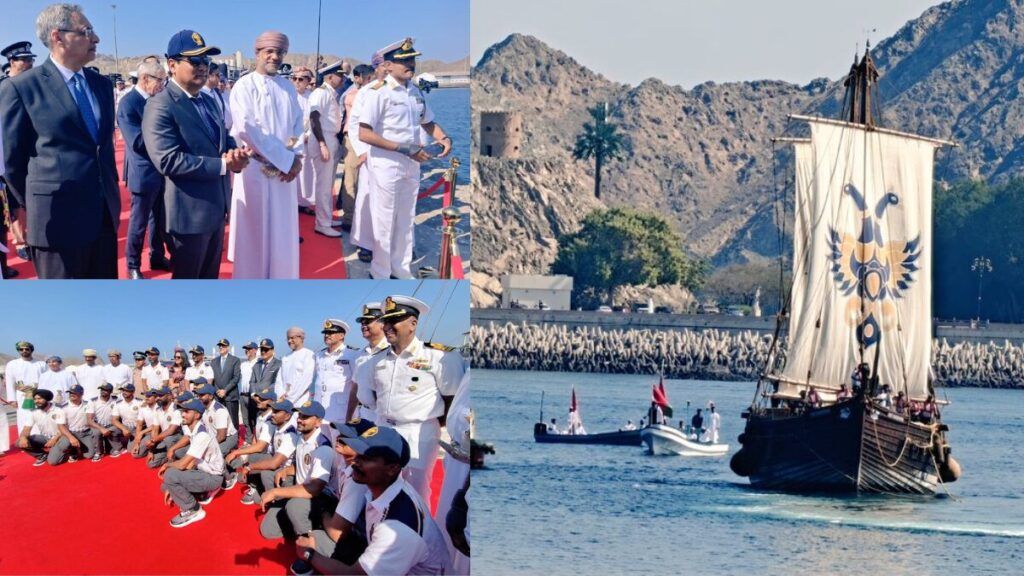
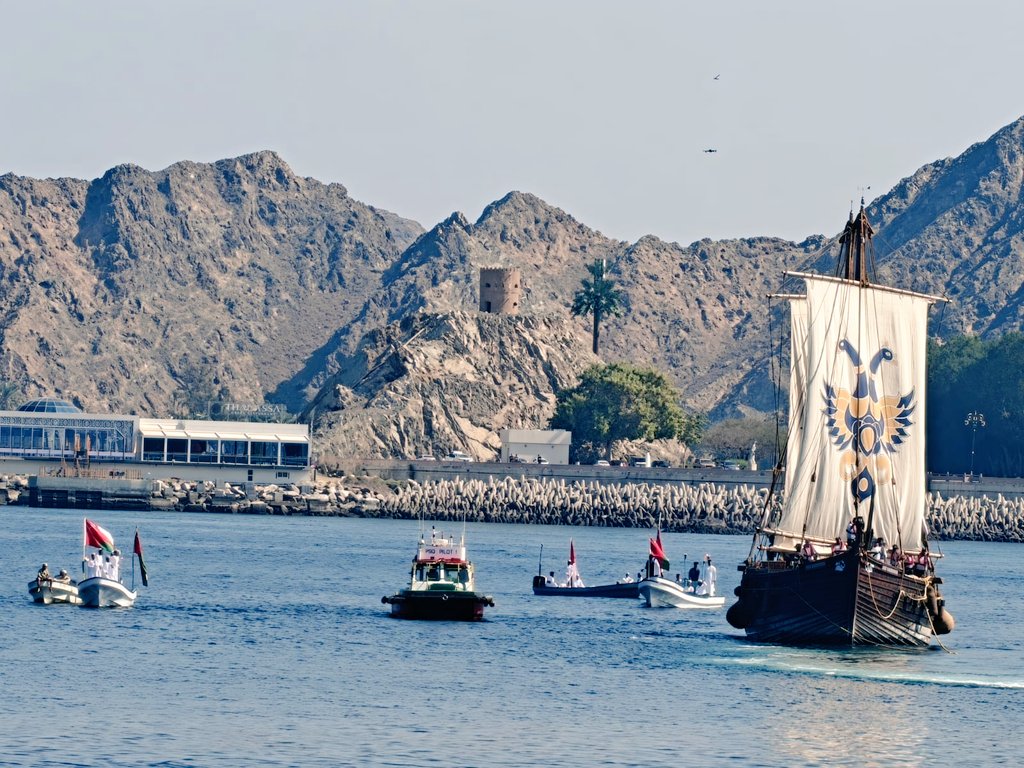
Muscat came alive this week as the Indian Naval Sailing Vessel INSV Kaundinya arrived at Port Sultan Qaboos, completing an 18-day maiden voyage from Porbandar in Gujarat. More than a simple port call, the vessel’s arrival was hailed as a vivid celebration of centuries-old civilisational, maritime, and cultural ties between India and Oman.

India’s Minister of Ports, Shipping & Waterways, Sarbananda Sonowal, welcomed the crew and described the moment as historic. “A historic moment of pride as INSV Kaundinya receives a grand welcome in Muscat!”
“The culmination of this historic 18-day voyage from Gujarat to Oman is a shining example of Hon’ble PM Shri Narendra Modi ji’s visionary leadership and firm resolve to revive India’s ancient shipbuilding genius. It also symbolises the enduring bond of our historic ties with the Gulf region.”
Highlighting the vessel’s unique craftsmanship, Sonowal added, “By sailing this magnificent stitched-ship inspired by the 5th-century paintings of Ajanta and crafted without a single nail by our master artisans from Kerala, we have proudly shown our civilisational legacy to the world.”
“This vessel is not just wood and rope; it represents the timeless strength of our maritime heritage, marked by indigenous skill and enduring innovation. It is a powerful symbol of Aatmanirbhar Bharat bridging our glorious past with a confident future.”
He also saluted the crew, saying, “I heartily congratulate Skipper Cdr Vikas Sheoran, Officer-in-Charge Cdr Y Hemant Kumar and the entire Indian Navy team. A special mention to Shri Sanjeev Sanyal ji, whose passion, participation and daily chronicles brought this ancient trade route back to life for millions of Indians. Truly a voyage that defines Virasat Bhi, Vikas Bhi!”
INSV Kaundinya is a traditionally built wooden sailing vessel that draws inspiration from fifth-century Ajanta Cave paintings. Constructed entirely with stitched-plank techniques and without modern nails or metal fastenings, the ship reflects India’s rich indigenous maritime knowledge and sustainable shipbuilding practices. Its design and voyage celebrate India’s ancient seafaring legacy while demonstrating the skill, resilience, and innovation of its modern navy.
The vessel retraced historic maritime routes that once connected India’s western coast with Oman, routes that facilitated trade, cultural exchange, and diplomacy for centuries. The expedition covered 650 nautical miles over 17 days, underlining the Indian Ocean as a bridge that has historically linked nations, economies, and cultures.
At Port Sultan Qaboos, the reception brought together senior officials from Oman’s Ministry of Heritage and Tourism, the Royal Navy of Oman, the Royal Oman Police Coast Guard, and the Indian Navy. The large Indian community in Oman, including students, joined in the celebrations with traditional Indian and Omani cultural performances, adding vibrancy to the historic occasion.
The voyage also coincides with the 70th anniversary of diplomatic relations between India and Oman, highlighting the long-standing and evolving partnership. During his visit, Sonowal held bilateral talks with Oman’s Minister for Transport, Communications and IT, H.E. Eng. Said bin Hamood bin Said Al Mawali, focusing on expanding maritime cooperation. Opportunities for Omani companies to participate in India’s rapidly expanding port and maritime sector were discussed, including major infrastructure projects under the Public–Private Partnership framework, such as the Vadhavan Port project in Maharashtra and the Tuticorin Outer Harbour Project in Tamil Nadu.
Sonowal also highlighted India’s US$8.4 billion maritime development package, designed to strengthen the shipbuilding ecosystem through dedicated industrial clusters, research and development support, and a Maritime Development Fund. A proposal for a green shipping corridor between India and Oman was outlined, aiming to deepen sustainable maritime collaboration. Additionally, a memorandum of understanding on maritime heritage and museums was signed, aimed at enriching the shared maritime history of both nations.
The voyage was commanded by Cdr Vikas Sheoran and crewed by four officers and 13 sailors under the leadership of Cdr Y Hemant Kumar. For the officers and sailors aboard, the journey was both challenging and exhilarating. “It is no mean task to sail on a transoceanic voyage from Porbandar to Muscat,” said Commander Kumar, reflecting on the 650-nautical-mile expedition.
Experts noted the expedition as a revival of India’s ancient maritime traditions. Economic Advisory Council member Sanjeev Sanyal, who joined the voyage, said,
“This project is to show that ancient India, which we are very proud of, was really based on risk-takers, adventurers and merchants who went out, discovered new markets, spread culture, and imbibed new ideas. That spirit is what we are celebrating here.”
The arrival of INSV Kaundinya in Muscat is thus not just a milestone in naval achievements but a living symbol of the enduring relationship between India and Oman—spanning over 5,000 years of maritime exchange, cultural dialogue, and civilisational bonds. As both countries mark seven decades of diplomatic relations, the stitched wooden ship serves as a tangible bridge between the past and the present, carrying the legacy of ancient mariners into the contemporary era.
Support our Journalism
No-nonsense journalism. No paywalls. Whether you’re in Australia, the UK, Canada, the USA, or India, you can support The Australia Today by taking a paid subscription via Patreon or donating via PayPal — and help keep honest, fearless journalism alive.

