

By Anurag Punetha
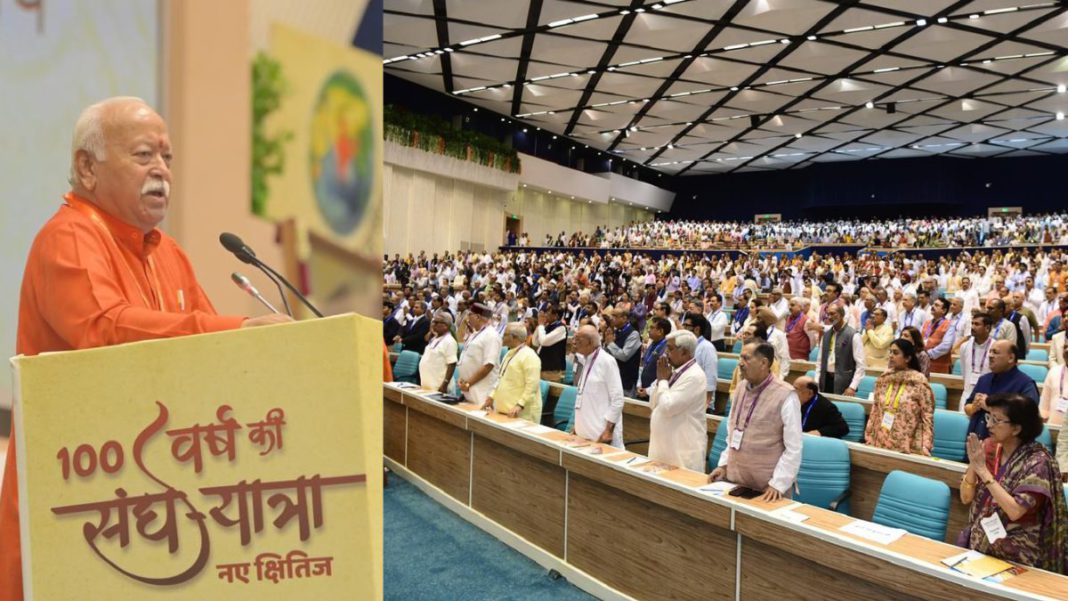
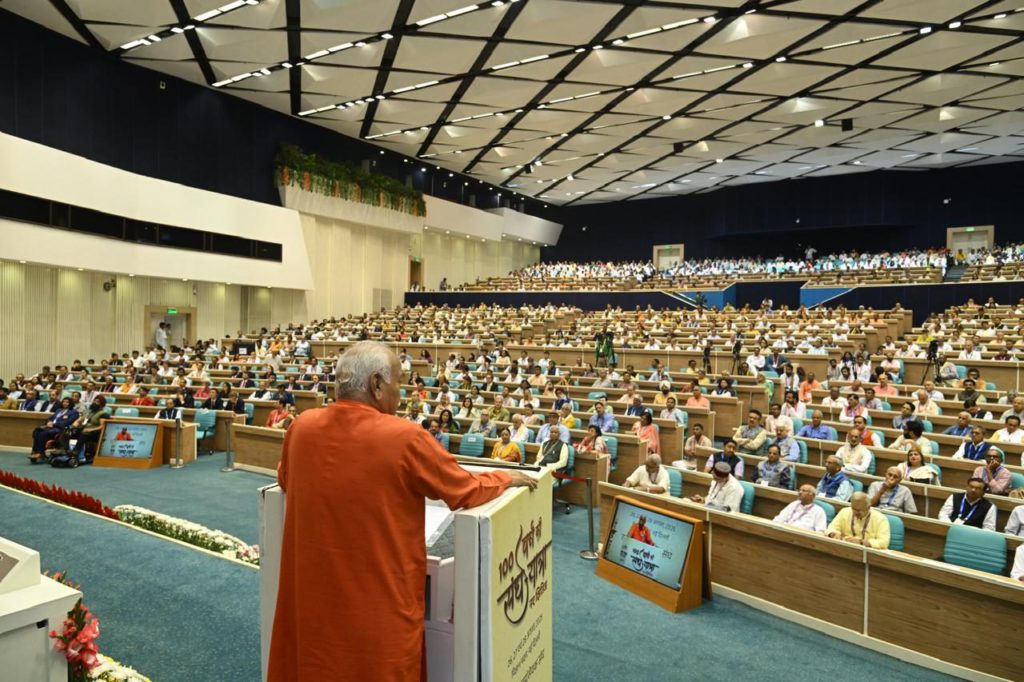
In India’s loudest season of opinion, the Rashtriya Swayamsevak Sangh (RSS) is both omnipresent and opaque. This week, its chief, Dr. Mohan Bhagwat, fielded the hardest questions—on temples and textbooks, Muslims and migration, demographics and diaspora—and, in doing so, gave observers a clearer map of where the organisation stands in 2025.
What follows is not a brief for or against the Sangh, but an attempt to separate signal from noise and assess how far this latest articulation might actually clear the air.
After Ayodhya, many expected a replay. Bhagwat’s line instead: the RSS will not spearhead movements for Kashi or Mathura; if citizens mobilise, swayamsevaks (RSS members) may join—but within law, dialogue, and restraint. He also framed the dispute as culturally exceptional—limited to Ayodhya, Kashi and Mathura—rather than an open-ended “reclamation” agenda.
For a group often caricatured as maximalist, that is a deliberately narrower, institution-respecting stance.

On schools and skilling, the RSS chief Bhagwat praised India’s New Education Policy’s thrust on mother-tongue learning, multi-lingual ability, and recovering indigenous knowledge without rejecting modernity. He backed integrating aspects of the gurukul tradition into mainstream schooling, while explicitly resisting the “make Sanskrit compulsory” caricature. The pitch is cultural confidence with pragmatic pedagogy, not a retreat from science or global readiness.
Dr. Bhagwat argued India should converge on a common, non-foreign link language while ensuring every Indian knows at least three languages: mother tongue, state language, and the national link. Agree or disagree, it’s a cohesive theory of nationhood through linguistic competence rather than compulsion. The practical test will be state capacity—teacher training, materials, and bridging across thousands of classrooms.
The RSS is routinely branded anti-Muslim. Bhagwat’s counter—the DNA of all Indians is the same—has been backed by outreach most visible in 2022, when he met Muslim intellectuals, visited a Delhi mosque and a madrasa, and amplified a “samvad” (dialogue) doctrine. Outreach does not erase every prejudice at the grassroots, but it provides a standard against which followers, affiliates, and critics alike can hold the organisation.

The headline-grabber was Bhagwat’s argument that Indian families should ideally have three children, justified as a hedge against below-replacement fertility and ageing pressures. He couched it alongside a long-standing RSS preference for a uniform population policy that applies equally across communities. The merits can and should be debated—on economics, women’s agency, climate, and urban capacity—but the position is now explicit, not whispered.
On illegal immigration—Bangladeshi and Rohingya influx—the RSS frame remains national security first. In policy terms, that aligns with tighter border management and due-process screening. The humanitarian counter-case (refugee, asylum norms) will continue to clash with this securitised lens, but at least the priors are on the table. (This stance has been consistent since the Rohingya crisis escalated in the late 2010s.)
Hindu, Hindavi, Bharatiya—what’s in a name?
Critics hear “Hindu Rashtra” and assume theocratic intent. Bhagwat’s repeated gloss is civilisational: “Hindu” as a cultural term for India’s long civilisational arc, not a template for second-class citizenship. You don’t have to buy the semantics to see the strategic shift—from majoritarian mobilisation toward a vocabulary of cultural identity that claims inclusivity as a core feature, not a grudging add-on. This sits in tension with hardliners, which is precisely the point of stating it publicly.
One more allegation that has not gone away is whether the BJP is the RSS’s political arm? The relationship is more nuanced. Ideological kinship is undeniable; personnel pipelines exist. Yet Bhagwat emphasised the party’s organisational autonomy—especially in appointments—and denies “remote control.” Practically, that keeps the Sangh’s leverage informal and deniable while allowing divergence in governance; analytically, it’s a reminder to judge policy on the government’s record, not only the Sangh’s worldview.
Taken together—law-first on temple disputes, education over agitation, semantics over sloganeering—this is an organisation leaning into institution-building after a decade of political dominance by its ideological sibling. Less theatre, more throughput: schools, service organisations, think-tanks, curriculum interventions. It’s the arc many mass movements take when they move from mobilisation to consolidation.
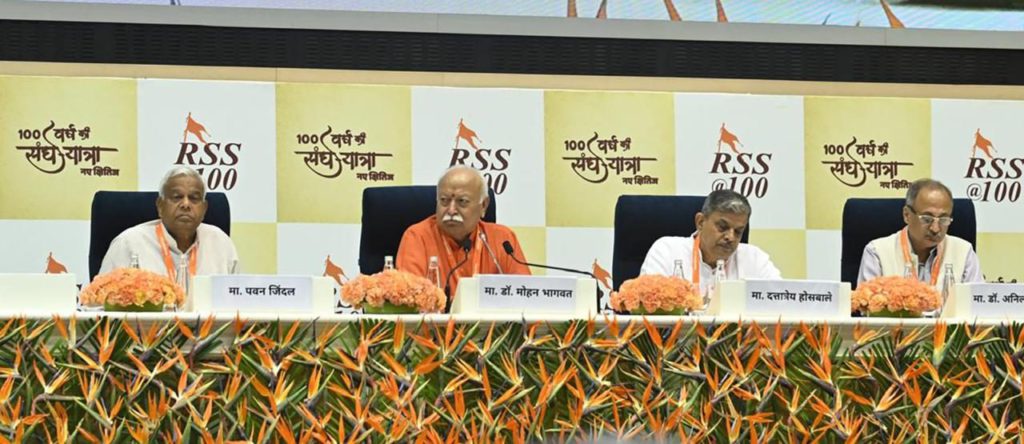
Outside India, the RSS’s closest analogue is not a party but a volunteer network: Hindu Swayamsevak Sangh (HSS).
It is registered as a cultural-educational nonprofit in Australia, the US and elsewhere, running weekend culture classes, service projects, and leadership camps. Supporters call it soft power; detractors see transnational nationalism. Either way, it is the RSS’s most durable overseas instrument—and a window into how “Vishwa Guru” rhetoric translates into volunteer hours.
Does this week’s articulation reduce communal temperature on the ground? That is ultimately an empirical question. If “no new movements,” “same DNA,” and “dialogue” are the standards, local cadres, online partisans, and affiliated outfits will need to act accordingly. Conversely, if hate speech spikes or vigilante violence goes unrebuked, the gap between doctrine and discipline will widen. The point of spelling out principles in public is precisely to be held accountable to them.
If the RSS vision “lands,” what would success look like in five years? Fewer communal flashpoints and faster court-led dispute resolution; measurable gains in foundational learning (especially in mother-tongue instruction); language proficiency that improves mobility rather than policing identity; a fertility debate governed by evidence and women’s choices, not panic; and diaspora networks that add to India’s global credibility without exporting domestic polarisation.
Measurable, not mystical: So, did Bhagwat’s Q&A silence critics?
Critics won’t be silenced by a speech, nor should they be. Healthy democracies argue—sometimes harshly—about identity and power. But this week’s articulation does two useful things. First, it narrows the scope of the hardest disputes (Kashi–Mathura) to law and dialogue, a material de-escalation in rhetoric compared to the 1990s. Second, it puts education—not agitation—at the centre of cultural renewal. These are not small pivots for an organisation built on mass mobilisation.
The unresolved parts are also clear. A “three children” ideal will meet resistance from economists, demographers, and women’s rights advocates; it will need to be argued with data, not destiny. The inclusivity claim must be matched by rapid, visible repudiation of bigotry at the periphery. And “no remote control” will convince more people when ideological distance produces policy distance—even occasionally.
Still, if the task is to reduce fog, Bhagwat’s answers mark progress: fewer dog whistles, more doctrine; fewer myths, more measurable. The RSS remains a cultural movement with political gravity, not a party with cultural cover.
For international readers, that distinction matters: one judges governments by governance and movements by the societies they help build. The Sangh said—again, and more clearly—what kind of society it thinks India can be. It’s now for India’s institutions, parties, civil society, and citizens to hold it to those words.
Author: Anurag Punetha is Consulting Editor of The Australia Today and Media Head of the Indira Gandhi National Centre for Arts, based in New Delhi, India.
Disclaimer: The opinions expressed within this article are the author’s personal opinions. The Australia Today is not responsible for the accuracy, completeness, suitability, or validity of any information in this article. The information, facts, or opinions appearing in the article do not reflect the views of The Australia Today, and The Australia Today News does not assume any responsibility or liability for the same.
Support our Journalism
No-nonsense journalism. No paywalls. Whether you’re in Australia, the UK, Canada, the USA, or India, you can support The Australia Today by taking a paid subscription via Patreon or donating via PayPal — and help keep honest, fearless journalism alive.
