

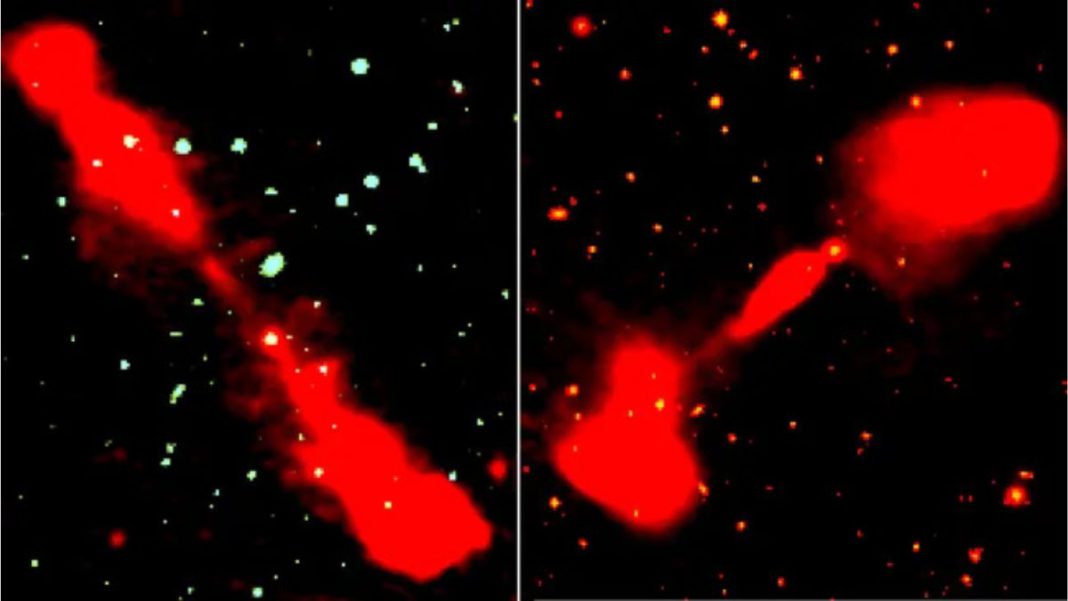
Indian astronomers have identified 53 newly discovered supermassive black hole–powered quasars unleashing jets of matter at nearly the speed of light, stretching as far as 7.2 million light-years — around 50 times the width of the Milky Way.
These extraordinary objects, known as Giant Radio Quasars, are part of a larger group of 369 radio quasars detected in data from the Giant Metrewave Radio Telescope (GMRT) near Pune. The findings emerged from the TIFR GMRT Sky Survey (TGSS), which mapped about 90% of the sky and proved ideal for spotting vast radio-emitting structures billions of light-years away.
Celebrating the discovery, Dr Yashwant Gupta, Director of the National Centre for Radio Astrophysics, said:
“This is another exciting result from our GMRT observatory using TGSS data. It beautifully highlights the power of data mining.”
“These jets dwarf anything found in our solar system or even our galaxy,” researcher Souvik Manik of Midnapore City College told Space.com.
“We are talking about 20 to 50 Milky Way diameters placed side by side.”
Supermassive black holes — millions to billions of times the mass of the Sun — lie at the cores of most large galaxies, but only some become powerful quasars, feeding on surrounding gas and dust in glowing accretion discs. Their intense magnetic fields channel super-heated plasma into twin jets that shoot outwards and inflate giant radio lobes across intergalactic space.
“Such enormous radio jets help us understand the late evolutionary stages of quasars and the intergalactic medium that surrounds them,” team leader Dr Sabyasachi Pal told Space.com. But locating these cosmic giants is difficult, he explained, because the faint radio “bridges” linking their lobes often fall below detection limits, making the structures appear incomplete.
Low-frequency surveys like TGSS are especially effective because the ageing plasma in these lobes shines more brightly at lower radio wavelengths. The team found that at least 14% of the giant quasars sit within galaxy clusters or near cosmic filaments — regions dense with gas, dust and dark matter.
“The environment plays a major role in shaping these jets,” said team member Netai Bhukta.
“In crowded regions, jets may slow, bend or fragment, while in emptier areas they can grow freely.”
The researchers also noted frequent jet asymmetry, where one jet appears longer or brighter than the other. This imbalance, said Sushanta K. Mondal, indicates that the two jets are battling very different cosmic conditions on either side of the black hole.
More distant giant quasars appear even more asymmetric — likely because we are observing them further back in time, when the universe was denser and more turbulent.
The research was published on 13 November in the Astrophysical Journal Supplement Series of the American Astronomical Society.
Support our Journalism
No-nonsense journalism. No paywalls. Whether you’re in Australia, the UK, Canada, the USA, or India, you can support The Australia Today by taking a paid subscription via Patreon or donating via PayPal — and help keep honest, fearless journalism alive.
