
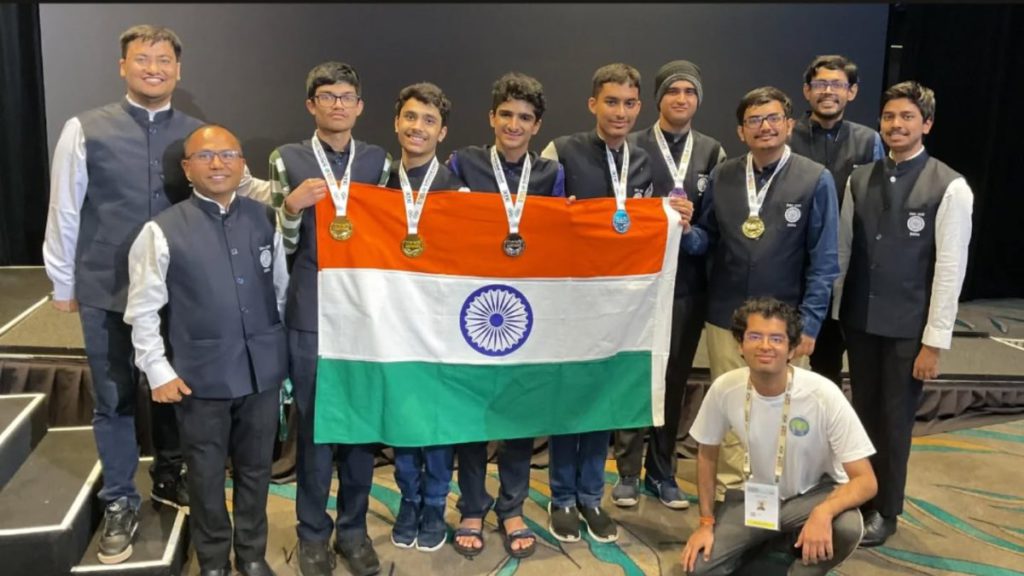
India has secured the 7th position at the prestigious 66th International Mathematical Olympiad (IMO) 2025, held on the Sunshine Coast, Queensland, with host nation Australia finishing 15th among the 110 participating countries.
India finished behind top performers China (1st), the United States (2nd), Republic of Korea (3rd), Poland and Japan (tied 4th), and Israel (6th). Following India were Singapore (8th) and Vietnam (9th).
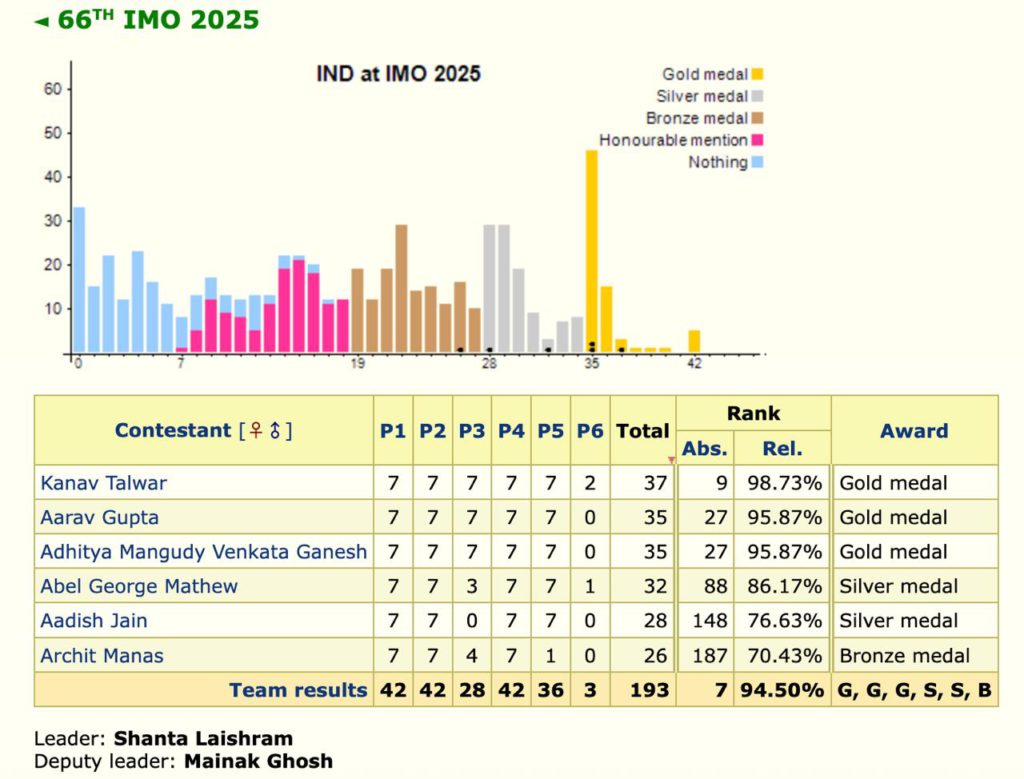
The Indian team also earned two silver and one bronze medal, bringing the total tally to six — a standout performance among 110 participating countries.
This year’s medal-winning team included Kanav Talwar, Aarav Gupta, and Adhitya Mangudy (gold), Abel George Mathew and Aadish Jain (silver), and Archit Manas (bronze). With a record-breaking cumulative score of 193 out of 252, this marks India’s best-ever result since it began participating in 1989.

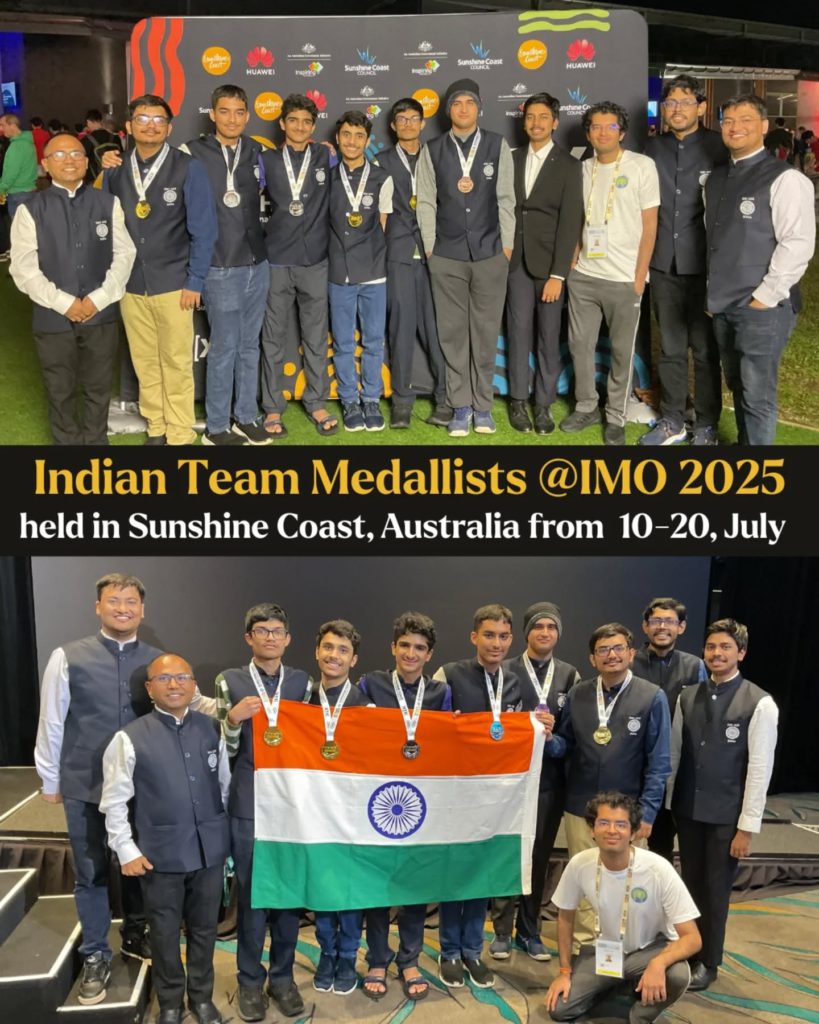
The Indian delegation was led by Prof. Shanta Laishram of ISI Delhi, with Dr Mainak Ghosh from ISI Bengaluru as Deputy Leader. Observers included Atul Shatavart Nadig, a BS student at MIT, and Dr Rijul Saini.
The Homi Bhabha Centre for Science Education (HBCSE), Tata Institute of Fundamental Research, manages India’s participation in the IMO, overseeing national selection, training, and preparation.
This is only the second time India has won three golds at the IMO — the first being in 1998 — and the third time it has ranked 7th, matching its placements in 1998 and 2001. India’s best-ever ranking was 4th in 2024 when it won four golds. From 2019 to 2025, Indian students have brought home 12 gold medals, nine of which were achieved in the last three years alone.

The Australian team also performed strongly, earning two gold medals (William Cheah and Jayden Pan), two silver medals (William Liu and Xiangyue Nan), and two bronze medals (Justin Tran and Zihui Zhang). Cheah and Pan achieved near-perfect scores of 35/42, placing them among the top global contestants.
This year’s Olympiad hosted 630 students from 110 nations, who competed over two days to solve six complex problems across algebra, number theory, combinatorics, and geometry.
Hosted by the Australian Maths Trust, the 2025 IMO also embraced cutting-edge innovation with the introduction of the $10 million AI Mathematical Olympiad (AIMO) Prize — aimed at encouraging the development of open-source AI models capable of solving Olympiad-level problems.
As part of the IMO’s fringe events, students engaged with representatives from AI companies and witnessed demonstrations of closed-source models tackling this year’s questions. While the IMO does not formally validate AI methods, President Gregor Dolinar acknowledged the growing influence of AI in mathematics, stating: “Correct mathematical proofs, whether produced by the brightest students or AI models, are valid.”
The 66th IMO concluded with inspiring lectures by global mathematicians, including Cheryl Praeger and Terence Tao, followed by a medal ceremony and a classic Australian barbecue.
Since its inception in 1959, the IMO has grown from just seven countries to over a hundred, becoming the world’s premier mathematics competition for high school students. Australia, a participant since 1981, last hosted the IMO in Canberra in 1988.

Support our Journalism
No-nonsense journalism. No paywalls. Whether you’re in Australia, the UK, Canada, the USA, or India, you can support The Australia Today by taking a paid subscription via Patreon or donating via PayPal — and help keep honest, fearless journalism alive.

