

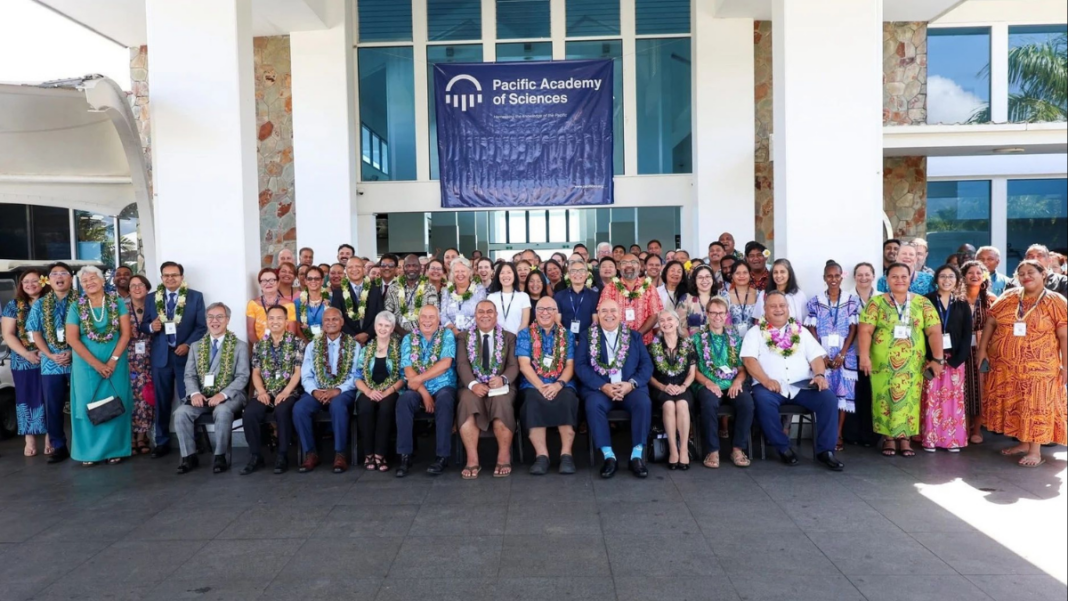
The inaugural Pacific Academy of Sciences Congress has wrapped up in Apia, Samoa, marking a historic step forward for regional scientific collaboration and the elevation of Pacific knowledge systems on the global stage.
Held from 16-18 February 2026, the three-day gathering brought together more than 250 academics, government leaders, researchers, policymakers and emerging scientists from across the Pacific and as far afield as Alaska.
The event coincided with the induction of new Fellows and the launch of major new initiatives aimed at strengthening Pacific research capacity.
Among those attending was Distinguished Prof. Emeritus Frances Separovic from the Australian Academy of Science, who travelled to Apia with the International Science Council Regional Focal Point for Asia and the Pacific.
The Congress, themed Harnessing the Knowledge of the Pacific, was officially opened by Samoa’s Minister of Education and Culture, Aiono Dr Alec Ekeroma. In his address, he underscored the importance of bringing together western science and indigenous knowledge.
“Western science and indigenous knowledge have not always walked together,” he said.
“But today, the world increasingly recognises that truly sustainable solutions require both – like the two hulls of an alia – each strengthened by the presence of the other.”
The Congress formed a key milestone for the Pacific Academy of Sciences, established in 2024 following a collective vision shared by more than 60 Pacific scholars who first met in Apia in 2023. Officially launched during the Commonwealth Heads of Government Meeting in Samoa in October 2024, the Academy represents the first regional mechanism created by Pacific Island nations to collectively harness their knowledge for evidence-based decision-making.
Throughout the Congress, speakers highlighted the need for ethical, inclusive and community-driven science.
Dr Saia Ma’u Piukala, Regional Director for the Western Pacific at the World Health Organisation, delivered a keynote on ethical leadership in science, stressing that research in the Pacific must be equitable and anchored in lived experience.
On day two, Prof. Sir Ashley Bloomfield emphasised openness, transparency and community involvement as essential to building public trust. He said blending scientific approaches with indigenous knowledge could generate new insights and deliver tangible benefits for people, communities and the planet.
Papua New Guinea’s Minister for Higher Education, Research, Science and Technology and Sport, Kinoka Hotune Feo, called for stronger capacity-building pathways to empower the next generation of Pacific scientific leaders.
Prof. Emma Kruse Va’ai of the National University of Samoa highlighted the importance of nurturing scientific curiosity from an early age, particularly through Pacific languages, to sustain cultural and environmental knowledge.
A major outcome of the Congress was the launch of the Pacific Research Hub, a collaborative platform designed to enable researchers across the region to share their work and strengthen connections. Delegates also celebrated the opening of applications for the Tupaia Research Grant for emerging Pacific researchers, funded by New Zealand’s Ministry of Foreign Affairs and Trade.
The Pacific Young Academy was also launched, beginning with a co-design workshop involving postgraduate and mid-career researchers to shape its future direction.
The free event was supported by the Australian Government Department of Industry, Science and Resources through the International Science Council Regional Focal Point for Asia and the Pacific, alongside partners including the Sasakawa Peace Foundation and the Royal Society Te Apārangi.
Organisers described the Congress as an invitation to action, signalling a new era of collaboration in which Pacific sciences – grounded equally in rigorous research and indigenous wisdom – are poised to have a growing global impact.
Support our Journalism
No-nonsense journalism. No paywalls. Whether you’re in Australia, the UK, Canada, the USA, or India, you can support The Australia Today by taking a paid subscription via Patreon or donating via PayPal — and help keep honest, fearless journalism alive.
