


By Sara L Gates
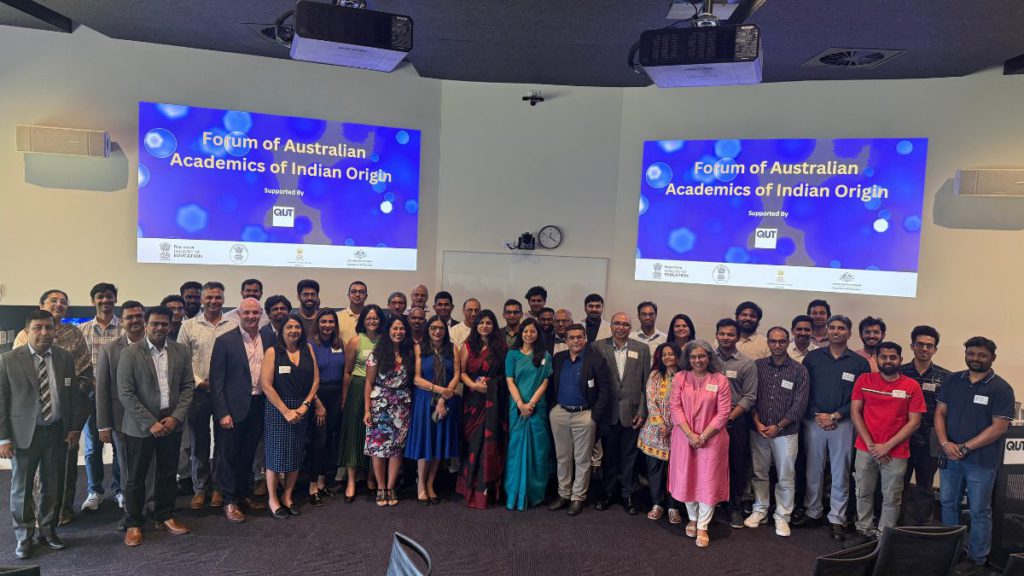
The first-ever Forum of Australian Academics of Indian Origin has been launched at Queensland University of Technology (QUT), bringing together leading scholars, policymakers and government representatives to strengthen education and research ties between Australia and India.
The inaugural meet-up was held at QUT and is being framed as the beginning of a standing platform for Indian-origin academics working in Australian universities.
The idea for the forum was first raised by academics of Indian heritage during the recent visit of India’s Minister of Education Dharmendra Pradhan, and Australia’s Minister for Education, Jason Clare, where both sides discussed ways to better harness the expertise of the Indian diaspora in Australia’s higher education and research sectors.
The Brisbane gathering was attended by senior representatives from both governments and the Indian mission, including Acting High Commissioner of India to Australia, Irina Thakur; Consul General in Brisbane, Neetu Bhagotia; President of the Australian Academy of Science, Professor Chennupati Jagadish AC; QUT Deputy Vice-Chancellor (International and Business Development), Professor Mark Harvey; Distinguished Professor Patsy Yates from QUT’s Faculty of Health; Acting Executive Dean of Engineering, Professor Ian O’Hara; Associate Dean (Research) in Engineering, Professor Clinton Fookes; and Vanessa Lapthorne, Assistant Secretary for International Engagement at the Australian Department of Education.
Welcoming participants, Professor Harvey said QUT was proud to host the first meeting of the forum and acknowledged the role of Indian-origin academics across Australia’s universities.
He noted that the initiative had come “from the academic community itself” and said institutions like QUT were ready to work with researchers and government to turn the network into a practical channel for collaboration.
Acting Indian High Commissioner Ms Thakur described the gathering as an important step in the evolution of the Australia–India relationship in education and research, saying it recognised the growing contribution of Indian-origin academics to both systems.
She underlined that as the two countries deepen their strategic and economic partnership, there is a parallel need to deepen cooperation in classrooms, laboratories and research centres.
Consul General Neetu Bhagotia said the forum was especially significant for Brisbane and Queensland, where the number of academics and researchers of Indian origin has increased in recent years alongside student numbers and institutional links with Indian universities.
She said she hoped the group would grow into a strong professional network that could support visiting delegations, joint projects and student mobility between Australia and India.
In his keynote address, Professor Chennupati Jagadish spoke online about the responsibility and opportunity facing researchers in both countries as they work on shared challenges in areas such as clean energy, health, food security, digital technologies and advanced manufacturing.
He stressed that collaboration between Australia and India should be grounded in “genuine partnerships” and emphasised the importance of responsible research, guided by environmental, social and governance (ESG) principles.
Participants at the forum included academics from a range of disciplines, with panel sessions devoted to emerging technologies, the use of artificial intelligence in education and research, health sciences, and neuroscience. Speakers discussed how Indian-origin academics, who often have strong professional and cultural links with both countries, can help design and lead new models of joint work.
Among the ideas canvassed were joint PhD programs, co-supervision arrangements, visiting fellowships, collaborative research centres and structured networks focused on thematic areas such as health, agriculture, engineering, AI and climate.
The event also highlighted the growing policy infrastructure supporting Australia–India cooperation in education, including recent agreements on mutual recognition of qualifications and frameworks to support student and staff mobility.
Officials from the Australian Department of Education outlined how the forum could complement existing bilateral mechanisms by feeding in practical ideas from researchers and helping identify areas where institutions on both sides are ready to move quickly.
Throughout the day, academics repeatedly described the forum as “overdue” and “much needed,” saying that while many already collaborate informally with colleagues in India, there has not previously been a national platform specifically for Australian academics of Indian origin.
Several participants called for the forum to meet regularly, rotate across different Australian cities, and establish working groups that can keep momentum between in-person gatherings.
The inaugural meeting was jointly supported by the High Commission of India in Australia and the Australian Department of Education, with QUT acting as the first host institution.
Organisers said the successful launch in Brisbane has laid the groundwork for a recurring forum dedicated to advancing Australia–India academic cooperation and building long-term partnerships in education, health, agriculture, science and technology.
As one participant put it, the new network is intended to ensure that “the story of Australia–India relations is not written only in communiqués and trade figures, but also in the everyday work of teachers, researchers and students who are connected across both countries.”
Support our Journalism
No-nonsense journalism. No paywalls. Whether you’re in Australia, the UK, Canada, the USA, or India, you can support The Australia Today by taking a paid subscription via Patreon or donating via PayPal — and help keep honest, fearless journalism alive.

