

By Priyanka Tripathi
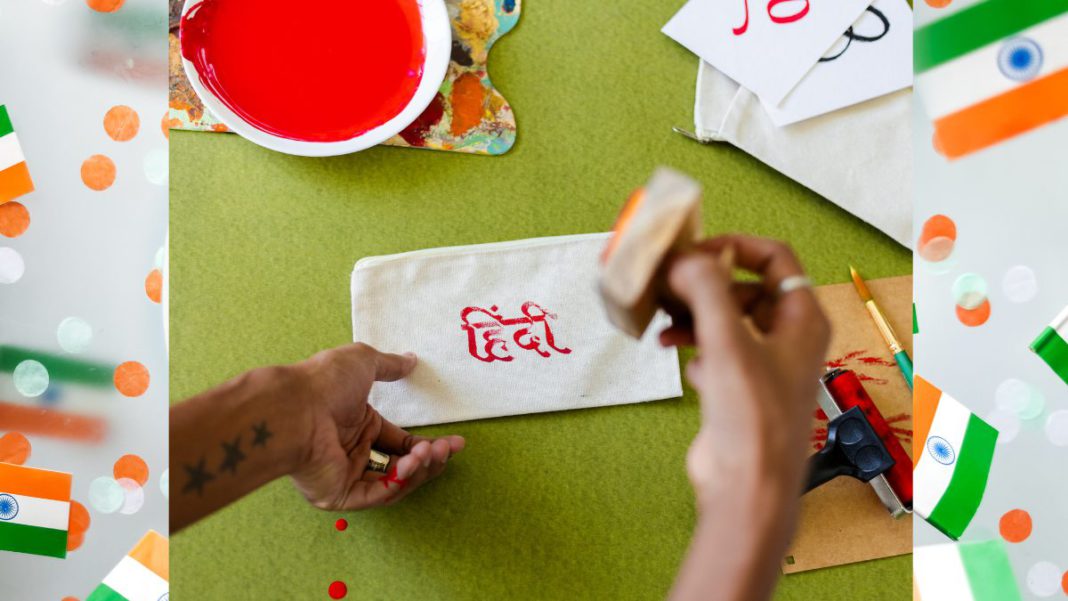
Hindi is not just a language; it is a medium through which the socio-cultural diversity of India gets unified. Every year on September 14, India pauses to celebrate Hindi Diwas, a reminder of the day in 1949 when Hindi, written in Devanagari script, was adopted as one of the official languages of the nation.
As per the Eighth Schedule of the Indian Constitution (2018), India has a total of twenty-two officially recognised languages, but alongside, there are over 1,600 dialects spoken across the country. An old saying, ‘kos-kos par badle paani, chaar kos par bani’ (every few miles the taste of water changes, and every few more, the dialect shifts), is a living example of India’s linguistic mapping, which is not static but is contingent upon altering geography, cultural practices, climate, and community. Amidst these dynamic expedients, Hindi becomes a thread of connection, a bridge that holds together diversity without erasing it.
Hindi Diwas is a reminder of asserting this linguistic pride and recognising how one language, emerging out of the soil, songs, and struggles of Indians, has carried the intimacy of family conversations, the explosion of poetic and cinematic creations, and the responsibility of national aspirations. Besides being a medium of communication, the language also acts as the shared thread of accessibility, which helps people from different walks of life and across regions to stay connected to the larger idea of unity that the country cherishes through its vast linguistic diversity.
Be it the bustling railway station, a street market, or workplaces in metropolitan cities like Delhi, Mumbai, or Bengaluru, Hindi enables a Tamil-speaking shopkeeper and a Punjabi customer, or a Bihari migrant and a Maharashtrian colleague, to understand each other. Whether it is a student moving across states for higher education or a person relocating for work, Hindi has ushered in a sense of familiarity, helping them to build small circles of belonging and navigate their way in otherwise unknown territories.
Hindi has long functioned as a language of cultural imagination, stretching across genres, styles, and expressive forms. From its early roots in Apabhramsha and dialects like Awadhi and Braj, Hindi literature grew through the medieval period, with devotional and philosophical works by Kabir, Tulsidas (Ramcharitmanas), Surdas, and Mirabai. These culturally compelling voices, besides providing the language a spiritual basis, offered it a quotient of intimacy that spoke about the everyday lives of people.
With the coming of modernity, Hindi literature acquired a different urgency. Writers like Munshi Premchand, Maithili Sharan Gupt, Sumitranandan Pant, Mahadevi Verma, and Suryakant Tripathi ‘Nirala’ raised questions of social reform, nationalism, and individual feeling. Their words seeped into the wider cultural consciousness, later echoed in cinema and, eventually, television and digital forms of storytelling.
In the decades following independence, Hindi cinema emerged as a dominant entity in the cultural sphere, representing not just entertainment but also a medium through which the essential understanding of identity, morality, and justice could be negotiated.
The screen reflected the changing times: Raj Kapoor individualised the idealist vision of the everyman, Bimal Roy translated the realistic ennui of the times into visual form, and Guru Dutt portrayed the isolation of modern existence. By the 1970s, resentment was expressed through the figure of the “angry young man”, embodied by Amitabh Bachchan, who came to symbolise a generation’s angst and disappointment towards systemic injustice and inequality.
At the same time, family dramas such as Roti Kapada Aur Makaan (1974) reaffirmed kinship bonds and filial responsibilities as the essence of the Indian moral landscape. Alternatively, parallel cinema sought to raise its voice against societal issues at the intersections of caste, class, and social power, with the film Ardh Satya (1983) being a befitting example of this perspective.
Television, too, effectively carried this cultural dialogue into homes across the country. The televised versions of Ramanand Sagar’s Ramayana (1987) and B.R. Chopra’s Mahabharata (1988) were not solely for entertainment, but they reimagined nationhood in a way that resonated with everyday life, thus fostering a sense of community feeling. Their resonance was so deep that decades later, in the early days of the COVID-19 lockdown, they returned once more to the national stage.
With the country under a 21-day shutdown in April 2020 and over 6,000 reported infections, Doordarshan decided to re-telecast these classics. For many, this felt like a return to a familiar anchor in a moment of profound uncertainty. Families, sometimes three generations together, watched the shows out of nostalgia and a shared need for comfort and continuity.
Interestingly, the Broadcast Audience Research Council reported that the popularity was not confined to older viewers. Children between the ages of two and fourteen tuned in in large numbers, often with grandparents by their side. Engagement levels were extraordinary: nearly three-quarters of the audience carried on from one episode to the next, and more than 80 per cent returned week after week.
During the week of 4–10 April 2020, Hindi general entertainment channels recorded their highest viewership since 2015, with Doordarshan once again becoming the country’s most-watched network. However, the small screen of the 1980s was not confined to epics alone. Serials such as Hum Log (1984) and Nukkad (1986) gave space to the aspirations and anxieties of the middle class. They sparked conversations around employment, gender roles, and urban life while providing reassurance and emotional connection at a moment of social transition.
In contemporary times, streaming content on OTT (over-the-top) platforms has changed the way stories are narrated and consumed. Regarding Hindi web series, what once remained confined within a regional viewership or the limits of state-run television is now available to viewers across and beyond India.
The reach of popular series like Sacred Games (2018), Mirzapur (2018), Delhi Crime (2019), Paatal Lok (2020), and Khakee (2022) rests not only on their gripping plots and cliffhangers but also on their attempt to portray the grim edges of everyday life in the Hindi-speaking belts of India. These are not just crime or psychological thrillers, but they bring to the forefront the varied shades of reality that Indian society embodies, thus making the content more relatable and authentic. Therefore, by focusing on such essential questions of human survival, safety, and dignity, the series propel viewers to consider this paradox of a society that proclaims a modern perspective yet remains tethered to older forms of bias, discrimination, and inequality.
However, these concerns are not entirely new; they draw inspiration from Hindi writers of the twentieth century—Krishna Sobti, Nirmal Verma, and Usha Priyamvada, among others—who raised similar concerns in their fictional narratives. The tropes of loneliness in migration, the weakening of the joint family structure, and the strain of changing gender dynamics did find their representation in such works. They created a space where these tensions could be questioned and even resisted, without negating the immediacy of the lived experience.
This particular spirit was effectively carried forward in the visual form by OTT platforms. What strikes as different today is the scale and immediacy with which these narratives circulate, are consumed, and are responded to. The screen now documents and interrogates social change, reminding one that the conditions depicted are what we inhabit, and that Hindi as a language brings us closer to such realisation.
To complement the cultural significance of Hindi, governmental initiatives have also contributed significantly to strengthening its role and preservation. At the Kendriya Hindi Samiti meeting in November 2024, essential measures were outlined, which included the Hindi Shabdsindhu project, envisioned to emerge as the most comprehensive and largest Hindi dictionary in the world within the next five years. Besides this, the Bhartiya Bhasha Anubhaag (Indian Languages Section) has been established to integrate technology into translation, ensuring wider accessibility of Indian languages in official and regular use.
Another pivotal attempt to spread awareness about the official language policy has been made through the Rajbhasha Sammelans (Official Language Conferences), which have successfully reaffirmed the role of Hindi as an essential link language.
Union Home Minister Amit Shah also underlined that the government, under the leadership of Prime Minister Narendra Modi, had consistently tried to preserve and promote the widespread use of Indian languages, with Hindi receiving the utmost attention. He has also emphasised the significance of education in one’s native language, as it enables children to connect with it effortlessly, improving their ability to read, reflect, and even make better decisions. Such a vision intends to weave language policy into empowerment at both cognitive and cultural levels.
As India continues to change, what keeps Hindi alive is not just its official status but the way it quietly threads through everyday life. It travels from a poet’s verse, through the silver screen, to the smallest phone screen, adapting without losing its essence. Hindi does not stand apart from the people who speak it; it grows with them, holds their memories, and carries their hopes. In this way, it does more than preserve the past; it keeps India’s cultural legacy moving forward, alive and responsive to every new moment.
Contributing Author: Priyanka Tripathi is an Associate Professor of English and Gender Studies at the Indian Institute of Technology Patna, India.
Support our Journalism
No-nonsense journalism. No paywalls. Whether you’re in Australia, the UK, Canada, the USA, or India, you can support The Australia Today by taking a paid subscription via Patreon or donating via PayPal — and help keep honest, fearless journalism alive.
