


By Stephen Howes and Natasha Turia
In August, we published a progress report on how the successful Pacific Engagement Visa (PEV) 2024 ballot applicants had fared, but at that time we only had data up to April. Now we have more recent data from the Department of Home Affairs, up to end of July. (Note that we are writing exclusively about the 2024 PEV round; the 2025 PEV ballot closed on 25 August and winners have already been notified.)
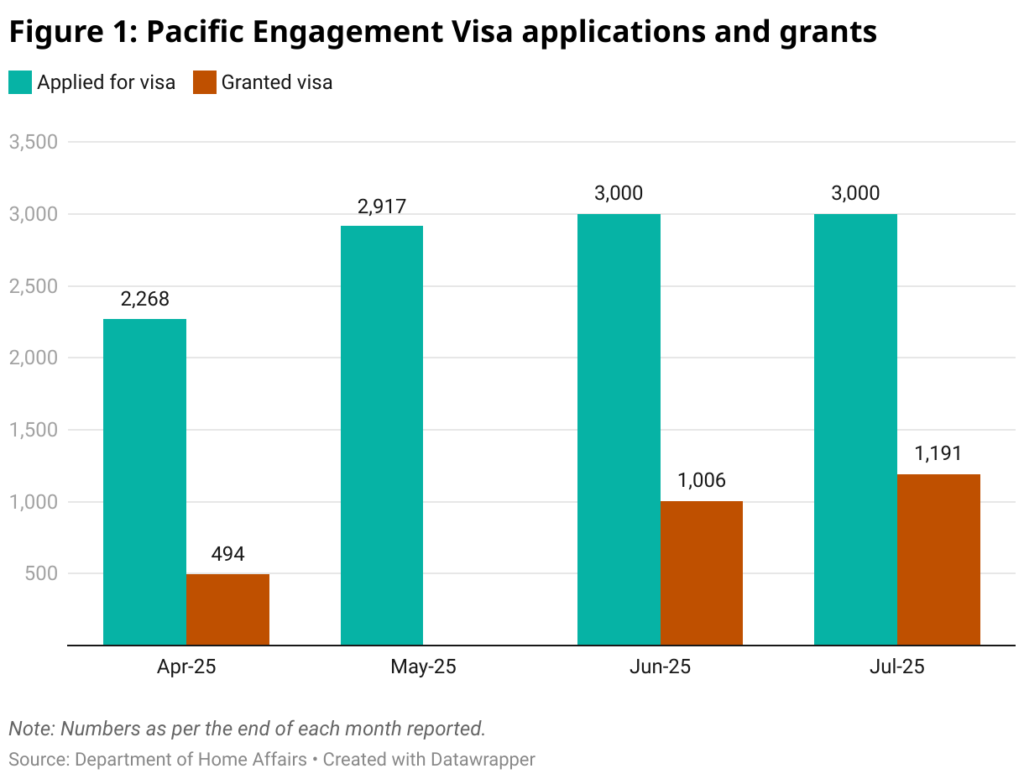
The good news is that just about everyone who was selected in the 2024 PEV ballot has now applied for a visa. This took some time. Most 2024 ballot winners were notified in August 2024. By the end of April 2025, only 2,268 or three-quarters of ballot winners had applied, but by the end of June this had increased to 3,000 (Figure 1).
Visa applications can be lodged without a job offer, but the visa will not be granted until employment has been secured (an offer of full-time work for a year is the minimum requirement). Finding a job has not been easy.
At the end of April, only 491 visas had been issued; that increased to 998 by the end of June, and 1,188 by the end of July, a 40% conversion rate (from applications to visas), almost double the 22% rate at the end of April.

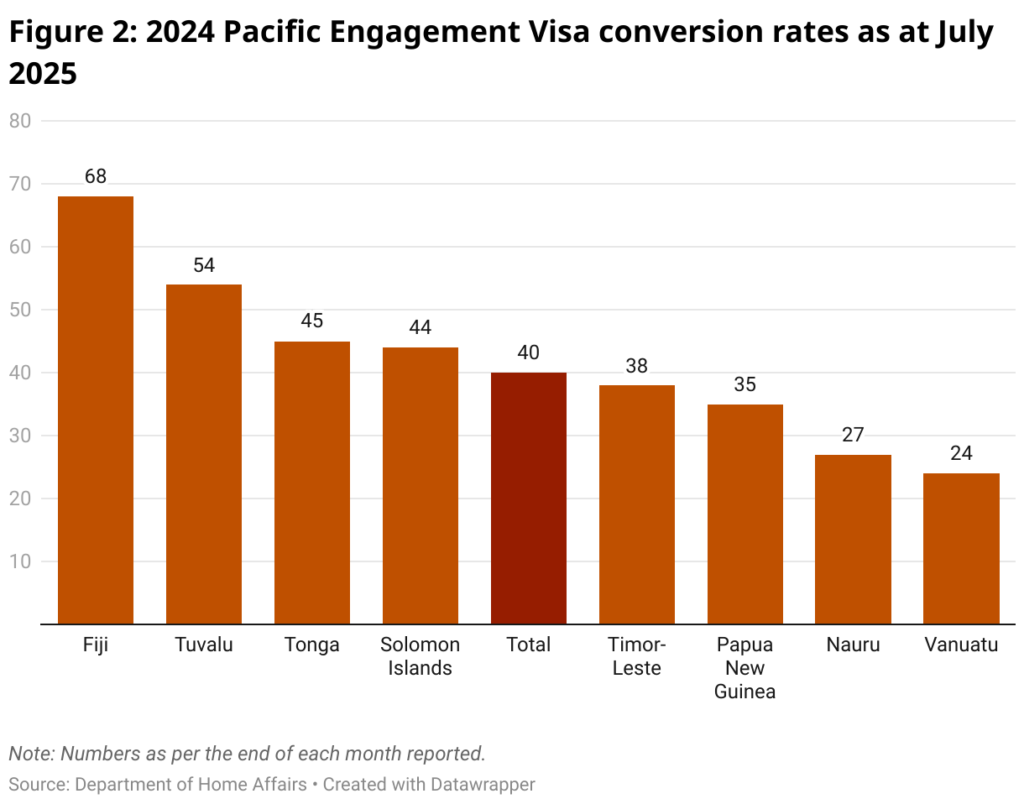
Fiji has the highest conversion rate of applications to visas at 68% (Figure 2). Vanuatu has the lowest rate of the countries shown at 24%. (Palau and FSM are excluded due to the very small numbers involved.) PNG, which has the highest PEV ballot allocation, has a conversion rate of 35%.

44% of those granted visas are primary applicants; the rest are partners and dependants. 52% of all visas have gone to men and 48% to women.
Overall, the good news is that the number of visas granted is growing. A decent conversion rate from making an application to getting a visa is critical for the PEV to be considered a success.
The bad news is that there is a long way to go. There is limited data to extrapolate from but at current rates it will take another eight months for all applicants to get a visa. Some will drop out so where the final number will settle remains to be seen.
One thing is certain though. How many and how quickly PEV applicants are able to get visas will depend on how many can find a job and how quickly the Department of Home Affairs is thereafter able to process their applications.
Disclosure: This research was supported by the Pacific Research Program, with funding from the Department of Foreign Affairs and Trade. The views are those of the authors only.
This article appeared first on Devpolicy Blog, from the Development Policy Centre at The Australian National University and has been republished here with the kind permission of the editor(s). The Blog is run out of the Development Policy Centre housed in the Crawford School of Public Policy, College of Law, Governance and Policy at The Australian National University.
Contributing Author: Stephen Howes is Director of the Development Policy Centre and Professor of Economics at the Crawford School of Public Policy at The Australian National University. Natasha Turia is a Papua New Guinean PhD candidate with the Department of Pacific Affairs and a Research Officer at the Development Policy Centre at the Australian National University.
Support our Journalism
No-nonsense journalism. No paywalls. Whether you’re in Australia, the UK, Canada, the USA, or India, you can support The Australia Today by taking a paid subscription via Patreon or donating via PayPal — and help keep honest, fearless journalism alive.

