


As arguments over the burqa resurface in Australia and overseas, a growing body of scholarship is challenging a common assumption: that the full-face veil is a core religious requirement in Islam.
Historians of the Middle East, Qur’anic scholars and Muslim feminists broadly agree on two points. First, Islam does prescribe modest dress for both men and women. Second, neither the Qur’an nor the earliest Muslim sources specifically require women to cover their faces or wear garments like the Afghan-style burqa or Gulf-style niqab. Those are later cultural developments that have been given religious meaning in some communities, but rejected in others.
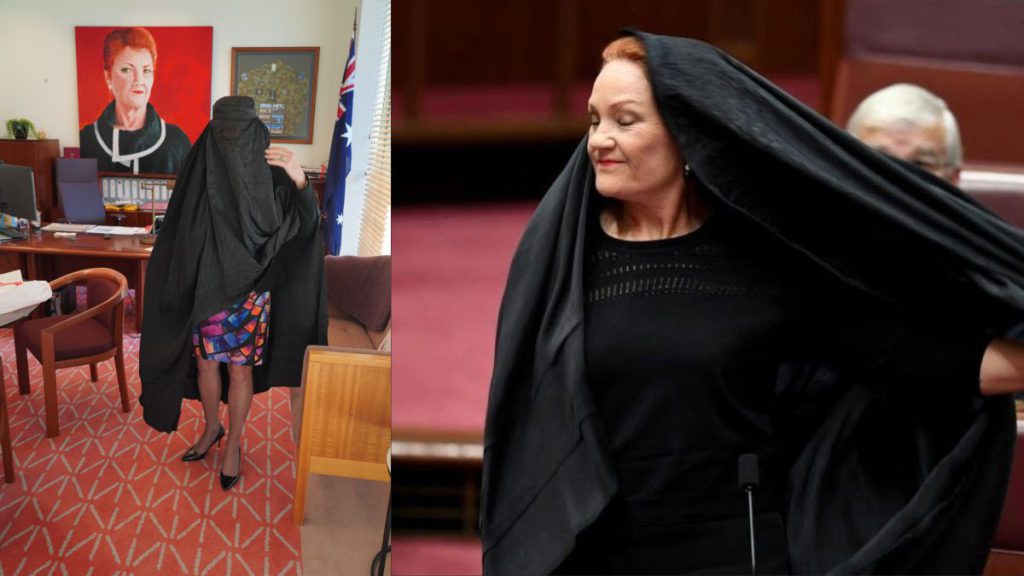
Against this backdrop, Australian debates about the burqa – most infamously Pauline Hanson’s repeated appearance in a full-face veil in the Senate – sit within a much longer global struggle over women’s bodies, state and religious symbolism.
What Islamic texts actually say about dress
The Qur’an contains only a handful of verses about women’s clothing, the most cited being 24:31 and 33:59. In these, believing women are instructed to draw their khimar (a head covering or shawl) over their chests, and to draw their jilbab (outer cloak) closer around themselves so they are recognised and not harassed.
Classical Arabic linguists and historians note that both garments already existed in pre-Islamic Arabia; the verses modified how they were worn (emphasising modesty and covering the bosom) rather than creating a new, specific style of dress. The text does not mention covering the face or eyes, nor does it describe a one-piece full-body covering like the modern burqa.
Over centuries, Islamic legal schools produced different opinions on how far this modesty should go. Many jurists held that showing the face and hands was permissible, while some – especially in more conservative contexts – argued that the entire body, including the face, should be covered. But even these stricter views describe a principle (maximum covering), not a particular garment.
This is why Muslim women’s dress varies so widely: from a simple scarf and loose clothing, to the abaya, to the niqab, to the Afghan chadari (often called burqa), and to no head covering at all. For most scholars, the burqa is not “Islamic” in the sense of being mandated by scripture; it is a regional way of interpreting modesty.
Pre-Islamic roots and elite culture
The idea of veiling and secluding women predates Islam by centuries. Research by historian Leila Ahmed and others shows that strict seclusion and full veiling were common among upper-class women in ancient Assyria, and later in Greek, Byzantine and Sasanian (pre-Islamic Persian) societies.
These practices marked status: elite women were veiled and kept out of public view, and enslaved and lower-class women often were not. When the early Muslim empires expanded, they encountered and absorbed many of these customs. By the Abbasid era (8th–9th centuries), urban upper-class Muslim families in places like Baghdad adopted similar seclusion and veiling norms. Over time, those elite habits spread more widely and took on religious language.
In other words, the idea that “good” women stay out of sight and heavily veiled is more rooted in ancient class hierarchies than in early Islamic teaching.
Muslim scholars and feminists have increasingly highlighted this distinction, arguing that what is often presented as timeless “religious law” is, in fact, a historical blend of scripture, culture and male-dominated power structures.
How the burqa entered the mainstream
The garment most people outside the Muslim world call “the burqa” is actually several different local styles.
- Afghanistan’s chadari (or chadari/burqa) – a loose, tent-like cloak with a mesh screen over the eyes – became widespread in many Pashtun areas over the 19th and 20th centuries. It was associated with honour, family respectability and female seclusion in conservative communities, not with a specific Qur’anic requirement.
- The niqab – a face veil worn with a separate headscarf and cloak – developed in parts of the Arabian Peninsula and spread with Gulf religious and cultural influence in the late 20th century.
- In the Indian Subcontinent (South Asia), forms of purdah (seclusion and veiling), including heavy shawls or veils over the face, long predate modern Islamist movements and draw on local customs as much as religious interpretation.
In each case, the full-face veil became more common in particular political moments – for example, under the Taliban in Afghanistan, who made the chadari compulsory in the late 1990s, and again after their return to power in 2021.
These rules are imposed by male-led regimes, not grounded in a new revelation. Human rights organisations routinely describe them as tools of gender control, not simply religious observance.
Women pushing back: unveiling, re-veiling and the fight over choice
From the early 20th century, women across the Middle East and South Asia began openly challenging enforced veiling and seclusion.
- In Egypt, feminist pioneer Huda Shaarawi famously removed her face veil in public at Cairo railway station in 1923, a symbolic act that helped launch a broader movement for education, suffrage and public participation.
- In Turkey, Mustafa Kemal Atatürk’s secular reforms discouraged face veiling and banned it in some public institutions, linking women’s visibility to national modernisation.
- In Iran, Reza Shah Pahlavi went further, issuing a 1936 decree that forced women to unveil – an authoritarian mirror image of later compulsory veiling. After the 1979 Islamic Revolution, mandatory hijab laws were introduced, with women facing fines, job loss or detention if they refused. Feminist scholars such as Valentine Moghadam argue that both extremes – forced unveiling and forced veiling – use women’s bodies as symbols of the state’s ideology.
- The recent “Women, Life, Freedom” protests in Iran, sparked by the death of Mahsa Amini in 2022 after her arrest by morality police, show how compulsory veiling has become a focal point of resistance to broader authoritarian control.
Across these contexts, many Muslim women insist the problem is not the veil itself but compulsion. Some choose hijab or even niqab as expressions of faith or identity; others see them as symbols of patriarchal control. Women’s movements in Muslim-majority societies have therefore focused less on banning specific garments and more on securing the right to decide – to veil or not – without state or family coercion.
The burqa in Australia: a small minority, a big political symbol
In Australia, only a tiny proportion of Muslim women wear the niqab or Afghan-style burqa; most wear a head covering or hijab. Surveys consistently suggest that full-face veiling is scattered even within Muslim communities here, but increasing in numbers.
Now the garment has taken on outsized political meaning. One Nation leader Pauline Hanson entered the Senate chamber wearing a black burqa, then removed it to demand a national ban on the full-face veil in public places. It was a repeat stunt of hers, in August 2017; Pauline did the same act.
This time, Attorney-General George Brandis delivered an unusually forceful rebuke on the floor of the Senate, telling Hanson her stunt risked “offending the religious sensibilities of other Australians” and warning it could undermine cooperation with Muslim communities crucial to counter-terrorism efforts.
Security agencies and legal experts have repeatedly advised against a blanket ban, arguing existing laws already allow for face coverings to be removed for identification or security when necessary. Muslim organisations and civil liberties groups condemned Hanson’s action as inflammatory, saying it targeted a tiny minority of women and turned a complex issue of faith, culture and personal choice into a crude political prop.
For many Muslim women in Australia who do cover their faces, the burqa or niqab is a personal religious interpretation. However, there have been reports of often adopting it because a man has ordered it, and some also describe intense family or community pressure to dress a certain way. Both experiences exist – and both are flattened when the debate is reduced to “for or against the burqa”.
Is the burqa “religious” or “cultural”?
Scholars are careful to distinguish between what Islam strictly requires and what Muslims in different times and places have practised:
- The core religious requirement, based on the Qur’an and early texts, is modest dress and behaviour, not a specific garment or face covering.
- The burqa and niqab are regional cultural forms that some Muslim communities have attached religious significance to, while others reject them as unnecessary or even harmful.
- Movements forcing women to wear (or remove) the veil are usually driven by state ideology or patriarchal norms, not by new religious revelation.
This is why many Muslim feminists say the real issue is power, not cloth. The same garment can be a symbol of faith for one woman, and of coercion for another, depending on who controls the choice.
Where does that leave Australia?
Australia’s public debate has often treated the burqa as a stand-in for Islam itself, despite its marginal place in both Islamic scripture and everyday Muslim life here. For researchers and many Muslim women, a more honest conversation would start from three basic realities:
- The burqa is not mandated by the Qur’an; it is a cultural form of covering that emerged over time.
- Women’s movements – including within Muslim communities – have long challenged male and state control over dress, whether that control enforces veiling or unveiling.
- Policies made in Canberra or state parliaments will affect real women, some of whom choose face veiling and some of whom feel pressured into it – and who are also navigating racism and sexism.
Seen through that lens, Pauline Hanson’s burqa stunt says less about Muslim theology than it does about Australian politics: a complex, historically layered piece of clothing turned into a blunt political symbol, while the nuanced voices of Muslim women themselves remain the least heard.
Support our Journalism
No-nonsense journalism. No paywalls. Whether you’re in Australia, the UK, Canada, the USA, or India, you can support The Australia Today by taking a paid subscription via Patreon or donating via PayPal — and help keep honest, fearless journalism alive.

