

By Om Prakash Dwivedi
What is Azadi – freedom? This is a question that looms large in an age marked by two profound and troubling issues that may annihilate the entire humanity – ongoing climate catastrophe and the unchecked villainy of artificial intelligence in our quotidian lives. Never in the history of human civilisation has one encountered this precarious condition where humanity and the planetary are in a constant battle against a handful of demagogues and oligarchs.
Let me state that Azadi may mean different things to different people, and I have absolutely no qualms about it, as long as such ideas do not quash others’ democratic spaces as found in the tukde tukde performatives.
But first things first. Azadi is not a fictional narrative, as it has now become commonplace. In fact, to equate freedom with fiction would account for a dangerous liaison. One only needs to read George Orwell’s Animal Farm, or for that matter, even a cursory glance around us will give us enough substance to see through the lurking threat of Azadi that is mostly served to us through the language of fictional narrative offered by the state-corporate duo. Azadi, after all, is not sloganeering.
Keeping this rhetoric aside, the point I am trying to make is that Azadi is something that only exists in practice. Of course, imagination remains central to its formulation. It is on the boiling pot of the imagination that we can also imagine our freedom and the freedom of others. It needs to be said with conviction that what cannot be imagined can never be created. No wonder, human history is replete with instances where imaginative people and spaces are always seen as sacrilegious bedfellows.
The cherry-picked fairy tales of development and globalisation offered under the guise of Azadi have a brutal face, which gets airbrushed as essential crusades for the sake of humanity. As the American Bar Association exposes this unchecked villainy of the US government, “The government separated more than 2000 children from their parents at the border during the period of mid-April to June” in 2018.
With another 11 million people set to be deported by the US to their places of origin, one could witness a virulent brand of xenophobia. The demonstration of such unabashed fascistic proclivities subtends the tyranny of the Azadi that is served to us. Hegel knew it better. He remarked,
“somewhere that all great world-historic facts and personages appear, so to speak, twice. He forgot to add: the first time as tragedy, the second time as farce.”
The thing about such farces is they have no national colour. They are globally available in different forms and manifestations. For example, there is a disproportionate sway over what we really mean when we dream of becoming a vishwaguru. For example, a report suggests that:
“As of 2025, Instagram Reels have become a central feature of the platform, engaging over 2 billion users monthly. India has become the largest market for Instagram Reels, with 385.35 million users, far outpacing the United States (166.15 million) and Brazil (135.05 million).”
With such a huge spike in the number of youths turning to gadgets and other digital tools in our educational institutions, the touch and smell of books, including the reading habits of many, are diminishing.
Apparently, reading is becoming a hackneyed idea. It needs to be reminded that when reading is lost, thinking spaces are also lost, and so do we lose our future. That one can think differently from the masses, and still come up with a better alternative to resolve the world’s problems, is a power rendered by the dialogical process of reading.
Reading also implies seeing and thinking between what is visible and invisible, to listen to those unheard or unsaid words that the virtual world controls and hides. How can we start that journey of vishwaguru in the wake of the eulogisation of such momentary pleasure that we get from wasting our time watching the reels?
Recently, I raised this issue with a shy, young intellectual – at least, that is how I imagine that nervous person, who otherwise has a knack for showing much promise, but still has to come to terms with how to tread the path of excellence – pointing out that Azadi and life are wedded.
My argument was this: that as humans, we have very limited time on our hands, and therefore, what makes it important is how we make use of whatever time we have been given in this life – a point that the addressee is still trying to grapple with. The infantile fantasy that one can get Azadi without engaging with the world and its absurdities has become a disturbing regularity of our screen-addicted youths, much in the way that the possibility of life on an alternative planet can save us all. Another farce indeed!
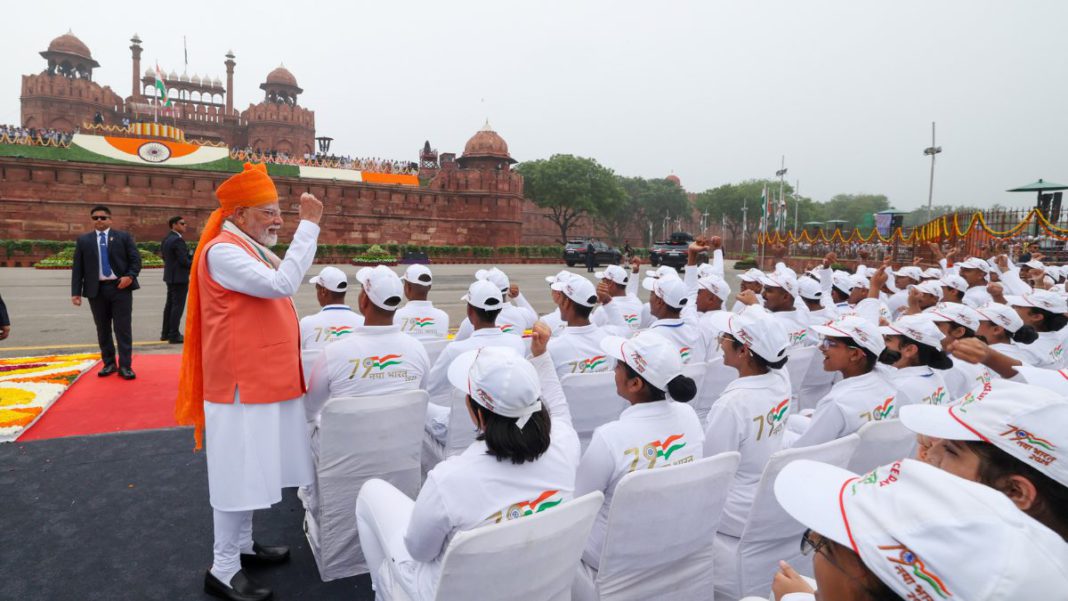
As we enter the 79th Independence Day, we must promote cultures of reading and more awareness about sustainable development. The idea of Azadi is very central to both. Azadi is not just to be reduced to national freedom or the freedom to butcher this planet while searching for life on another one. It is also the individual freedom that matters – that freedom which prioritises and protects the freedom of the other. Life is all about choices. The desire must match our actions. As Troilus pointed out to Cressida in Shakespeare’s Troilus and Cressida, arguing that desire may be limitless, but achievement is not:
“This is the monstrosity in love, lady, that the will is infinite, and the execution confin’d; that the desire is boundless, and the act a slave to limit.”
Support our Journalism
No-nonsense journalism. No paywalls. Whether you’re in Australia, the UK, Canada, the USA, or India, you can support The Australia Today by taking a paid subscription via Patreon or donating via PayPal — and help keep honest, fearless journalism alive.
