


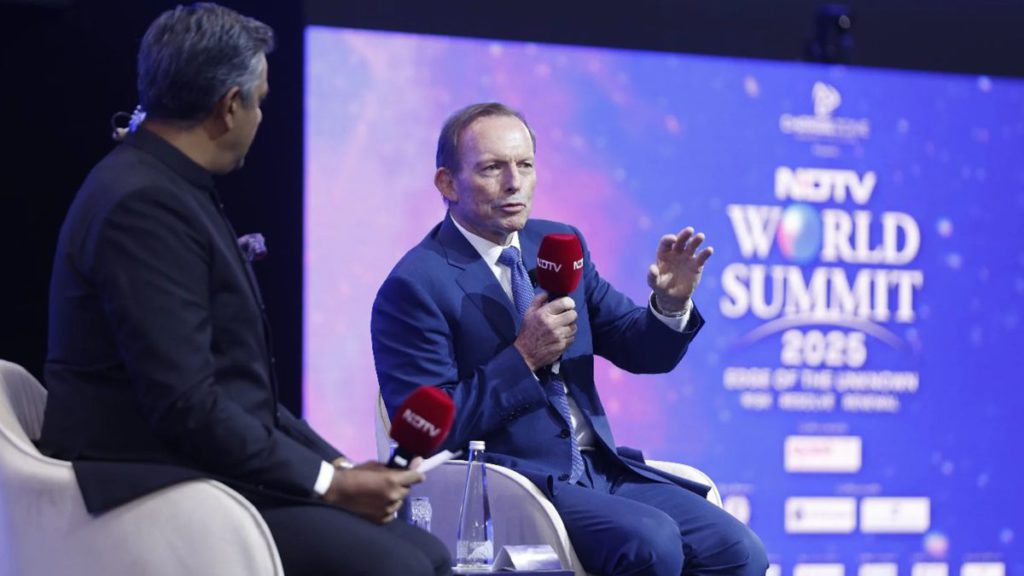
Former Prime Minister Tony Abbott has said the 21st century belongs to India, predicting that the country’s Prime Minister — whoever that might be four or five decades from now — could one day take over the mantle of “leader of the free world” from the President of the United States.
Speaking at the NDTV World Summit 2025, Abbott described India as a rising democratic superpower and urged New Delhi to embrace its role as a “democratic counterweight” to China in the Asia-Pacific region.
“The 21st century belongs to India just as it belongs to China,” Abbott said.
“India has three great advantages — democracy, the rule of law, and the English language. The Prime Minister of India, whoever that might be in four or five decades, could well be the leader of the free world.”
Abbott, who served as Prime Minister from 2013 to 2015, said India’s rapid economic growth, technological innovation, and infrastructure boom make it a credible alternative to China in global trade and manufacturing.
“You go to any Indian city — there is a massive infrastructure push, new airports, highways, metros. India is rising fast and can be a substitute to China in global supply chains.”
He pointed to India’s trade deals with Australia in 2022 and with the United Kingdom last month as clear indicators that “the democratic world is realigning itself and shifting away from dependency on China.”
Abbott warned that Beijing’s ambition to “dominate the world” poses a strategic challenge to every democracy. He argued that India, as a stable and powerful democracy, “holds the key to checking Beijing’s hegemonic designs.”
“China wants to be the hegemonic power — and this spells trouble for all of China’s neighbours, as well as the world.”
He pointed to Taiwan as the first potential flashpoint, urging democracies to remain vigilant and united.
“The best way to ensure nothing untoward happens is not to pretend that China has peaceful intentions but to be prepared. Weakness is provocative.”
Abbott also stressed that cooperation among democracies is critical to maintaining a rules-based world order. He suggested that the war in Ukraine might have been avoided had the country been a member of NATO and under the protection of Western military alliances.
“The Ukrainians have been absolutely heroic. If Ukraine was part of NATO, there would have been no Russian incursion.”
He urged India, Australia, and other democracies to deepen partnerships across trade, technology, and defence, arguing that shared values must underpin global alliances in the 21st century.
Abbott did not shy away from criticising past American policies, describing Washington’s Cold War strategy of supporting Pakistan as “one of its biggest mistakes.”
“America tilted towards Pakistan — a military dictatorship — instead of India, a liberal democracy,” he said.
“Pakistan even gave Osama bin Laden a home for the best part of a decade. India is completely different. I’m not saying the US shouldn’t work with Pakistan where possible, but it should know where its true friends are.”
He also took aim at sections of the Western press for their critical portrayal of Indian Prime Minister Narendra Modi, saying such narratives ignore India’s strong democratic institutions.
“Sometimes the Western liberal press compares PM Modi to a ‘subcontinental Trump’. But anyone who knows India understands it has a riotously free media, a robustly independent judiciary, and free and fair elections. That’s democracy in action.”
Abbott commented on the United States’ imposition of 25% tariffs on India for purchasing Russian oil, calling it a miscalculation by former President Donald Trump.
“I’m a supporter of Trump, but he misplayed his hand with India. He imposed punitive tariffs while letting others, like China, get away with far worse. That was a mistake.”
He argued that India’s pragmatic foreign policy — maintaining relations with both the West and Russia — reflects its growing maturity as a global power.
Abbott concluded his address by reaffirming the importance of the Australia–India relationship, especially in a world undergoing geopolitical realignment. “India is not just a partner for Australia — it is a friend with shared values and strategic interests,” he said.
“Together, our democracies can ensure peace, stability, and prosperity in the Indo-Pacific.”
His remarks come amid ongoing debate in Australia about immigration and multiculturalism. Recent March for Australia rallies in major cities have distributed flyers targeting Indian migrants — a trend many have criticised as divisive.
Abbott, however, struck an optimistic tone, noting that India’s growing influence on the global stage reflects the strength of its diaspora and the shared democratic ethos between the two nations. “India’s rise is not a threat,” he said.
“It is a promise — a promise that democracy, diversity, and hard work can indeed shape the world’s future.”
Support our Journalism
No-nonsense journalism. No paywalls. Whether you’re in Australia, the UK, Canada, the USA, or India, you can support The Australia Today by taking a paid subscription via Patreon or donating via PayPal — and help keep honest, fearless journalism alive.

