

By Mollyn Nakabea
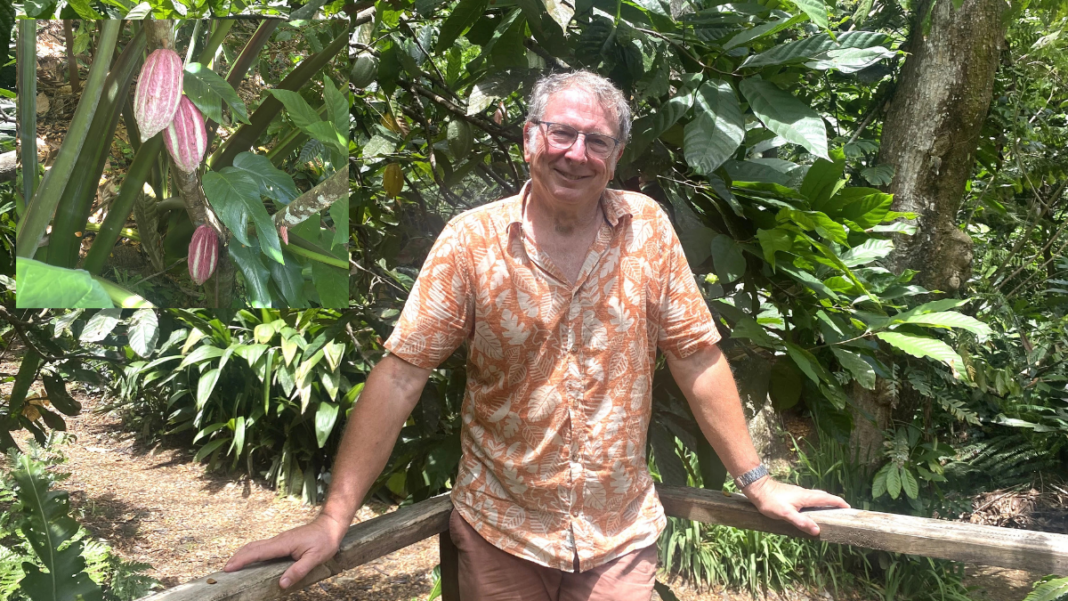
Tucked away in a rainforest just outside Savusavu, a small cocoa farm is quietly proving that Fiji can produce good-quality chocolate while protecting the environment and supporting local farmers.
KokoMana Chocolate Factory and Cocoa farm produces fine-flavour, pure Fijian chocolate using cocoa grown on its own farm and sourced from local suppliers.
The founders Richard Markham and Anne Moorhead established the farm in 2012 on what was once degraded land sparsely populated with old raintrees.
Mr Markham and Ms Moorhead have decades of experiences in sustainable development. With more than 40 years of experience in agricultural development and research, Mr Markham worked on several agricultural development projects in Suva.
Ms Moorhead is a writer and editor specialising in sustainable development in the Pacific Islands.
Mr Markham said his motivation for starting the farm was to apply lessons learnt from decades of work in a practical agri-business setting.
“My personal motivations for establishing this farm was to apply lessons from I learnt from my 40 years of working in agricultural development in Africa, Central America and the Pacific, and make them work in the private sector, without government subsidies,” Mr Markham said.
“The farm has steadily restored soil fertility through agro-forestry despite ongoing challenges from pests, diseases, and repeated natural disasters.”
The farm consisting of a six-member team, operates in all-natural controlled environment. It is home to 400 cocoa trees across 16 varieties, alongside 80 to 90 forest plant species including yaqona, Vesi trees (Moluccan Ironwood) and turmeric, that support biodiversity.
According to Mr Markham, a cocoa tree takes two to three years of consistent care before it begins to flower, and another six months before the pods are ready to harvest.
Since planting its cocoa forest, the KokoMana has been hit by four tropical cyclones.
Following Tropical Cyclone Yasa and Tropical Cyclone Ana during the COVID-19 pandemic, the farm had no cocoa to harvest for almost a year and had to rely entirely on external suppliers.
Staying true to their philosophy of working with nature, the farm avoids using pesticides and chemical treatments.
Instead, they rely on vegetable waste and their three environmentally friendly cats for rat control.
Mr Markham said the cats reduce the damage down to 10 per cent, which by the standards of organic agriculture is not bad.
While KokoMana supplies chocolate to local supermarkets and hotels, Mr Markham says the work highlights the potential of cocoa farming in Fiji and the support it needs.
Despite KokoMana’s environmentally friendly approach to cocoa farming, Mr Markham says the challenges faced within the farm mirror the issues of Fiji’s cocoa sector.
One major reason, he said, is that farmers were given seedlings but no long-term support.
“People think Cocoa is a low maintenance crop, and they confuse low maintenance with zero maintenance,” Mr Markham said.
“It’s not a high maintenance crop, but for four or five hundred trees, you need to at least put in a family for half a day’s work each week, maybe two to four hours each week to do maintenance. If you don’t do that, you will harvest nothing because the cocoa will get overrun by what we call black pod disease.”
Another gap present is the lack of processing facilities, leaving farmers to struggle with producing good-quality cocoa beans.
“You need a minimum of 300 pods to be ripe at the same time to get a vigorous fermentation which will then have to be dried by the sun,” he explained.
“Without that, you won’t get the flavor, and if the beans are dried using copra dryer, they end up tasting like campfire.”
To address this, KokoMana buys ripe cocoa pods directly from out growers. Mr Markham said while the approach is costly, it ensures quality.
“Even if it’s not profitable, we do it anyway because we want to build this industry. It’s sort of an economic model, trying to show that if you do it right, you can have a business that’s environmentally friendly, socially responsible and have a fair trade.”
KokoMana is committed to showing how cocoa farming can be sustainable. With real investment, this model could help revive Fiji’s cocoa industry.
This article was first published on Wansolwara News and has been republished with permission.
Support our Journalism
No-nonsense journalism. No paywalls. Whether you’re in Australia, the UK, Canada, the USA, or India, you can support The Australia Today by taking a paid subscription via Patreon or donating via PayPal — and help keep honest, fearless journalism alive.
