

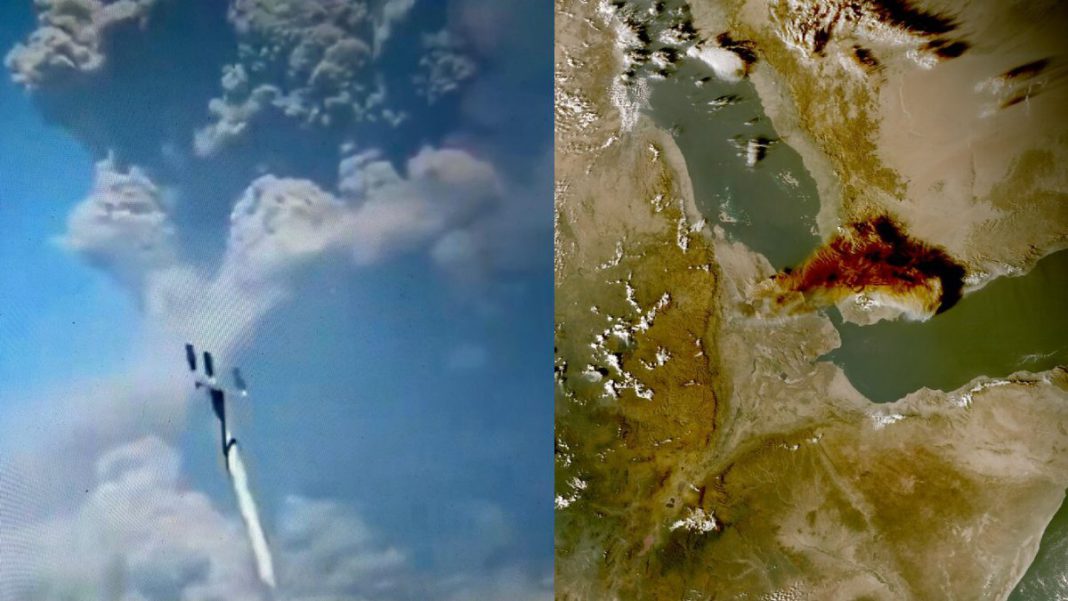
Ethiopia’s Hayli Gubbi volcano erupted on 23 November 2025, its first confirmed activity in roughly 10,000 years. The volcano sits in the Danakil Depression in the Afar region, an area with no documented eruptions in the modern era.
Satellite instruments picked up the start of the eruption at about 08:30 UTC, showing an ash column rising to around 13–15 kilometres. Following these observations, the Toulouse Volcanic Ash Advisory Centre issued alerts to aviation authorities in multiple regions.
As the plume travelled eastward across the Red Sea into the airspace above Yemen and Oman, upper-level winds carried ash into flight paths used by airlines linking East Africa with the Middle East, Europe, and India. Carriers in the Gulf reported cancellations on routes to destinations including Jeddah, Kuwait, and Abu Dhabi. European services were also disrupted; KLM cancelled its Amsterdam–Delhi flight due to ash contamination risks along the route.
In India, aviation regulators released advisories after forecasting models indicated that high-altitude ash could affect long-haul corridors connecting Indian cities with Middle Eastern and European hubs. Some flights into and out of India faced delays or precautionary route changes.Ash at cruising altitude can damage aircraft engines and interfere with onboard systems, prompting authorities across several regions to take preventive measures. In Ethiopia, communities near the volcano, including areas close to Afdera, reported ashfall.
Although the population in this zone is limited, officials cautioned that grazing land, livestock, and water sources could be affected. Satellite data also showed elevated sulfur dioxide emissions spreading along the plume’s path, raising potential short-term air quality concerns. While the most intense phase of the eruption diminished later in the day, monitoring agencies continued to follow the movement of ash and volcanic gases.
Support our Journalism
No-nonsense journalism. No paywalls. Whether you’re in Australia, the UK, Canada, the USA, or India, you can support The Australia Today by taking a paid subscription via Patreon or donating via PayPal — and help keep honest, fearless journalism alive.
