

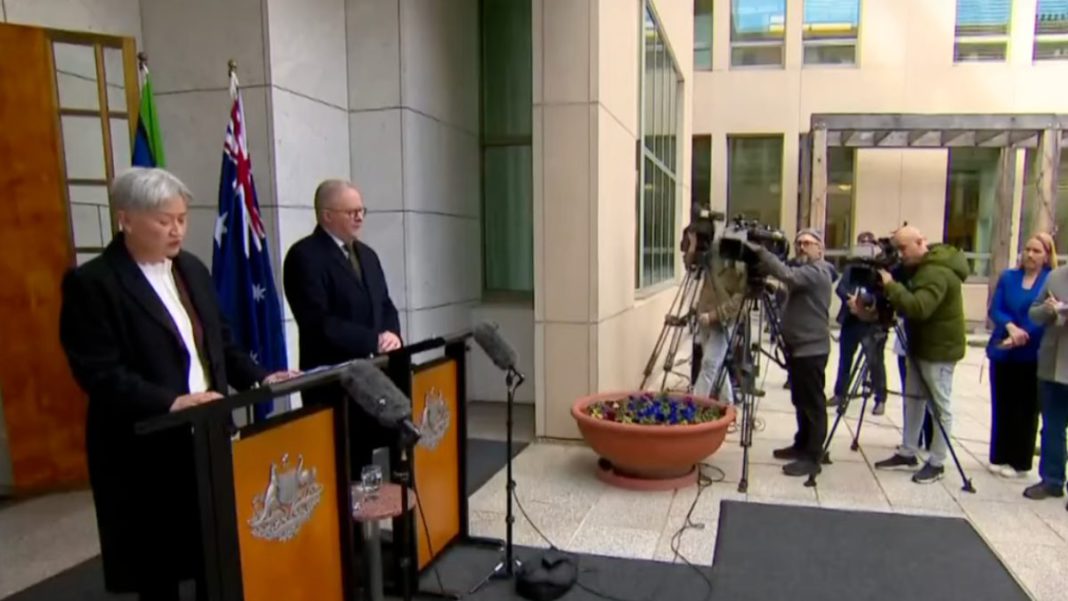
Australia will formally recognise the State of Palestine at next month’s United Nations General Assembly, Prime Minister Anthony Albanese has announced — describing the move as a historic push to “break the cycle of violence” and insisting Hamas can have no role in future governance.
“Today I can confirm that at the 80th session of the United Nations General Assembly in September, Australia will recognise the state of Palestine,” PM Albanese said.

“A two-state solution is humanity’s best hope to bring an end to the conflict, suffering and starvation in Gaza.”
Foreign Minister Penny Wong framed the timing as an effort to add momentum towards two states, saying September is “the time” to act.
The government’s position is grounded in commitments it says it has received from the Palestinian Authority and broader regional diplomacy aimed at isolating Hamas.
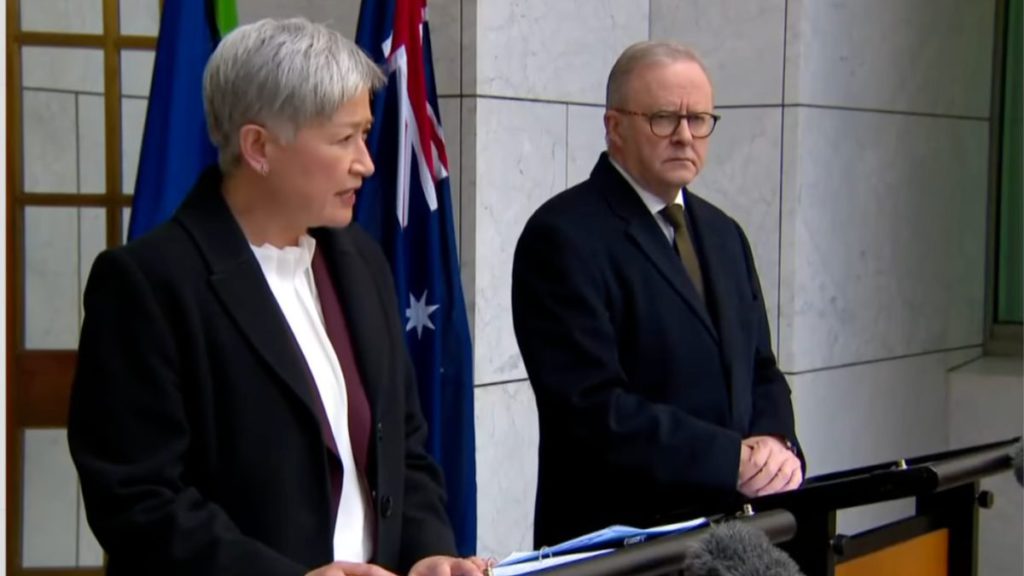
Those commitments — welcomed in a recent cross-country statement — include disarming Hamas, ending prisoner payments, reforming education/governance and holding elections within a year. Mr Albanese has also spoken recently with Palestinian Authority President Mahmoud Abbas.
Regional partners have amplified that pressure. In an unprecedented move, Arab states including Qatar, Saudi Arabia and Egypt urged Hamas to relinquish control of Gaza and disarm — a step Australia says strengthens the case for recognition that elevates moderates and further isolates extremists.
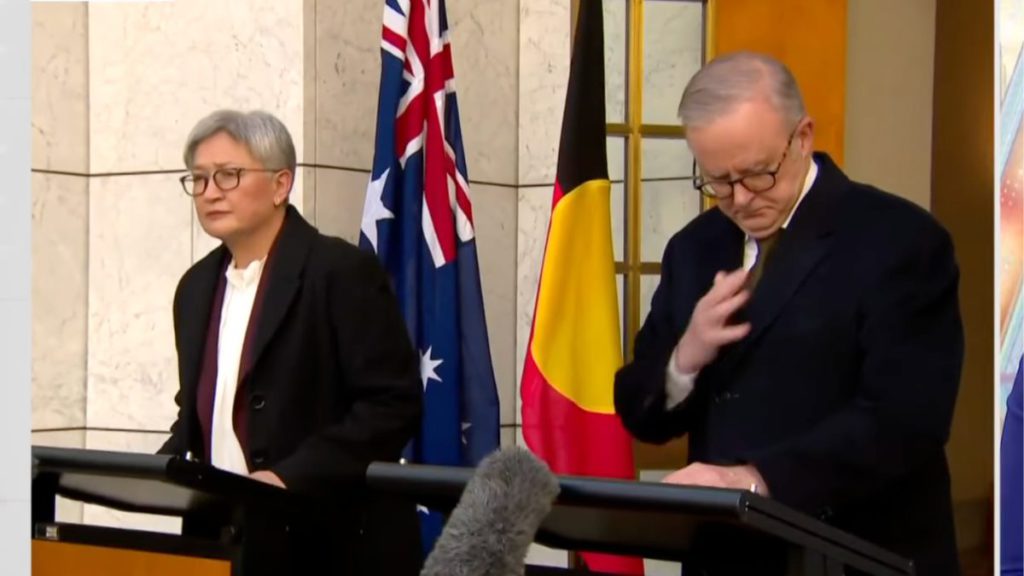
The Coalition has criticised the government’s move to recognise a Palestinian state, warning it breaks with bipartisan policy and risks undermining peace efforts.
In a joint statement, opposition leaders said the decision “puts Australia at odds with the United States … the most consequential player in the conflict in Gaza” and ignores US advice that premature recognition has disrupted ceasefire talks.
“Until today, it was a bipartisan position that there should be no recognition of a Palestinian state with Hamas still in control of Gaza,”
the statement said.
“Recognising a Palestinian state prior to a return of the hostages and defeat of Hamas … risks delivering Hamas one of its strategic objectives of the horrific terrorism of October 7.”
The Coalition argued the move “does not appear to make the world a safer place, expedite the end of the conflict, deliver a two-state solution, see the free flow of aid, support the release of hostages or put an end to the terrorist group Hamas.”
Australia’s shift follows similar signals from key allies: the United Kingdom says it will recognise Palestine at the UN in September unless Israel takes meaningful steps toward a two-state process; France has said it will move in September; and Canada has announced its intent to do likewise, conditional on Palestinian reforms.
Israel condemned the Australian decision. In a statement, Israel’s ambassador in Canberra said recognition “undermines Israel’s security,” while Prime Minister Benjamin Netanyahu has castigated such moves by Western governments. Mr Albanese, who confirmed he spoke with Mr Netanyahu last week, maintains recognition can be done in a way that isolates and disarms Hamas.
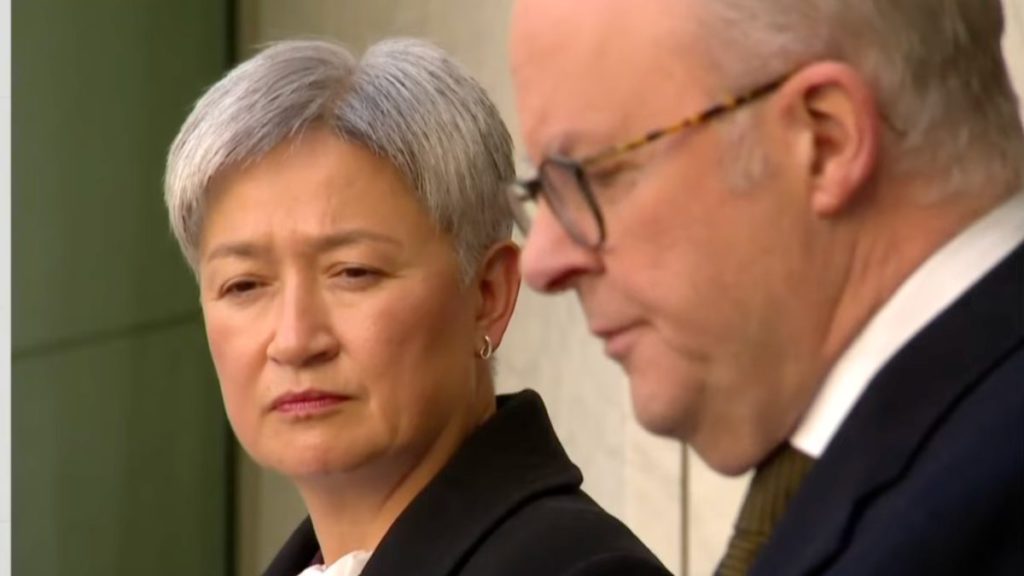
The United States remains opposed. President Donald Trump and senior officials have argued that recognising Palestinian statehood would “reward Hamas.” The Albanese government says it briefed Washington but will act in Australia’s sovereign interest.
Domestically, the announcement has drawn strong criticism from peak Jewish organisations.
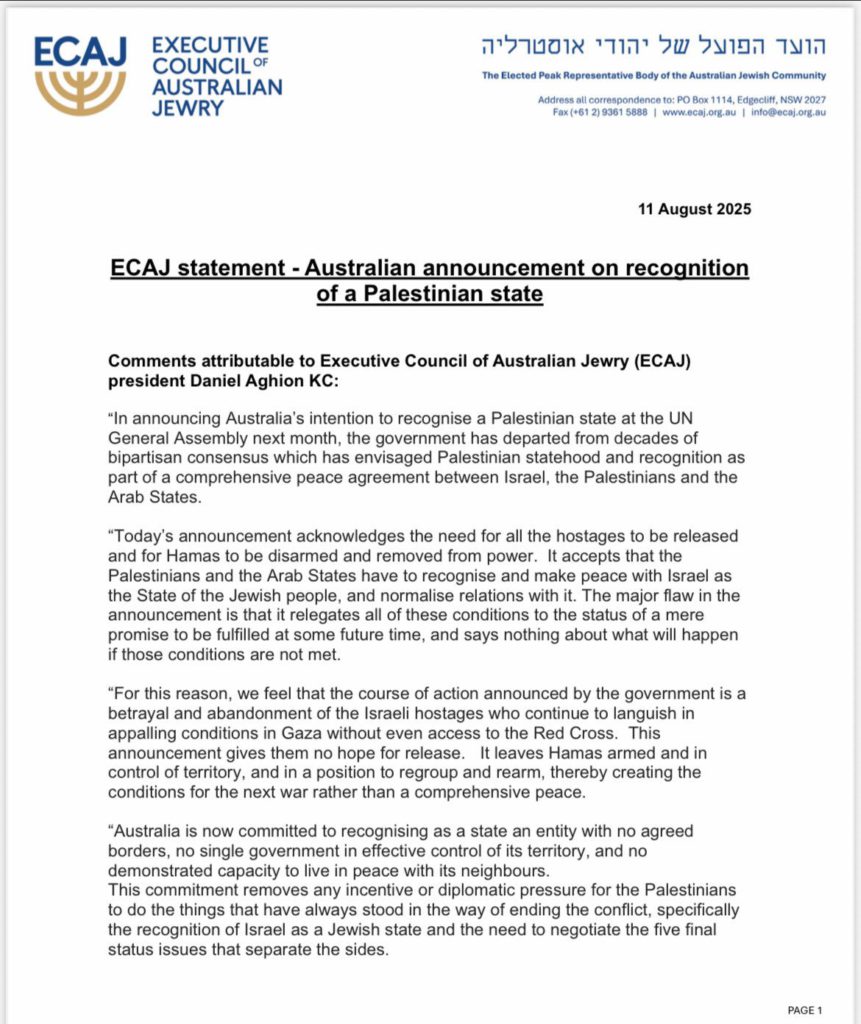
The Executive Council of Australian Jewry (ECAJ) said in a statement that the Albanese government had broken decades of bipartisan policy that tied recognition to a comprehensive peace agreement involving Israel, the Palestinians and Arab states.
ECAJ acknowledged the government’s condition that hostages be released and Hamas be removed from power, but argued these had been relegated to “mere promises” with no enforcement. The group warned that recognising Palestine under current conditions would leave Hamas armed, enable it to regroup, and “create the conditions for the next war rather than a comprehensive peace.”
It further claimed the move “removes any incentive or diplomatic pressure for the Palestinians” to recognise Israel as a Jewish state or negotiate final status issues, leaving Israel “wronged and abandoned by a longstanding ally.”
The Australian Jewish Association (AJA) in a statement on X accused Labor government of “rewarding the Hamas atrocities of October 7” and calling the move “a reckless attack on the Jewish people in Australia and abroad.”
“This is more than a betrayal of a friend,”
AJA CEO Robert Gregory said.
“The decision will do nothing to advance peace in the Middle East since the Albanese Government has no influence there. It is Australian Jews who bear the brunt of Labor’s actions, which have contributed to the firebombing of synagogues and attacks on Jews. Increasing numbers are discussing plans to leave.”
Gregory warned that recognising an entity linked to a proscribed terrorist group undermined national security and risked Australian lives, claiming it,
“signals weakness to those who seek our harm” and “puts Australia at odds with our closest ally, the United States.”
“There has never been a State of Palestine, and there never will be. If Anthony Albanese wants to create a ‘Palestine,’ he can do it in his own backyard, not on Israel’s land,” he said, urging Israel to respond by asserting sovereignty over Judea and Samaria.
The Zionist Federation of Australia has condemned the government’s plan to recognise a Palestinian state at the UN next month, warning it would “undermine peace efforts and reward terrorism” while Hamas remains in power and the Palestinian Authority has yet to deliver verified reforms.
ZFA President Jeremy Leibler said the government was relying on “non-binding commitments from the Palestinian Authority, which lacks the capacity to implement them,” and argued that,
“advancing recognition without demonstrable change will embolden Hamas and weaken efforts to build accountable institutions.”
He said recognition should be tied to “clear, independently verified benchmarks,” including Hamas’s removal and disarmament, the release of hostages, sustained humanitarian access, deep reforms to the Palestinian Authority, and recognition of Israel as a Jewish and democratic state.
The Coalition also voiced “serious concerns,” arguing the decision risks putting Australia at odds with the U.S.
Former Prime Minister Tony Abbott condemned the government’s decision, saying recognition should only follow positive actions from the Palestinians.
“Recognition of Palestine should be a reward for good behaviour, not bad,” he said.
“Recognising Palestine with Hamas still armed, still holding hostages, still largely running Gaza and withholding aid, and still pledged to the destruction of Israel is unconscionable … handing a propaganda victory to terrorism is just wrong.”
Despite the backlash, Albanese insists the recognition is a “practical contribution towards building momentum” for peace, promising Australia will work with partners on a credible plan for Palestinian governance and Israel’s security.
Meanwhile, in response to Australia’s announcement, New Zealand is weighing recognition of a Palestinian state, with a formal decision due in September, Foreign Minister Winston Peters says.
“New Zealand has been clear for some time that our recognition of a Palestinian state is a matter of when, not if,” he said, adding the Government would “weigh up whether sufficient progress is being made … to warrant New Zealand recognising a Palestinian state at this juncture.”
Peters said the issue would be approached “calmly, cautiously and judiciously,” noting Arab states have insisted Hamas must disarm and have no role in Palestinian governance. He will take the Government’s position to the UN Leaders’ Week in late September.
Almost 150 UN member states already recognise Palestine; Australia will join a widening group of Western nations planning to do so in September.
With recognition slated at the UN next month, the government says attention will turn to a credible plan for Palestinian governance and Israel’s security — including enforcing PA commitments, advancing humanitarian relief and backing efforts that keep Hamas out of Gaza’s future.
Support our Journalism
No-nonsense journalism. No paywalls. Whether you’re in Australia, the UK, Canada, the USA, or India, you can support The Australia Today by taking a paid subscription via Patreon or donating via PayPal — and help keep honest, fearless journalism alive.
