

Australia’s Social Media Minimum Age laws are expanding to include Reddit and Kick, bringing the total number of restricted platforms to nine as the country moves to protect children from the harmful effects of social media.
Prime Minister Anthony Albanese said the legislation reflects the community’s demand for stronger protection of young Australians online.
“This isn’t a debate that’s come from government down – it’s come from parents and families, some who have tragically lost their children, demanding that social media companies show social responsibility,” Albanese said in an interview with ABC News.
From 10 December 2025, Facebook, Instagram, Snapchat, TikTok, YouTube, X (formerly Twitter), Threads, Reddit, and Kick will be required to take reasonable steps to prevent children under 16 from creating or maintaining accounts. Failure to comply could result in fines of up to $49.5 million under the Albanese Government’s world-leading legislation.
The assessment by the eSafety Commissioner determined that these platforms meet the criteria of having the “sole or significant purpose of enabling online social interaction”, making them subject to the new age restrictions.
Minister for Communications and Sport Anika Wells said the government is determined to curb the growing influence of social media on children’s wellbeing.
“There’s a time and place for social media in Australia, but there’s not a place for predatory algorithms, harmful content and toxic popularity meters manipulating Australian children,” Wells said.
“Online platforms can target children with chilling control. We are mandating that they use that same sophisticated technology to protect them.”
Wells said she had met with major tech companies in recent weeks to ensure they understood the new rules and the serious consequences of failing to implement them.
“I have made it clear to the platforms that there is no excuse for failure in implementing this law. We aren’t chasing perfection, we are chasing a meaningful difference,” she said.
She encouraged Australians to engage with the eSafety resources now available online, including webinars, checklists, conversation starters and how-to guides to help parents and carers understand the new laws and their purpose.
eSafety Commissioner Julie Inman Grant said the restrictions would give young Australians valuable time to grow and learn away from the pressures of algorithms and endless scrolling.
“Delaying children’s access to social media accounts gives them valuable time to learn and grow, free of the powerful, unseen forces of opaque algorithms and endless scroll,” she said.
“I strongly encourage parents, educators and young people to visit eSafety.gov.au, download our resources and register for a live webinar where we will explain the social media age restrictions and answer questions in sessions tailored for parents, carers and educators.”
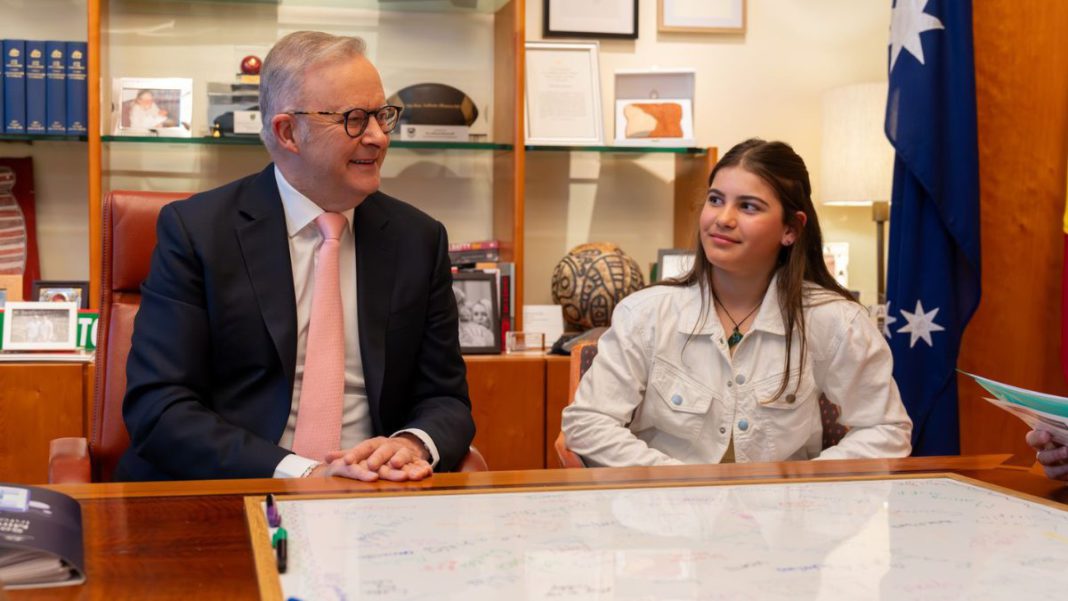
The Prime Minister also praised young Australians like Flossie, a Year 6 student who presented a school project on the new age laws and their importance. As part of her research, Flossie interviewed neuroscientist Dr Lila Landowski and child psychologist Cassie Xintavalonis to explore how social media affects young brains.
For her exhibition, Flossie created a pledge for classmates under 16 to sign, promising not to use social media until they are old enough. She later presented her project to the Prime Minister and Minister Wells.
“I decided to choose this topic because I’ve always been super interested in how the brain works, and I’ve never been allowed social media. I wanted to see if the science actually backed up my parents’ reasoning,” Flossie said.
“And they were right – social media has lots of impacts that I wouldn’t want to be exposed to yet.”
When asked about her peers potentially finding ways around the ban, Flossie said it would be difficult and not worth it. “I think they are probably going to try find a way around it, but I don’t think it’s going to be that easy. I think they should be educated on the impacts social media actually has on them.”
Albanese said young advocates like Flossie show why the reforms matter. “People like her give me not just confidence but pride as Prime Minister. The world is watching what we’re doing here,” he said.
“We know it won’t be perfect from day one, but this is about setting clear expectations and giving young people a healthier, safer start in the digital world.”
As the December deadline approaches, the government expects platforms to comply fully with the law. The eSafety Commissioner will oversee enforcement and may issue penalties for non-compliance.
Support our Journalism
No-nonsense journalism. No paywalls. Whether you’re in Australia, the UK, Canada, the USA, or India, you can support The Australia Today by taking a paid subscription via Patreon or donating via PayPal — and help keep honest, fearless journalism alive.
