

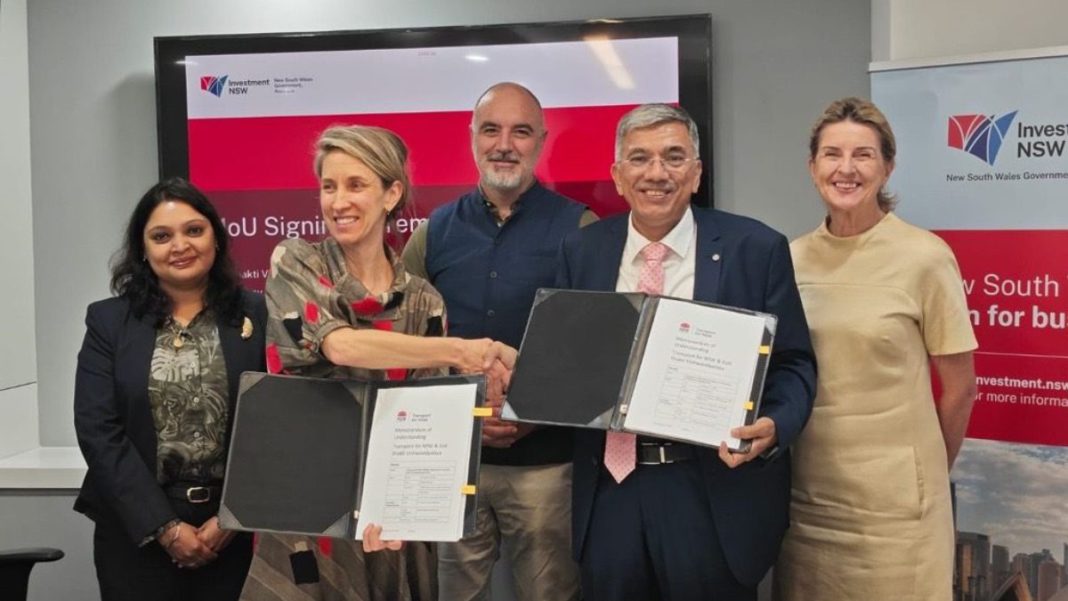
Sydney Coordinated Adaptive Traffic System (SCATS) has signed a Memorandum of Understanding (MoU) with Gati Shakti Vishwavidyalaya (GSV), India’s first university dedicated to transport and logistics.
Facilitated by Austrade in partnership with Investment NSW, the agreement marks a significant step in connecting Australian innovation with India’s rapidly growing smart mobility sector.
The initiative will begin with a pilot deployment in Vadodara (Baroda), showcasing the strength of the NSW–Gujarat sister-state relationship.
SCATS, developed by Transport for NSW and currently deployed at 65,000 intersections across 200 cities in 32 countries—including several in India—will work with GSV to localise and adapt its globally recognised adaptive traffic management software for India’s complex traffic conditions.

“There is a real opportunity for further collaboration,” said Adele Beachley, Transport for NSW Executive Director, SCATS.
“Through this partnership, we will explore how we can tailor the SCATS solution to India’s dynamic traffic conditions.”
Beachley described the collaboration with GSV as a “powerful partnership for progressing into the future”, combining the university’s deep expertise in India’s domestic traffic landscape with SCATS’ proven software capabilities.
Under the MoU, a pilot system will be implemented across at least five intersections in Vadodara, with hardware sourced wherever possible through India’s ‘Make in India’ programme.
SCATS will provide operational software during the MoU period, while GSV students will gain access to SCATS training through the SCATSlearn e-learning portal and jointly developed training modules.
“Our online eLearning portal, SCATSlearn, will be leveraged to benefit students, researchers, and academics so they can hit the ground running with a thorough understanding of the software and how it can be customised to best meet local needs,” Beachley said.
The collaboration also includes strategic engagement and market development to support SCATS’ long-term deployment in India. For NSW, the agreement will help refine the software to ensure suitability for large-scale rollout across one of the world’s most complex traffic environments.
Prof. Manoj Choudhary, Vice-Chancellor of GSV, said the MoU represents a crucial step toward improving traffic management across India’s congested cities.
“Our ultimate goal is to improve traffic management within our cities, and this is a starting point for that.”
He noted that India’s highly heterogeneous traffic—ranging from two-wheelers and trucks to cattle—demands adaptive, technology-driven solutions. Intelligent traffic systems would allow signals to adjust in real time, optimising red and green times based on variable traffic flows.
“This is what we will work on in this MoU—collecting data, analysing data and refining algorithms using AI, ML or other emerging models to develop a configurable, adaptive traffic management system that is intelligent enough for the country,” Prof. Choudhary said.
The Vice-Chancellor stressed that the objective is not merely experimental.
“Our big goal is to evolve the SCATS software together so that it can be deployed at mass scale, potentially translated into local languages and adapted to India’s unique conditions through a co-development model.”
SCATS is already being trialled at 20 junctions each in Sarangpur, Uttar Pradesh, and in Jamnagar, Gujarat.
For the Vadodara pilot, five intersections have been identified, with the ambition to eventually scale the technology nationwide.
“We want this pilot to be so successful that this technology can be deployed at every intersection and junction in the country,” Prof Choudhary said.
Support our Journalism
No-nonsense journalism. No paywalls. Whether you’re in Australia, the UK, Canada, the USA, or India, you can support The Australia Today by taking a paid subscription via Patreon or donating via PayPal — and help keep honest, fearless journalism alive.
