

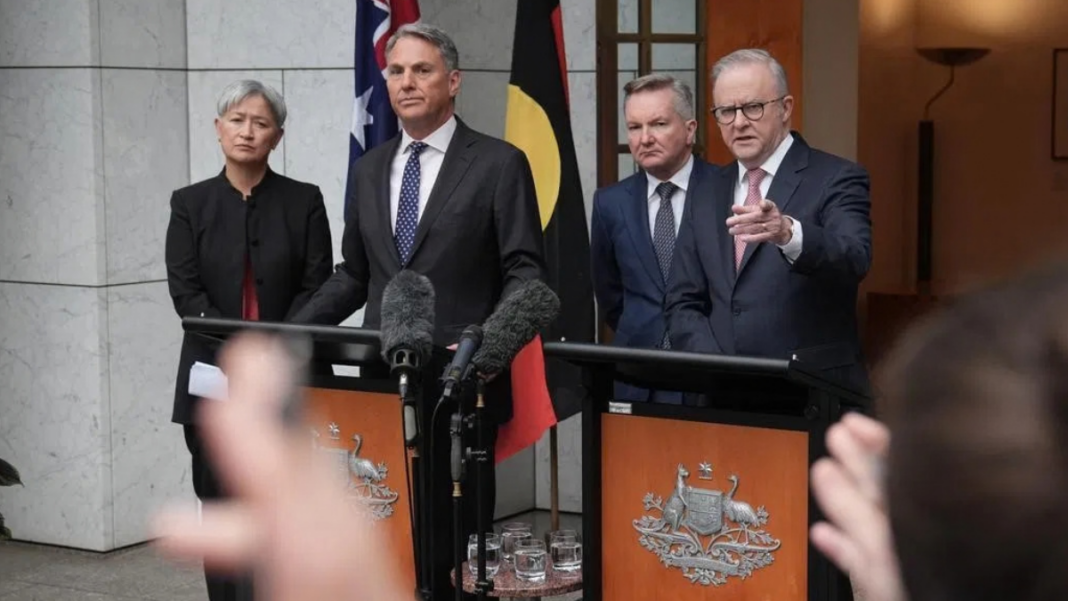
Australia will deploy military assets to the Middle East to support Gulf nations following a series of Iranian missile and drone attacks across the region, Prime Minister Anthony Albanese has confirmed.
The federal government announced that an E-7A Wedgetail surveillance aircraft and about 85 Australian Defence Force personnel will be sent to the United Arab Emirates, where they will assist in protecting regional airspace and defending allied nations.
The aircraft and personnel are expected to be operational by the end of the week for an initial four-week deployment focused on what the government described as the “collective self-defence of Gulf nations.”
Albanese: protecting Australians is the priority
Prime Minister Albanese said the deployment was primarily aimed at protecting Australians living in the region while supporting Gulf partners facing escalating attacks.
“The first priority of my government is and always will be to keep Australians safe,” Albanese said.
“There are around 115,000 Australians in the Middle East, including approximately 24,000 in the United Arab Emirates.
“Helping Australians means helping the UAE and other nations defend themselves.
“We are not protagonists. What we are doing is providing for the defence of the UAE and of Australian citizens.”
The government also confirmed that medium-range air-to-air missiles will be provided to the UAE to strengthen defensive capabilities.
Defence minister stresses mission is defensive
Defence Minister Richard Marles emphasised that Australia’s involvement would be limited strictly to defensive operations and surveillance support.
“What this aircraft will be doing is very similar to what it has been doing in recent times in Poland in respect to the defence of Ukraine,” Marles said.
“These are defensive weapons — I want to make that clear.
“The announcements that we are making today are all about the defence of Gulf countries.”
He said the deployment was designed to help monitor airspace and provide early warning capabilities rather than participate in combat operations.
“It is for the defence of the countries of the Gulf, particularly the UAE, where there are significant numbers of Australians living.”
Foreign minister warns Australians to leave region
Foreign Minister Penny Wong said the security situation in the Middle East had deteriorated rapidly and warned Australians in the region to leave while commercial travel remained possible.
“Iran’s attacks on neighbouring countries have escalated overnight,” Wong said.
She urged Australians who wished to return home to act immediately.
“Do so now. Do so while commercial flights are still available, however limited.”
More than 27,000 flights across the Middle East have been cancelled since the conflict escalated on February 28, severely restricting travel options.
Wong said the government was monitoring the situation closely and working with international partners as the crisis unfolds.
Energy security also under scrutiny
Energy Minister Chris Bowen said the government was closely watching the impact of the conflict on global energy markets, noting that instability in the Gulf could disrupt oil supply chains.
Bowen said officials were monitoring international fuel prices and supply routes to ensure Australia’s energy security remained stable amid rising geopolitical tensions.
Escalating regional conflict
The deployment comes after a major escalation in the Middle East conflict.
The crisis intensified following missile strikes by the United States and Israel on Iran on February 28, which targeted nuclear and military facilities. Iran responded with retaliatory attacks across the region.
Iranian missile and drone strikes have since hit multiple countries, including the United Arab Emirates, Saudi Arabia, Bahrain, Kuwait and Qatar, with several incidents targeting civilian infrastructure such as airports.
Wedgetail capability
The E-7A Wedgetail is one of Australia’s most advanced airborne surveillance platforms, designed to monitor large areas of airspace and coordinate defensive responses.
The aircraft was previously deployed to Europe in support of Ukraine’s defence, flying dozens of operational missions over several months.
Officials say its deployment to the Gulf will enhance regional airspace awareness and help coordinate defensive responses against missile and drone threats.
Political response
While the opposition has not formally endorsed the deployment, senior Coalition frontbencher Dan Tehan said the move was appropriate in principle.
“Obviously, we want to be doing our bit to keep the region safe and help bring this conflict to an end,” he said.
The Australian government has stressed the deployment does not represent direct participation in the conflict but rather a contribution to regional defence and the protection of Australian citizens.
The mission will be reviewed after the initial four-week period as the situation in the Middle East continues to evolve.
Support our Journalism
No-nonsense journalism. No paywalls. Whether you’re in Australia, the UK, Canada, the USA, or India, you can support The Australia Today by taking a paid subscription via Patreon or donating via PayPal — and help keep honest, fearless journalism alive.
