

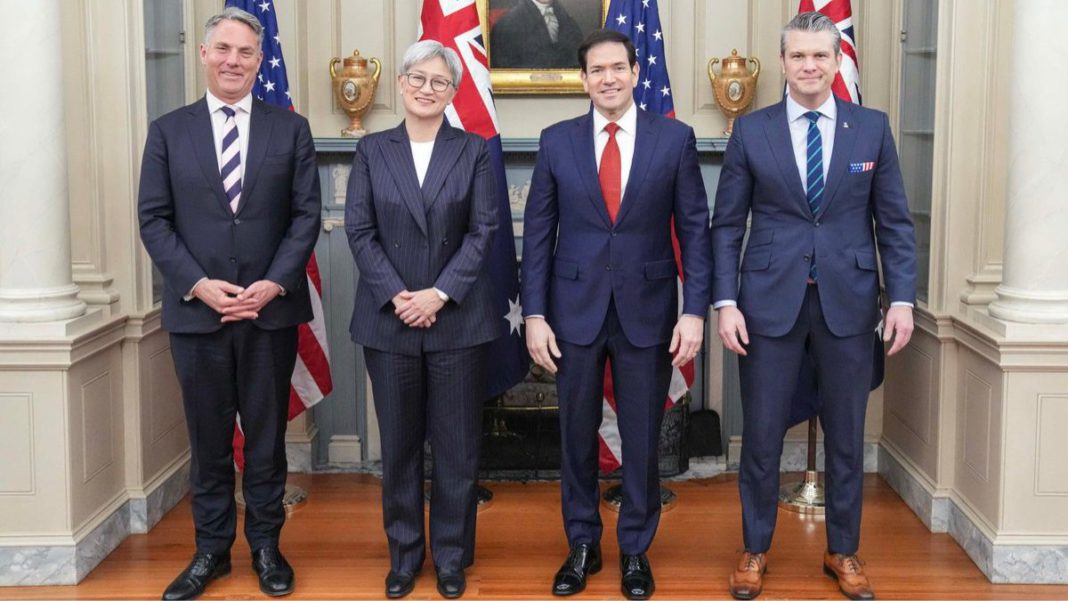
Australia and the United States have unveiled sweeping new defence, security and economic initiatives following the 40th Australia–US Ministerial Consultations in Washington, with both sides declaring the alliance stronger than ever as regional tensions rise.
US Secretary of State Marco Rubio and Secretary of War Pete Hegseth hosted Foreign Minister Penny Wong and Deputy Prime Minister and Defence Minister Richard Marles on 8 December, building on momentum from the October meeting between President Donald J. Trump and Prime Minister Anthony Albanese.
Secretary Rubio said the United States had “no better friend, partner or ally than Australia”, adding that the consultations would “continue to build momentum behind the many priorities we share”.
Senator Wong thanked her counterpart “for welcoming me so warmly to Washington… Together, we’re working to shape the Indo-Pacific for the better.”
From the outset, the ministers stressed the need to promote a free and open Indo-Pacific and resist growing threats to regional stability. Officials committed to new deterrence and economic-resilience initiatives and pledged to work closely with regional partners through mechanisms such as the Quad. They agreed to help counter economic coercion, promote transparent development, and strengthen trusted technologies across Southeast Asia and the Pacific.
Australia will collaborate with the United States, the Philippines and Japan to advance the Luzon Economic Corridor, while both countries deepen their partnership with Papua New Guinea through digital infrastructure, telecommunications reform, and major development at Lae Port. Washington will increase support for PNG’s disaster-management capabilities through its National Disaster Centre, a move described as a demonstration of continued commitment to Pacific resilience.
Both countries applauded the completion of the Vaka Submarine Cable to Tuvalu, a US–Australia–Taiwan–New Zealand–Japan project worth USD $56 million, and agreed to explore further ICT investment opportunities across the region. They also committed to enhancing trilateral cooperation with Japan on training and sharing air and missile defence data, and to continue maritime activities in the South China Sea with the Philippines and others.
A joint working group will be established to combat online scam operations, and the renewed AUSTRAC–FinCEN agreement will expand financial-intelligence sharing to disrupt transnational crime. Cybersecurity coordination will increase through more than USD/AUD $10 million in new investments aimed at bolstering the Pacific’s cyber resilience, including a future Pacific Cyber Week.
The ministers described 2026 – the 75th anniversary of the ANZUS Treaty – as a milestone year and reaffirmed their commitment to deeper defence integration. They noted the “full steam ahead” directive from President Trump and Prime Minister Albanese on AUKUS and welcomed progress on submarine-industrial cooperation. Australia will soon deliver its next USD $1 billion contribution towards enhancing US submarine-building capacity, bringing its total to USD $2 billion.
Force-posture cooperation will also expand, with plans to upgrade facilities at RAAF Bases Tindal, Darwin and Amberley to support rotations of US bombers, fighters and surveillance aircraft. The Marine Rotational Force–Darwin will grow through new logistics and infrastructure support, including the prepositioning of MV-22 Osprey aircraft. Both nations confirmed plans for northern and southern logistics hubs and a new US Oversight and Support Group in Australia to coordinate posture initiatives.
The ministers reaffirmed the goal of establishing Submarine Rotational Force-West at HMAS Stirling as early as 2027 and endorsed a two-year pathway for the Guided Weapons and Explosive Ordnance Enterprise. This includes hypersonic co-production, deeper missile-sustainment work, and new cooperation on maritime-strike and interceptor capabilities. Expanded use of export-control exemptions will continue to streamline defence-industrial collaboration.
Economic security featured strongly in the talks, with both nations committing to accelerate implementation of the Critical Minerals Framework. They welcomed rapid progress by Alcoa towards gallium production in 2026 and supported coordinated financing—via Export Finance Australia and the US EXIM Bank—worth USD $600 million for Tronox’s rare-earths expansion in Australia. Canberra will also establish an EFA office in Washington to deepen strategic-finance coordination.
The two countries are exploring reserve mechanisms and new offtake arrangements to secure critical-mineral supply chains. People-to-people ties will also strengthen, with Global Entry opening to all Australian citizens from 15 December. Both sides are considering a Customs Mutual Assistance Agreement to improve investigations into customs violations.
Secretary Rubio said the alliance would “continue to expand our joint efforts to promote a free and open Indo-Pacific”, while Senator Wong emphasised that AUSMIN had guided the partnership “through periods of great strategic change and challenge”.
Support our Journalism
No-nonsense journalism. No paywalls. Whether you’re in Australia, the UK, Canada, the USA, or India, you can support The Australia Today by taking a paid subscription via Patreon or donating via PayPal — and help keep honest, fearless journalism alive.
