

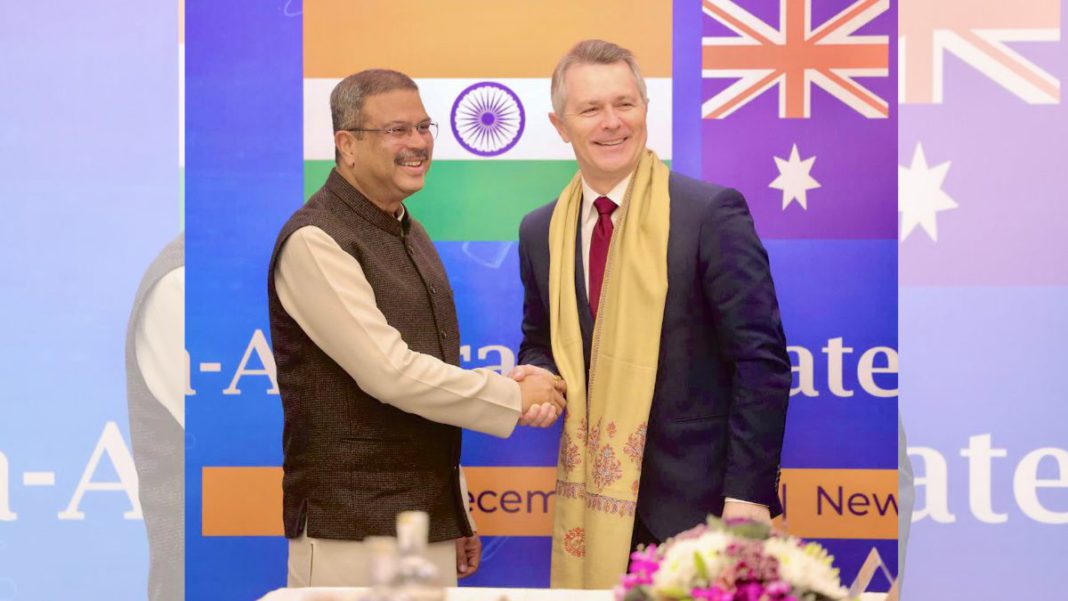
Australia and India have unveiled a major expansion of their education partnership, with ministers from both nations meeting in New Delhi for the 3rd Australia–India Education and Skills Council (AIESC) meeting and confirming a raft of new initiatives, including a Letter of Intent for the University of New South Wales to establish a campus in India.
Education Minister Jason Clare said the partnership reflected the growing strength of bilateral ties and the scale of opportunity for both nations.
“Australia has some of the best universities in the world, and as a result higher education is one of our biggest exports,” Clare said.
“This is a win–win. It is good for Australia and it is good for India.”
He highlighted UNSW’s announcement this week that it would open a campus in India—making it one of seven Australian universities now committed to offshore campuses under India’s National Education Policy.
India’s Education Minister Dharmendra Pradhan welcomed Clare, Skills Minister Andrew Giles and Assistant Minister for International Education Julian Hill, saying their visit “reflects the strength of India–Australia friendship that is built upon shared values, ambition and future”.
The high-level council meeting, co-chaired by Pradhan, Minister of State Jayant Chaudhary, Clare and Giles, reviewed progress across school education, higher education, research, skills and mobility. Senior officials, university leaders and sector representatives from both countries attended.
A key outcome was the formal handover of a Letter of Intent to UNSW—ranked 20th globally—under new regulations allowing foreign universities to operate campuses in India. The LoI adds to approvals granted earlier this year to La Trobe, Victoria University, Western Sydney University and the University of Western Australia.
With this addition, seven Australian universities now have approval to establish eight campuses across India.
India also announced ₹9.84 crore (AUD 1.64 million) for 10 new joint research projects under the SPARC program in fields including artificial intelligence, energy, MedTech, sustainability and space. Of SPARC’s 865 funded projects to date, 129 involve top Australian universities.
The two nations also exchanged multiple MoUs covering agritech innovation, marine sciences, teacher training, disaster resilience, global job readiness, mining and skills development.
Other collaborative initiatives include:
- Alignment of early childhood education curricula between CBSE and Australian ECEC qualifications
- Partnerships between Australian TAFEs and India’s National Skills Training Institutes
- Joint work on sports integration in school and higher education
- Discussions on establishing a CBSE-affiliated school in Australia
- Cooperation on hackathons addressing real-world challenges
Giles said the growing partnership was “invaluable to progressing both nations’ skills and training capabilities”, while Hill said the UNSW announcement demonstrated the depth of Australia’s commitment to providing “world-class education directly to Indian students”.
Clare also held bilateral talks with Pradhan and Hill, with discussions focused on strengthening collaboration “from preschool to PhD”, boosting critical-thinking skills, and preparing an AI-ready generation.
Pradhan noted that education, skills and research were “key pillars” of the India–Australia strategic partnership, urging all stakeholders to implement the fresh commitments “with clear timelines and stronger bridges”.
Australia has invited India to the 4th AIESC meeting, to be held next year.
Support our Journalism
No-nonsense journalism. No paywalls. Whether you’re in Australia, the UK, Canada, the USA, or India, you can support The Australia Today by taking a paid subscription via Patreon or donating via PayPal — and help keep honest, fearless journalism alive.
