
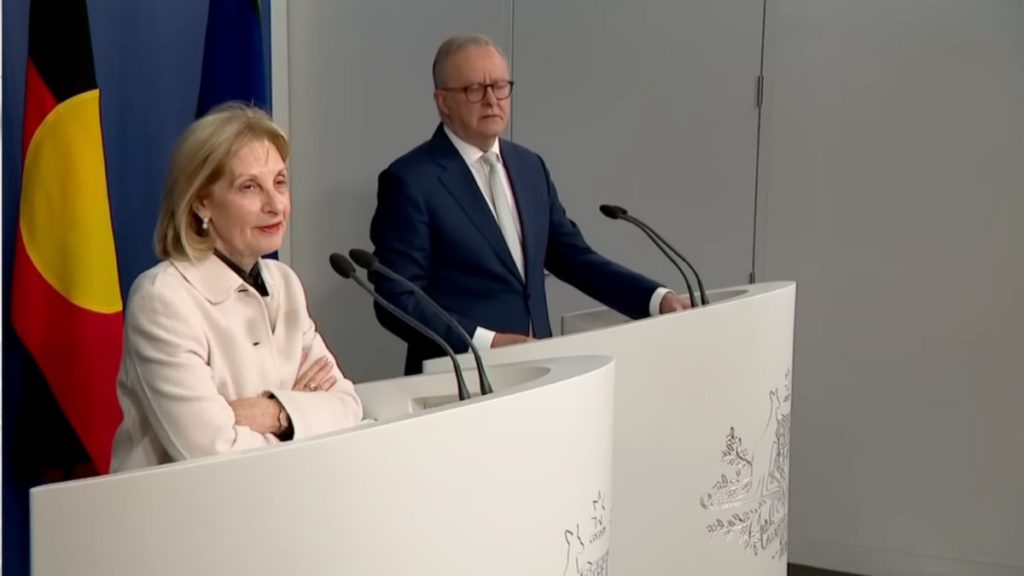
Under a bold initiative unveiled by the prime minister on Thursday morning, the government’s special envoy for combating antisemitism will collaborate with federal agencies to deny funding to universities that do not effectively counteract hostility toward Jewish students.
The envoy will also oversee media outlets to promote fair and accurate reporting on antisemitism and implement visa-screening measures to identify applicants harbouring antisemitic beliefs.
Jillian Segal, who has served as the special envoy since her appointment a year ago, added that she will advise on updating Australia’s hate-speech legislation, including laws against vilification and the encouragement of hatred. Describing the scheme as a “comprehensive, long-term” effort—modelled on frameworks used in other countries—Ms Segal maintained that while outright elimination of antisemitism may be unattainable, it can be driven to the fringes of society.
“In the space of just one year, reported incidents increased over 300 per cent.
These are not isolated events and they form part of a pattern of broader intimidation and violence that is making ordinary Jewish Australians feel very unsafe,”
she said.
Universities Australia (UA), has signalled its full support for the plan and outlined steps to implement its recommendations across the higher education sector.


UA Welcomes Special Envoy’s Roadmap
Chief Executive Luke Sheehy described the envoy’s report, authored by former Senator Jillian Segal, as a “significant body of work” that aligns with the sector’s longstanding commitment to fostering “respectful, inclusive and safe environments for all students and staff.” UA has been engaged in a months-long dialogue with Segal’s office, he confirmed.
“We’ll work closely with our members as we consider the recommendations,” Sheehy said in an official UA statement.
“Racism has absolutely no place in Australia’s universities, and our sector condemns it in all forms.”
Sheehy underscored the union issues at stake: academic freedom and freedom of expression remain central to university missions, but he warned these rights “must be exercised with responsibility and never as a cover for hate or harassment.” UA will continue to liaise with the government, community stakeholders and the envoy’s office to flesh out practical measures.
Key Recommendations: Target Campus Culture, Funding and Legal Frameworks
Segal’s report proposes a seven-point plan to tackle antisemitism, among them:
- Education and Training: Deploying resources to build understanding of antisemitism across curricula, staff induction programs and student orientation.
- University Accountability: Empowering universities to withhold public funding from any institution that “facilitates, enables or fails to act” on antisemitism in its community.
- Legislative Review: Commissioning a review of federal and state hate-speech and vilification laws to close gaps in criminalising the promotion of hatred.
- Media and Arts Protocols: Introducing guidelines for accurate representation of Jewish history and culture in public broadcasting and state-funded arts.
- Stronger Policing Partnerships: Establishing a permanent, standing taskforce for law enforcement cooperation on antisemitic incidents, modelled after the Avalite taskforce created after the 2023 synagogue firebombing.
- Online Hate Mitigation: Regulating social-media algorithms, fostering “trusted voices” to counter extremist content, and expanding takedown powers.
- Visa Screening: Tightening the Migration Act to screen applicants for antisemitic views and more readily cancel visas of visa-holders who engage in hateful conduct.
Opposition Demands Clarity on Government Endorsement
While Universities Australia awaits the government’s formal response, the federal Opposition has pressed for clarity on which recommendations will be adopted. Shadow Home Affairs Minister James Paterson highlighted that Prime Minister Anthony Albanese recently declined to guarantee full implementation of the plan.
“Australians deserve to know which measures the government will back,” Paterson said.
“Addressing antisemitism is not just a matter of law enforcement; it requires cultural change in our schools, universities, media and arts.”
Labor’s Arts Minister Tony Burke, however, emphasised that Creative Australia already factors anti-hate criteria into its grant processes, and noted the flexibility exists now to withhold funding from entities that fail to meet community standards.
Jewish Community Leaders Back the Plan
The Executive Council of Australian Jewry (ECAJ) hailed the envoy’s recommendations as “urgently needed,” particularly in light of recent antisemitic incidents in Melbourne and Sydney.
“This is a well-considered plan aligned completely with the Jewish community’s expectations,” ECAJ President Daniel Aghion stated.
“We call on all sectors—government, law enforcement, universities, media and education authorities—to cooperate with the special envoy to make antisemitism a thing of the past.”
Universities Gear Up for Funding and Policy Shifts
The prospect of funding cuts for non-compliant universities has set off intensive consultation within UA’s membership. Senior administrators from the Group of Eight and regional universities alike are reviewing their campus policies, counselling services and grievance processes to ensure alignment with the envoy’s standards.
At Monash University, Vice-Chancellor Professor Margaret Gardner confirmed Monash will “thoroughly audit” existing protocols on hate speech, enhance staff training and expand student-led peer support networks.
“We welcome the report’s emphasis on embedding an understanding of antisemitism into curriculum and co-curriculum,”
Gardner said.
Similarly, the University of Sydney has announced plans to establish a dedicated office for responding to racial and religious vilification, bolstering helplines, and improving data collection on hate incidents. A senior Senate member remarked, “We view the envoy’s report as a timely call to action—and an opportunity to demonstrate leadership in Australian higher education.”
Next Steps: Government Response and Implementation Timeline
The Albanese government has pledged to “carefully consider” all recommendations. Home Affairs Minister Clare O’Neil has convened inter-departmental working groups to draft policy responses, while Education Minister Jason Clare has signalled forthcoming guidelines on university funding conditions.
Prime Minister Albanese reiterated that implementation will be “an ongoing process” requiring cooperation from state governments, universities, civil society and online platforms.
He stressed the plan’s goal:
“To build the inclusive Australia that most Australians want to see, regardless of faith.”
Segal, appointed as the nation’s first Special Envoy on Antisemitism in February, has scheduled follow-up meetings with UA, ECAJ, student bodies, and state education authorities over the next two months.
An annual progress report will chart achievements against key performance indicators, such as reductions in campus hate crimes and improvements in community sentiment metrics.
A Turning Point for Campus Culture
As Universities Australia mobilises its 43 member institutions, the higher education sector stands at a pivotal juncture. The envoy’s report not only underscores the imperative of stamping out antisemitism but also reframes the challenge as part of a broader mandate to uphold academic freedom responsibly.
With equipping universities to balance free expression and safeguarding vulnerable communities, the sector’s response in the coming months will test both policy resolve and institutional will, setting a precedent for tackling all forms of hate across Australia’s public sphere.
Support our Journalism
No-nonsense journalism. No paywalls. Whether you’re in Australia, the UK, Canada, the USA, or India, you can support The Australia Today by taking a paid subscription via Patreon or donating via PayPal — and help keep honest, fearless journalism alive.

