

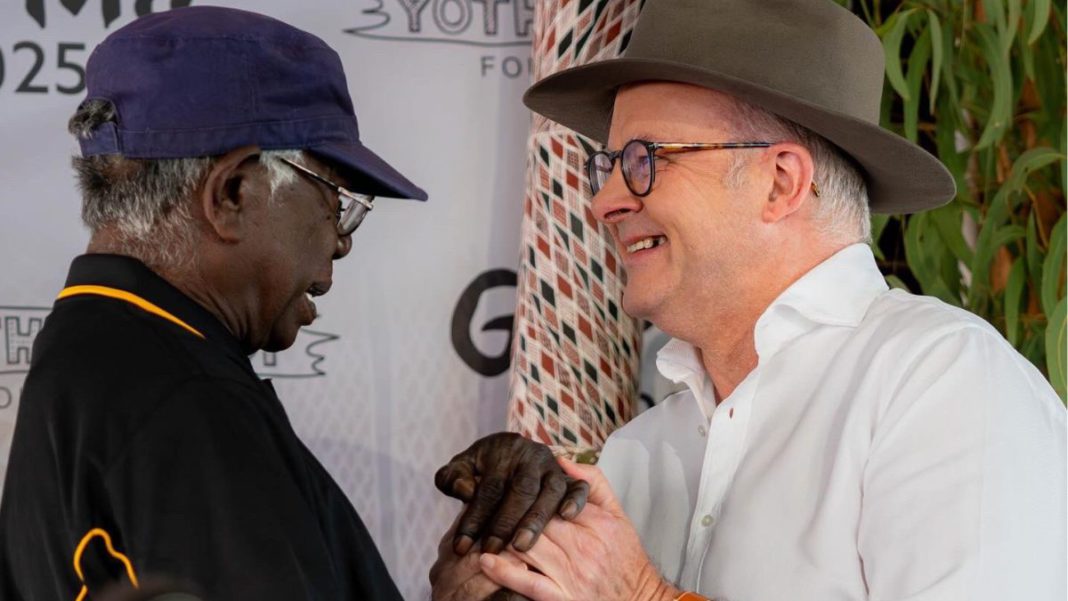
Prime Minister Anthony Albanese returned to Arnhem Land this weekend, using the Garma Festival as a powerful platform to recommit to First Nations justice, economic opportunity, and truth-telling—two years after the national rejection of the Voice referendum.
Addressing hundreds of influential Aboriginal leaders at Gulkula in north-east Arnhem Land, the Prime Minister said, “Garma Festival is an opportunity to share in the oldest continuous culture on Earth. To learn from over 60,000 years of Aboriginal and Torres Strait Islander knowledge and tradition.”
“This year, Garma is dedicated to ‘standing firm’—and the Government I lead is proud to stand with you, and walk with you, side by side, toward a better future.”
Three years after first making a “solemn promise” at Garma to implement the Uluru Statement from the Heart—Voice, Treaty, Truth—Albanese praised Victoria’s Yoorrook Justice Commission for confronting the deliberate exclusion of Indigenous Australians from their land and resources.
“As a nation, we are still coming to terms with the full truth and toll of this exclusion.”
While his speech offered clear support for economic development and land rights, some observers noted what was left unsaid—particularly in the wake of the failed Voice referendum and continued calls for bolder reforms.
The Albanese Government also used Garma to announce a new multi-million-dollar economic development plan for Indigenous communities. However, the Coalition has demanded more detail, with Shadow Attorney-General Julian Leeser the only federal Opposition figure attending Garma.
Founded in 1999 by the Yothu Yindi Foundation, the Garma Festival has grown into the nation’s premier Indigenous cultural and policy gathering. Alongside political discussion, the four-day event showcases Yolngu music, dance, art and ceremony—drawing participants from the five regional clan groups: Gumatj, Rirratjingu, Djapu, Galpu, and Wangurri.
Support our Journalism
No-nonsense journalism. No paywalls. Whether you’re in Australia, the UK, Canada, the USA, or India, you can support The Australia Today by taking a paid subscription via Patreon or donating via PayPal — and help keep honest, fearless journalism alive.
