

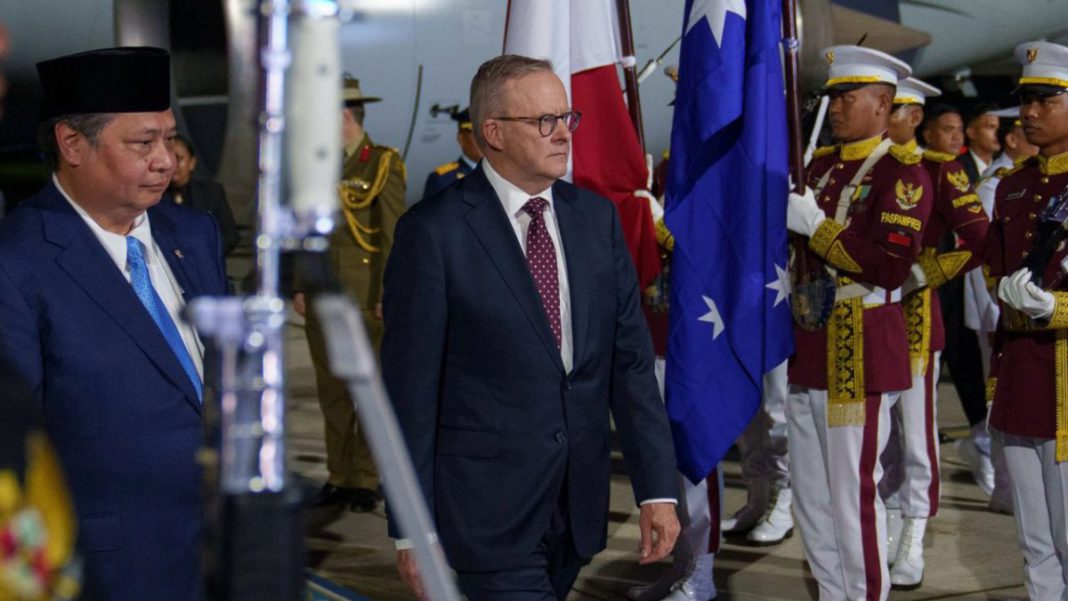
Prime Minister Anthony Albanese touched down in Jakarta on Wednesday evening, receiving a guard of honour and a warm welcome from President Prabowo Subianto and Economic Affairs Minister Airlangga Hartarto. This visit marks Mr Albanese’s first international trip since his landslide re-election on May 3, underlining that “our region comes first,” the prime minister told supporters on Instagram.
“Australia and Indonesia are the nearest of neighbours and the closest of friends,” Mr Albanese posted.
“Working with President @prabowo over the coming years, we will build stronger connections between our two countries.”
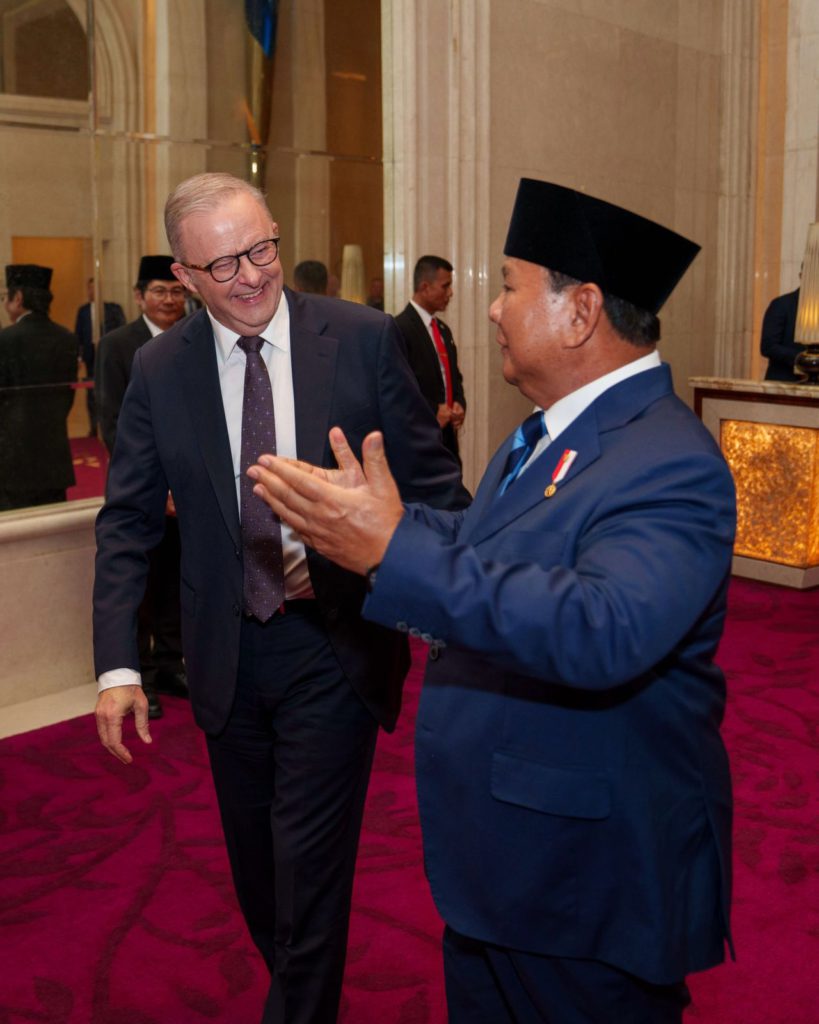
Why Indonesia first?
Choosing Indonesia as his inaugural destination follows a tradition dating back to John Howard’s prime ministership. By reaffirming this gesture, Mr Albanese signals that Canberra views Jakarta as its top regional partner.
“There’s no more important relationship than the one we have with Indonesia,”
he said in Perth just before departure.
Australian Strategic Policy Institute analyst Gatra Priyandita noted that this move underscores Canberra’s commitment to Southeast Asia.
“Albanese wants to make sure Jakarta understands that Indonesia remains a key priority,”
Ms Priyandita said.
Deepening defence cooperation
At the heart of Mr Albanese’s agenda is defence and security cooperation. Last year’s landmark security pact—signed when President Prabowo visited Canberra—paved the way for expanded joint exercises, intelligence sharing, and military interoperability. This visit aims to translate that agreement into concrete programs.
With rising regional tensions, including China’s expanding naval presence, both leaders are expected to discuss:
- Joint military drills: increasing the frequency and scale of exercises like “Garuda Shield.”
- Maritime security: enhancing patrols in the Indo-Pacific corridor.
- Technology transfers: sharing surveillance, drone, and cyber-defence capabilities.
“Defence tops our priority list,” a senior Australian official said, adding that Canberra is keen to deepen trust amid strategic uncertainty.
Balancing ambitions and neutrality
Despite mutual interest in stronger defence ties, Indonesia remains cautious about formal alliances. President Prabowo has reiterated Jakarta’s commitment to non-alignment, steering clear of binding military blocs. Indonesia’s recent outreach to BRICS and its ongoing defence relationship with Russia illustrate this careful balancing act.
Australian observers acknowledge these limits but emphasise that the existing security agreement does not compromise Indonesia’s neutrality. Instead, it opens practical avenues for collaboration without entangling either country in broader geopolitical rivalries.
Brief but symbolically powerful
Mr Albanese’s visit to Jakarta lasts just one full day. After meetings with President Prabowo and senior Indonesian ministers, he departs for Rome to attend the Vatican’s papal inauguration and meet European leaders. Nevertheless, the short stop in Jakarta carries outsized significance, reaffirming the enduring Australia-Indonesia partnership at a critical juncture for regional security.
As the prime minister’s convoy departed Halim Perdanakusuma Airport, it was clear that both capitals regard this encounter as more than a customary courtesy—rather, it is the opening act in a renewed era of strategic cooperation that places defence at its core.
Support our Journalism
No-nonsense journalism. No paywalls. Whether you’re in Australia, the UK, Canada, the USA, or India, you can support The Australia Today by taking a paid subscription via Patreon or donating via PayPal — and help keep honest, fearless journalism alive.
