


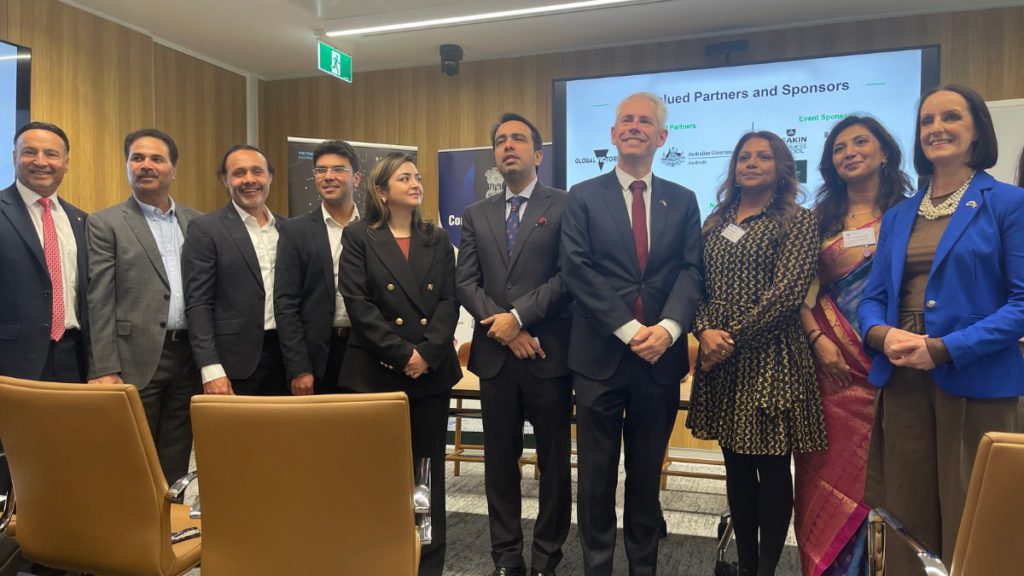
Australia and India will deepen cooperation on skills and training under existing government-to-government frameworks, ministers told an Australia India Business Council (AIBC) forum this week, outlining new pathways for co-designed qualifications, apprenticeships and industry-led pilots across priority sectors.

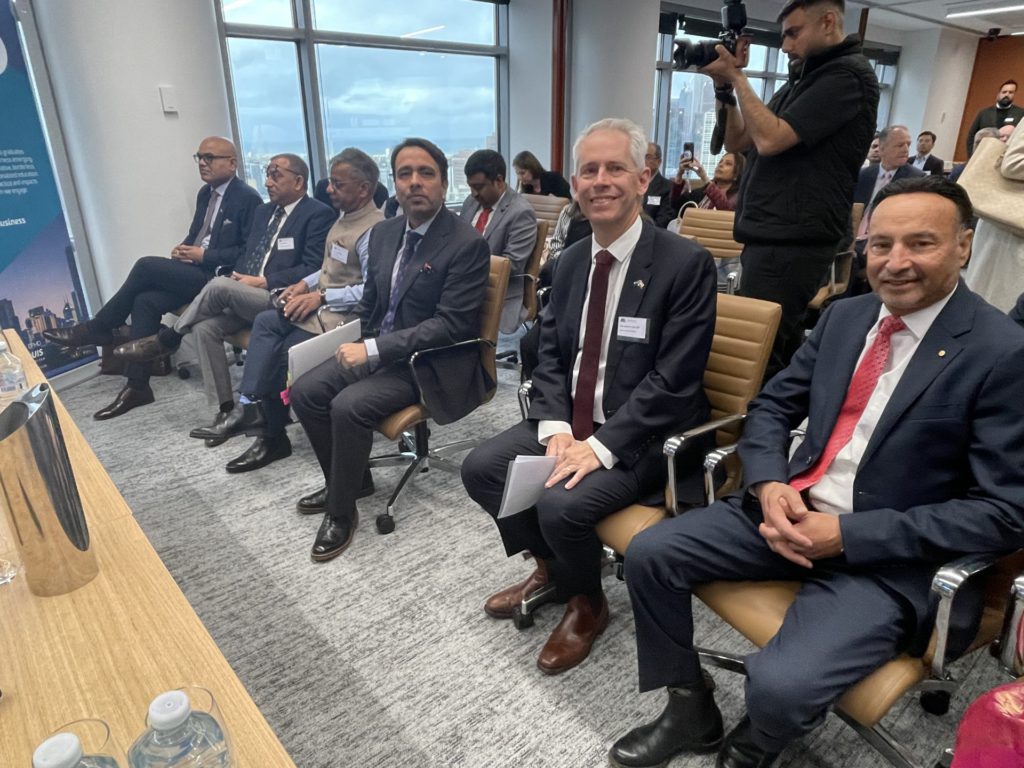
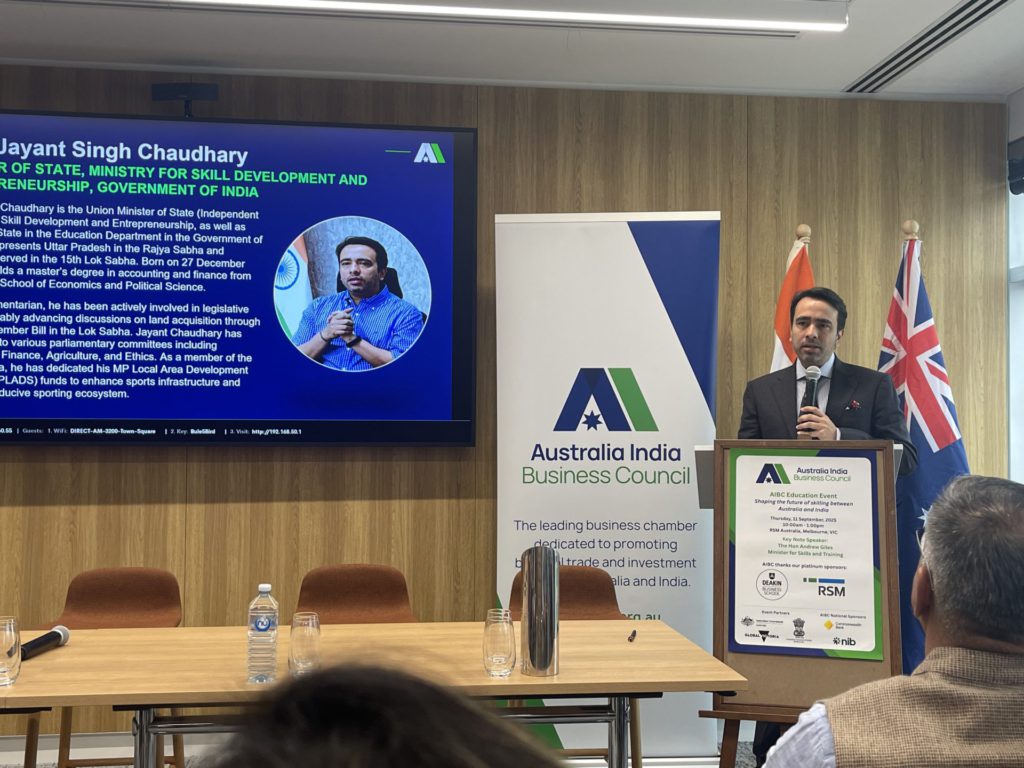
Speaking alongside business and education leaders, India’s Minister of State (Independent Charge) for Skill Development and Entrepreneurship, Jayant Singh Chaudhary, and Australia’s Minister for Skills and Training, Andrew Giles, said the two countries are now positioned to translate policy architecture into large-scale delivery.
Minister Chaudhary said, “Our goal is simple: train at scale, with quality, and for jobs that truly exist.

“With Australia, we plan to co-design modules industry wants—advanced manufacturing, renewables and healthcare—then jointly certify the outcomes so graduates can work with confidence on either side.”
The ministers pointed to three pillars already in place: the Australia-India Education and Skills Council (AIESC) as the primary bilateral forum for skills and education policy; the Mutual Recognition of Qualifications mechanism that eases student and professional mobility; and the new MATES visa stream for Indian early-career professionals in targeted fields.
Andrew Giles explained, “This partnership is about trusted skills that travel.”
Minister Giles framed skilling as both an economic project and a values choice. He condemned recent attempts “to divide and diminish us,” reaffirming that Indian-Australian communities “belong,” and argued Australia must turn its advantages—location, First Nations knowledge and multicultural depth—into outcomes.
He pointed to the government’s turnaround agenda: Free TAFE, Jobs and Skills Australia, and the $30 billion National Skills Agreement, alongside integrity upgrades to student visas and new Guiding Principles and Standards for Skilled Migration Assessing Authorities to ensure fair, consistent recognition of skills. With 33% of occupations facing shortages in 2024, Giles said skilled migration—especially employer-sponsored pathways—remains crucial, provided standards are clear and enforcement is strong.
“We’ll align training where it makes sense, protect integrity, and ensure learners—whether in Ahmedabad, Adelaide or Alice Springs—can demonstrate capability in real workplaces.”


Business also sees momentum on the ground. Australia’s first international branch campuses in India (Deakin University and University of Wollongong) and Western Australia’s WACE school board gaining equivalence in India demonstrate fast-maturing education links that can feed skills pipelines.
Minister Giles cast education and skills as “cornerstones” of the India–Australia relationship, highlighting momentum since the first Australia-India Education and Skills Council meeting: an agricultural skills-mapping project, ongoing implementation of the Mutual Recognition of Qualifications (signed 2 March 2023), and a new STEM research fellowships program for women.
He urged more transnational VET delivery and industry-backed partnerships in India, citing the landmark Kangan Institute–Gujarat Govt–Maruti Suzuki International Automobile Centre of Excellence. With India now Australia’s top source country for international VET (about 1 in 5 students).
Giles said December’s AIESC meeting in India—alongside ministers Jason Clare and Julian Hill—will focus on practical steps to align training, protect integrity and bridge critical skills gaps, complementing efforts to expand the bilateral trade agreement.

What’s new: industry-first delivery
AIBC National President Deepak-Raj Gupta OAM said members want “practical, employer-led pilots that place learners into real projects.”
Deepak-Raj Gupta: “We’ll convene cohorts where industry co-invests, curricula are co-written, and assessment is done in real factories, mines, hospitals and labs.”
“This is how we turn friendship into jobs and productivity.”
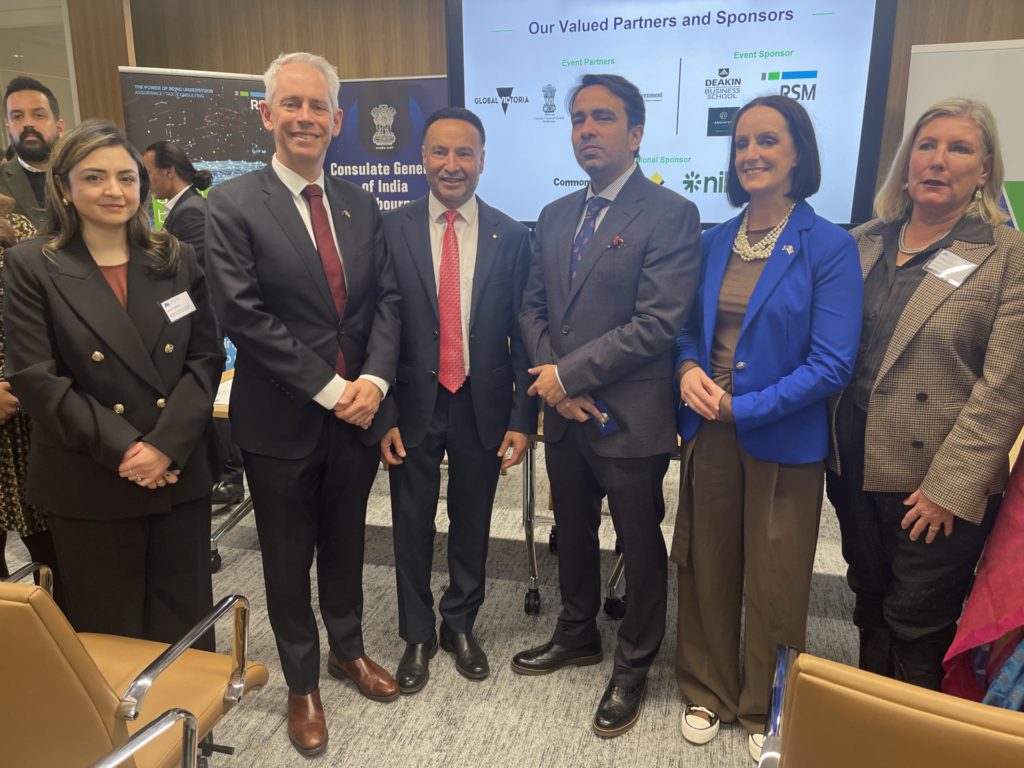
AIBC’s National Education & Skills Lead Prof. Dhara Shah outlined immediate priorities:
Prof. Dhara Shah outlined that educational institutes need to “(1) Map equivalences for apprenticeships and micro-credentials; (2) build dual-sector pathways linking TAFE, universities and Indian training partners; (3) scale work-integrated learning with secure, ethical mobility; and (4) embed integrity—digital assessment, supervised practicals, and employer sign-off.”

Both ministers stressed integrity and capacity planning. Giles noted Australia’s broader skills agenda and workforce planning under Jobs and Skills Australia, while Chaudhary highlighted India’s scale—over 60 million people trained under Skill India—now being oriented to higher-value, globally portable skills.
The MATES mobility pathway—now live via a ballot process—will channel up to 3,000 Indian graduates annually into Australian roles in AI, renewables, mining, ICT, fintech and ag-tech, with a two-year stay and an emphasis on real experience.

Why it matters
- Demand and fit. Australia’s skills shortages in priority sectors align with India’s rapidly growing technical talent base—if training is co-designed and quality-assured.
- Shared standards. The qualifications recognition mechanism reduces friction for learners and employers, while AIESC provides a table to solve problems quickly.
- Integrity by design. After pandemic-era quality concerns in parts of the international education system, both sides are emphasising supervision, workplace assessment and data-driven oversight.
Australia and India need to move from policy framing to delivery by launching employer-backed pilot cohorts in five priority areas: cybersecurity, healthcare, solar energy, advanced manufacturing and installation. These are to be co-designed with industry so learners train on the equipment, standards and workflows they will encounter on the job, with employers helping to assess competence and offering pathways into paid roles.
A skills equivalence map will be published to translate qualifications and micro-credentials across systems. By aligning outcomes rather than just course titles, the map will make it easier for students, employers and regulators to compare like with like, speeding up recognition and reducing duplication in training plans.
To grow capacity, partners will have to expand TAFE–polytechnic collaborations with dual certification and shared assessment rubrics. The aim is to let learners stack modules across Indian and Australian providers, complete supervised practicals in either country, and graduate with credentials that carry weight in both labour markets.
Mobility will be supported by scaling the MATES placements for Indian graduates, with wrap-around services—orientation, pastoral support, housing guidance, and workplace mentoring—and transparent outcomes reporting. Publishing completion, employment and retention metrics is intended to build community confidence and keep providers accountable.

These initiatives sit under the Australia-India Education and Skills Council (AIESC), the primary bilateral forum for skills and education cooperation, with recent ministerial communiqués reaffirming skills as a central pillar. The Mutual Recognition of Qualifications agreement signed on 2 March 2023 underpins easier two-way mobility for graduates and professionals, while the MATES visa stream has commenced with ballot windows and policy settings in place to channel talent into priority sectors.
On the education side, Deakin University’s GIFT City campus and the WACE senior-secondary equivalence in India signal deeper integration between systems, creating pipelines from school to VET and higher education that can feed the skills partnership. All of this aligns with Australia’s current skills policy settings and ministerial stewardship focused on workforce shortages, integrity, and productivity.

Support our Journalism
No-nonsense journalism. No paywalls. Whether you’re in Australia, the UK, Canada, the USA, or India, you can support The Australia Today by taking a paid subscription via Patreon or donating via PayPal — and help keep honest, fearless journalism alive.

