

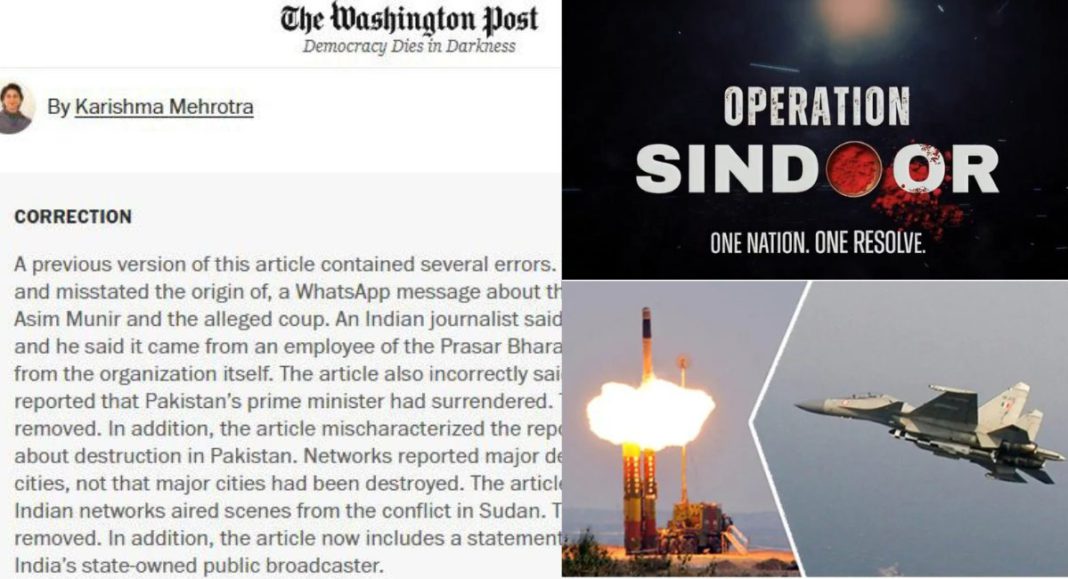
The Washington Post has formally acknowledged incorrect reporting in an article related to Operation Sindoor, and has issued a correction and apology to Indian news network TV9 Bharatvarsh. The acknowledgment follows a legal notice sent by TV9 challenging the accuracy of the article and demanding the retraction of misleading claims.
Operation Sindoor, launched by India in early May, was a targeted counter-terror mission following the April 22 terror attack in Jammu and Kashmir’s Pahalgam region.
In a correction note added to the article “How misinformation overtook Indian newsrooms amid conflict with Pakistan” published on June 7, the Post admitted it had wrongly stated that TV9 Bharatvarsh reported the surrender of Pakistan’s Prime Minister amid India-Pakistan tensions. That claim has now been removed from the article, along with other references that were found to be inaccurate.
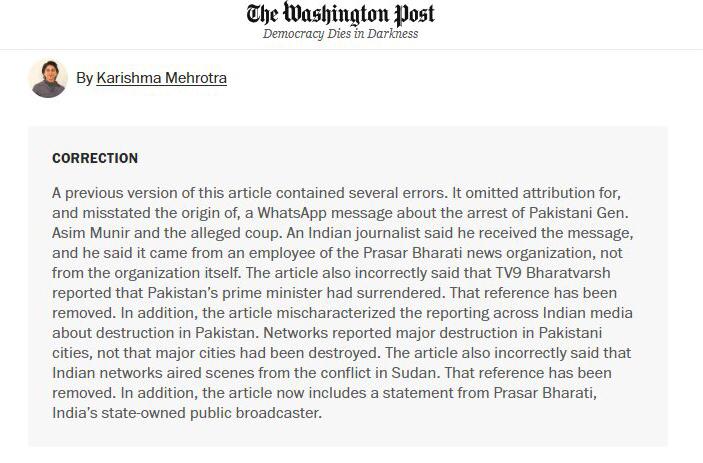
The correction further clarified that a WhatsApp message referenced in the original story — which suggested a coup in Pakistan — did not come officially from India’s state broadcaster Prasar Bharati, but from an individual employee. Other corrections addressed the mischaracterization of Indian media coverage and the mistaken claim that Indian channels aired footage from the Sudan conflict.
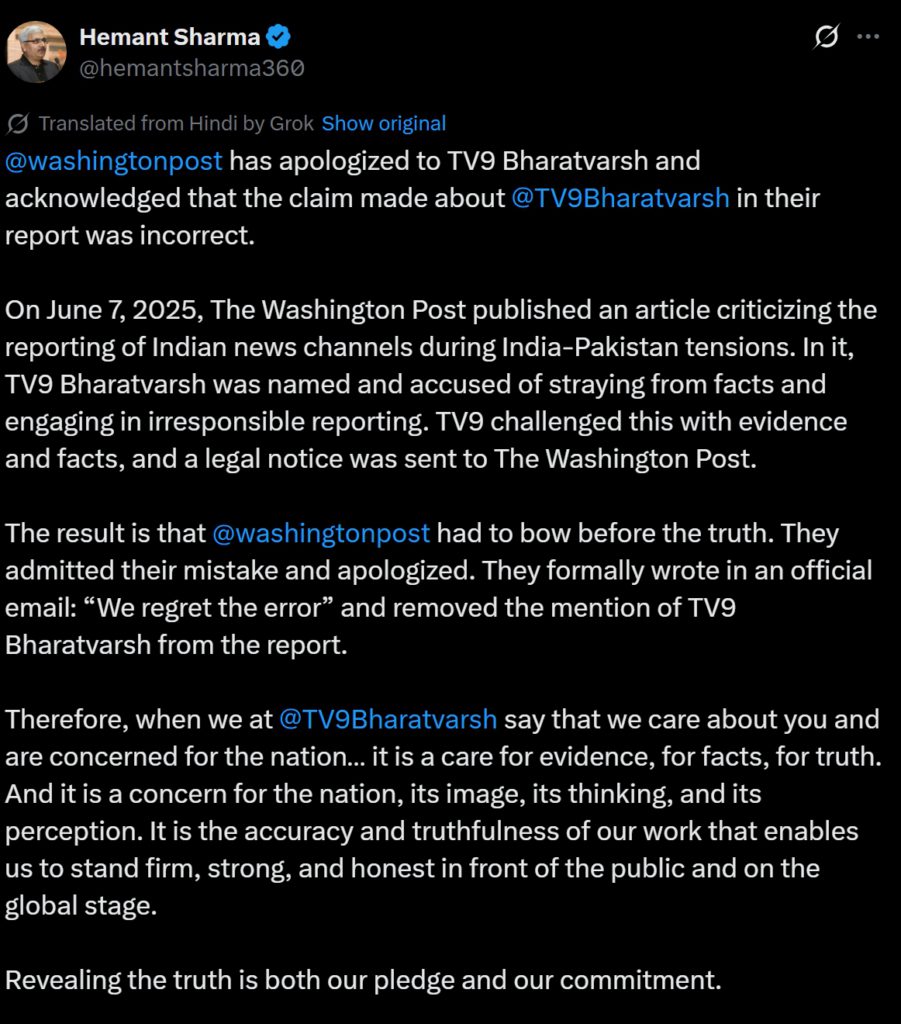
Senior Indian journalist and News Director of TV9 Hemant Sharma posted on social media that The Washington Post had formally apologized to TV9 Bharatvarsh through email, stating: “We regret the error.” The message reportedly followed a legal notice and evidence submitted by TV9 to dispute the claims made in the original report.
Translation by Grok
The correction, now prominently displayed above the article outlines a series of editorial missteps. These include:
- Misstating the origin of a WhatsApp message that claimed Pakistan’s Army Chief Gen. Asim Munir had been arrested. The message, according to the correction, was received by an Indian journalist from an individual employee of Prasar Bharati, not officially from the broadcaster itself.
- Incorrectly attributing claims about the surrender of Pakistan’s Prime Minister to TV9 Bharatvarsh. This specific reference has since been removed.
- Mischaracterizing Indian media reports about destruction in Pakistan by suggesting they claimed entire cities had been destroyed. The networks, in fact, reported major destruction in some Pakistani cities, but not that entire cities were flattened.
- Incorrectly stating that Indian networks aired conflict footage from Sudan, which was also later retracted.
The Washington Post’s correction marks a rare and telling instance of editorial backtracking by a major Western media outlet—prompted not by internal oversight, but by the persistent fact-checking of an Indian news organisation that exposed its flawed and potentially biased coverage.
In addition to removing the erroneous claims, the updated article now includes a statement from Prasar Bharati, India’s national public broadcaster.
The Washington Post‘s correction follows criticism by many observers who questioned the accuracy and objectivity of international legacy media reporting during the conflict.
Operation Sindoor reset global military matrix due to the scale and precision of India’s cross-border strikes on Pakistan. However, several established media outlets were observed circulating unverified claims during the conflict, deviating from fact-based reporting. These included falsehoods like Pakistan taking Indian soldiers prisoners (Bloomberg) and a female Indian pilot taken into custody (Al Jazeera) among others.
Support our Journalism
No-nonsense journalism. No paywalls. Whether you’re in Australia, the UK, Canada, the USA, or India, you can support The Australia Today by taking a paid subscription via Patreon or donating via PayPal — and help keep honest, fearless journalism alive.
