

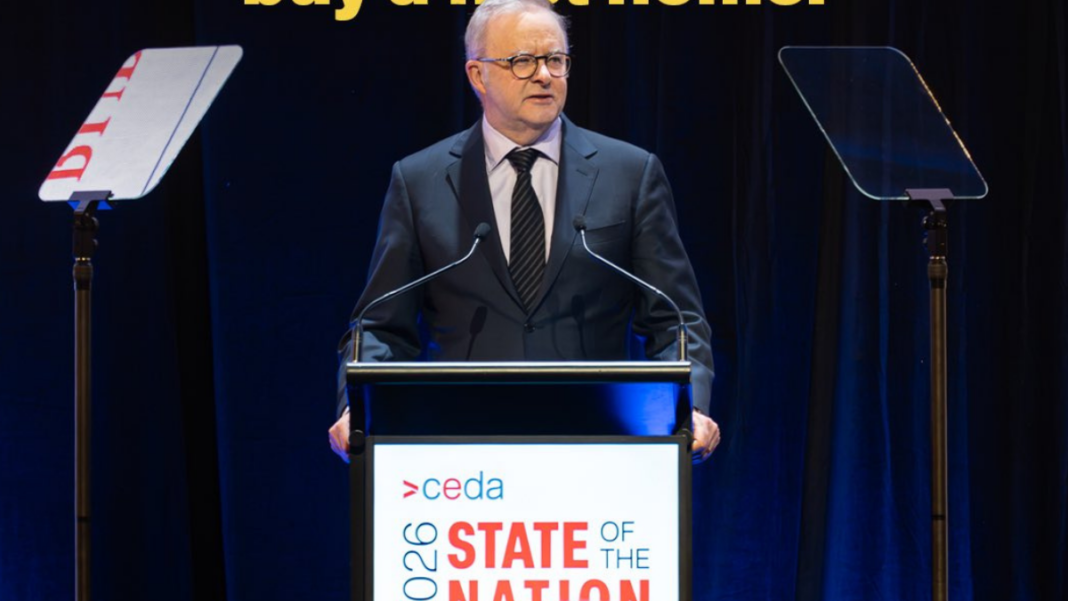
Prime Minister Anthony Albanese has highlighted stronger ties with India as a key part of Australia’s long-term economic and strategic future, saying the nation must actively shape global changes rather than wait for them to happen.
Addressing the Committee for Economic Development of Australia (CEDA) State of the Nation Conference in Canberra, Albanese said Australia’s prosperity towards 2050 would be shaped by major global shifts including the clean energy transition, artificial intelligence, changing supply chains and regional partnerships.
“The Australia of 2050 will be defined by how we respond to this changing world.”
He said Australia had the opportunity to emerge from a period of global uncertainty as a stronger, fairer and more resilient nation by investing in innovation, manufacturing, energy security and international partnerships.
“Stabilising our relationship with China, deepening our investment in South East Asia, elevating our ties with India,” Albanese said, outlining key priorities for Australia’s engagement with the region.
The Prime Minister said Australia must “own our place” in the Indo-Pacific, describing it as the fastest-growing region in the world and emphasising the importance of partnerships with regional neighbours.
Australia and India have strengthened their relationship in recent years through the Australia–India Comprehensive Strategic Partnership, expanded trade cooperation and increased collaboration in areas including critical minerals, technology, education and security.
Albanese said the future economy would require Australia to combine its natural resources, skilled workforce and innovation capacity to create products and industries that meet global demand.
“We can build on our global leadership in clean energy and use it to power a new generation of Australian manufacturing.”
He also highlighted the transformative potential of artificial intelligence, saying Australia needed to ensure the technology supported economic growth while protecting social cohesion and national interests.
“The debate can’t be, is AI good or bad… you can’t stop progress. You’ve got to shape it or else it’ll shape us,” Albanese said during a question-and-answer session.
The Prime Minister said Australia’s challenge had historically been less about innovation and more about commercialising ideas, pointing to the need for greater cooperation between researchers, universities and businesses.
“We’ve got to stop [thinking] someone else, somewhere else will do it for us,” he said, arguing Australia needed to build more domestic manufacturing capability.
On productivity, Albanese said the government was focused on cutting red tape, improving skills, supporting research and development, and encouraging private sector investment.
He also defended the government’s economic reforms, including housing, tax and energy policies, saying governments had a responsibility to address long-term challenges rather than avoid difficult decisions.
“I’m in government to make a difference, not to just occupy the space.”
The Prime Minister pointed to Australia’s growing renewable energy sector, investment in battery storage and emerging industries as examples of how the country could create future opportunities.
He also addressed concerns about artificial intelligence affecting young workers, saying technological change would reshape jobs but also create new opportunities if managed correctly.
“You will get some change in workplaces. Some jobs that exist today will not exist in 10 years’ time, but there’ll be new jobs.”
Albanese said Australia’s multicultural workforce, international connections and regional partnerships were among its greatest advantages.
“There’s no country you’d rather be at the moment than Australia,” he said, highlighting the nation’s resources, skills base and global links.
The Prime Minister’s remarks come as Australia continues to deepen engagement with India across trade, investment, education, defence and people-to-people links, with both nations seeking to expand cooperation in the Indo-Pacific.
Support our Journalism
No-nonsense journalism. No paywalls. Whether you’re in Australia, the UK, Canada, the USA, or India, you can support The Australia Today by taking a paid subscription via Patreon or donating via PayPal — and help keep honest, fearless journalism alive.
