

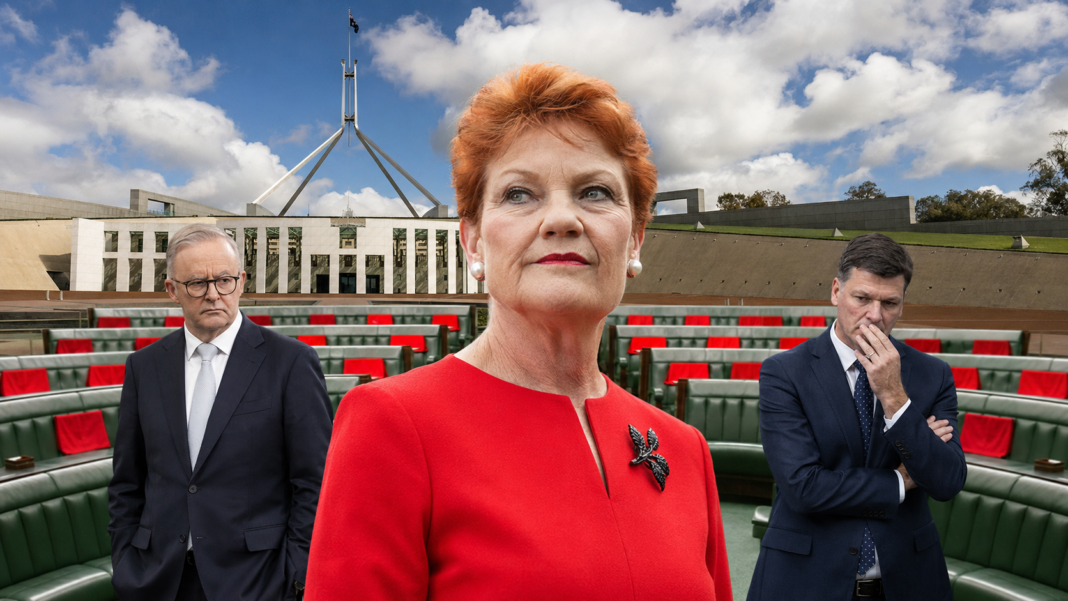
Pauline Hanson’s One Nation could win as many as 63 seats in the House of Representatives, while the Coalition risks being reduced to fewer than a dozen MPs, according to new federal election modelling.
The latest Capital Brief/DemosAU poll places One Nation on 30 per cent of the primary vote, three points ahead of Labor on 27 per cent. The Liberal-National Coalition has fallen five points to 18 per cent, while the Greens remain on 13 per cent and other parties and independents account for 12 per cent.
DemosAU used the results to conduct 20,000 Monte Carlo simulations, assuming uniform national swings from its January-to-March multilevel regression and post-stratification model.
If the polling figures were replicated at a federal election, the model projects One Nation would secure between 54 and 63 of the House’s 150 seats.
Labor would win between 71 and 81 seats, leaving it best placed to form either a majority or minority government. The Coalition would be reduced to between four and 11 seats, while the Greens would win up to four and other candidates between four and eight.
The result represents a significant deterioration for the Coalition. In May, DemosAU projected the Liberal and National parties would retain between 16 and 28 seats.
One Nation’s projected range has increased from 47–58 seats in May to 54–63 in June, placing the party within reach of becoming the official opposition and potentially transforming Australia’s two-party political system.
DemosAU Head of Research George Hasanakos said Labor remained the most likely party to form government, despite trailing One Nation on primary support.
Mr Hasanakos explained,
“On these numbers, One Nation would likely fall short of forming government, even with Coalition support, but a further improvement in support, or a further drop for Labor, could change the equation.”
The modelling should be treated as a scenario rather than a firm election forecast. It assumes the national movement in support would be replicated broadly across individual electorates, while candidate quality, preference flows and local campaigns could produce substantially different results.
The poll surveyed 1,497 Australian voters between June 16 and 18 and had an effective margin of error of plus or minus 3.3 percentage points.
Cost of living remained the dominant concern, nominated as a leading issue by 47 per cent of respondents. Housing affordability and homelessness followed on 17 per cent, with immigration on 12 per cent.
Prime Minister Anthony Albanese continued to lead the three-way preferred prime minister contest on 35 per cent, followed by Senator Hanson on 28 per cent and Opposition Leader Angus Taylor on 19 per cent.
However, all three leaders saw their personal ratings decline. Mr Albanese’s net rating fell to minus 23, Senator Hanson’s dropped to minus three, and Mr Taylor’s declined to minus seven.
The poll also tested whether former prime minister and recently installed Liberal Party president Tony Abbott would improve the Coalition’s position if he returned as parliamentary leader.
The hypothetical change produced little movement, with One Nation attracting 31 per cent, Labor 26 per cent, and the Coalition remaining on 18 per cent.
Mr Hasanakos said the result demonstrated the scale of the Coalition’s challenge in winning back conservative voters.
“Tony Abbott is a long-established conservative voice. The fact he would be unable to make a dent in One Nation’s support shows how strongly conservatives have swung behind Ms Hanson,” he said.
“It’s also a sign of how resilient One Nation support could be, at least while Ms Hanson remains leader.”
One Nation presently has two members in the House of Representatives. Former Nationals leader Barnaby Joyce joined the party in December, while David Farley won the previously safe Liberal seat of Farrer at a May by-election, becoming the first One Nation candidate elected directly to the federal lower house.
Deputy Liberal leader Jane Hume has questioned whether One Nation could retain a large parliamentary team, pointing to the party’s history of defections and internal disputes.
“One Nation has actually successfully elected over 50 people in the last decade or so, and yet fewer than 10 have actually lasted more than one term,” Senator Hume told Sky News.
“Either they leave in a huff, they decide that the party isn’t for them, they don’t like an authoritarian regime that is imposed by the One Nation structure, or One Nation realise that they were inappropriately selected in the first place. So let’s see how they go.”
Despite those questions, the new modelling shows One Nation’s rise is no longer merely a threat to individual Coalition electorates. If sustained, it could reshape the federal parliament and leave the Liberal and National parties facing their worst electoral defeat in modern Australian political history.
Support our Journalism
No-nonsense journalism. No paywalls. Whether you’re in Australia, the UK, Canada, the USA, or India, you can support The Australia Today by taking a paid subscription via Patreon or donating via PayPal — and help keep honest, fearless journalism alive.
