

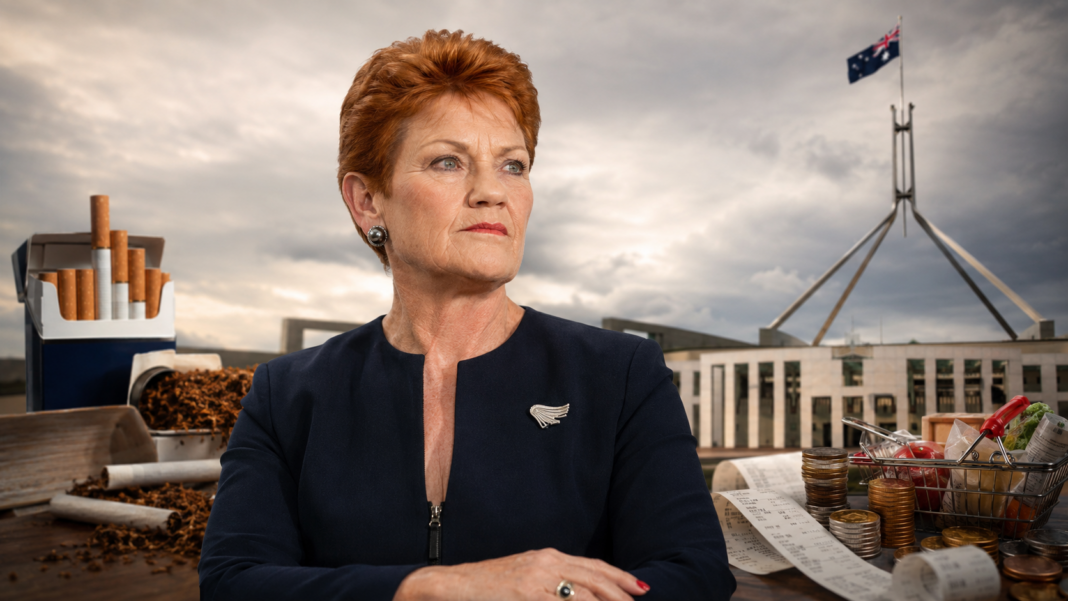
One Nation leader Pauline Hanson has called for Australia’s tobacco excise to be cut by 50 per cent and frozen until mid-2028, arguing high taxes have pushed smokers into the illegal black market and fuelled organised crime.
Hanson said the federal excise had made legal tobacco so expensive that many Australian consumers were turning to illicit products, creating what she described as a $5 billion black market.
According to Hanson, about 70 to 75 per cent of the cost of legal tobacco products in Australia is now federal excise, which is increased twice a year.
“One Nation will cut the tobacco excise by 50 per cent, and freeze indexation until 30 June 2028, with an option to review and extend,” Hanson said.
She said the move would reduce the retail price of tobacco products by about 35 per cent, or roughly $17 off a pack of 20 cigarettes.
“The aim is to reduce the incentive for consumers to go to the black market,” she said.
“This would improve consumer and business safety, reduce the black market and related criminal activity to manageable levels for law enforcement agencies, and potentially reverse the decline in government revenue.”
The announcement comes amid growing political pressure on the Albanese Government over the scale of Australia’s illicit tobacco and vaping market.
The Australian Bureau of Statistics recently estimated that consumption from illicit sources rose from 12 per cent of total tobacco consumption in 2017 to 80 per cent in 2025. The ABS also found the quantity of nicotine consumed in Australia increased by almost 40 per cent between 2017 and 2025, despite population growth of about 14 per cent over the same period.
The figures have intensified debate over whether Australia’s tobacco control strategy, built heavily around high taxes and restricted access, is still working as intended.
Hanson said the policy had failed if nicotine use was rising while legal sales and government revenue were falling.
She pointed to a sharp fall in tobacco excise receipts, saying revenue declined from $16.3 billion in 2019-20 to a projected $3.6 billion in 2026-27 and a forecast $2.1 billion in 2029-30.
The latest federal budget has also downgraded tobacco excise revenue sharply, with the growth of the black market now a major concern for the Treasury, police and state governments.
The tobacco excise is indexed in March and September each year, while the Albanese Government also introduced additional annual five per cent increases from September 2023 to September 2025.
Supporters of high tobacco taxes argue that the policy has helped reduce smoking rates over the decades by making cigarettes less affordable. Public health groups have warned that lowering excise could make legal tobacco cheaper, increase consumption and benefit tobacco companies.
Cancer Council Australia and other health organisations have warned against using the illicit market as a justification for tax cuts, arguing governments should strengthen enforcement, public education and support for quitting instead of reducing tobacco prices.
But Hanson and other critics argue that the scale of the illegal trade has changed the policy equation.
The illicit tobacco market has been linked to organised crime, firebombings, extortion, violence and black-market retail networks across several states.
Victoria has been at the centre of the crisis, with authorities investigating repeated firebombings and arson attacks linked to tobacco turf wars. Queensland and Western Australia have also moved to strengthen enforcement powers against retailers selling illicit tobacco and vapes.
NSW Premier Chris Minns recently added pressure on the federal government, arguing that high tobacco taxes had helped create the conditions for criminal gangs to profit from cheaper illegal products.
The Albanese Government has defended its approach, pointing to increased enforcement funding and action against illegal tobacco and vaping products. In 2025, the federal government announced $156.7 million to help law enforcement agencies tackle the black market.
Health Minister Mark Butler has previously said illicit tobacco and vaping products pose serious concerns for Australia’s tobacco control efforts and public health.
The debate now cuts across public health, law enforcement, tax policy and consumer behaviour.
Hanson’s proposal would mark a major reversal of Australia’s long-running tobacco tax strategy, which has relied on price pressure to discourage smoking.
For One Nation, the argument is that policy has gone too far and created a criminal economy more dangerous than the legal market it was designed to shrink.
For health advocates, the concern is that cutting excise would risk undoing decades of anti-smoking progress and make cigarettes more affordable again.
The issue is likely to become another flashpoint in federal politics as One Nation seeks to position itself as the party prepared to challenge what it calls failed government policy.
With illegal tobacco consumption now dominating the market by some official estimates, the fight over tobacco excise is no longer just about smoking. It has become a test of whether governments can balance public health, criminal enforcement, tax revenue and community safety.
Support our Journalism
No-nonsense journalism. No paywalls. Whether you’re in Australia, the UK, Canada, the USA, or India, you can support The Australia Today by taking a paid subscription via Patreon or donating via PayPal — and help keep honest, fearless journalism alive.
