

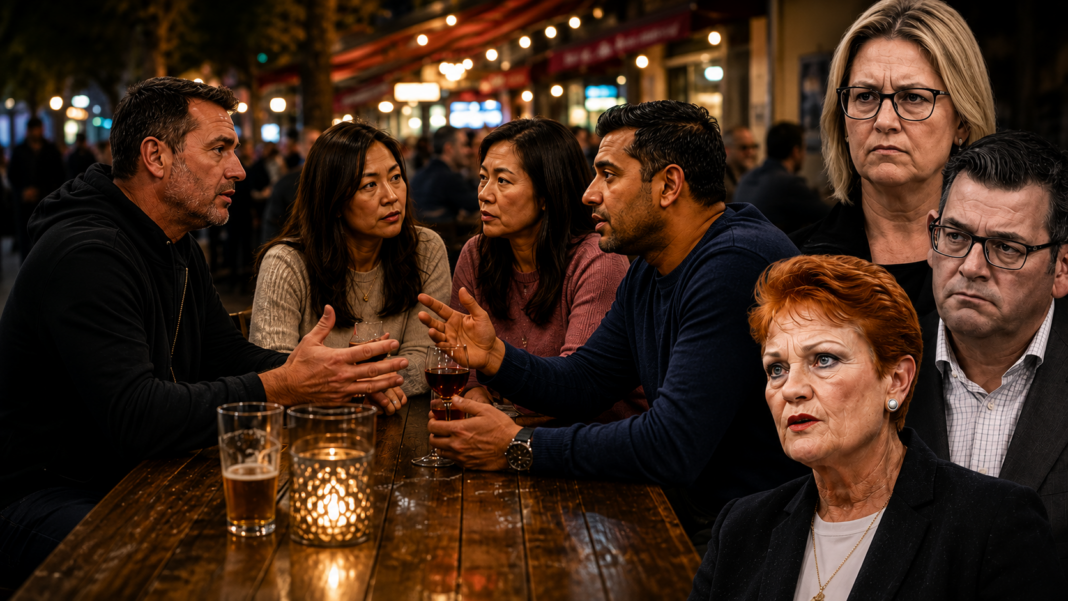
Last night, I walked into a bar on Lygon Street expecting a normal Melbourne conversation: footy, food, the weather, maybe the rising cost of a pint.
Instead, I heard something Victorian Labor should find far more unsettling.
Four ordinary Victorians, from four very different backgrounds, told me with surprising passion that they were now looking at One Nation.
Not whispering it. Not half-embarrassed. Not as a protest joke.
They meant it.
One was a 46-year-old Australian-born man. Two were Asian-born women. Another was an Australia-born Indian Australian. These were not the stereotype that inner-city commentators lazily attach to One Nation voters. They were not angry caricatures from a regional pub. They were suburban, working, taxpaying, multicultural Victorians sitting in the middle of Melbourne, explaining why they felt abandoned by Labor.
That is the story the Allan Government does not want to hear.
The 46-year-old man, a Preston resident, told me bluntly that his area was changing politically.
“People think Preston is automatically Labor or Greens,” he said.
“That’s old thinking.
People are angry.
They don’t say it loudly at work, but they say it at the pub, at home, with friends. One Nation is coming through because people feel nobody else is listening.”
I pushed back. Preston has long been treated as a progressive stronghold. Labor and the Greens dominate the political conversation there.
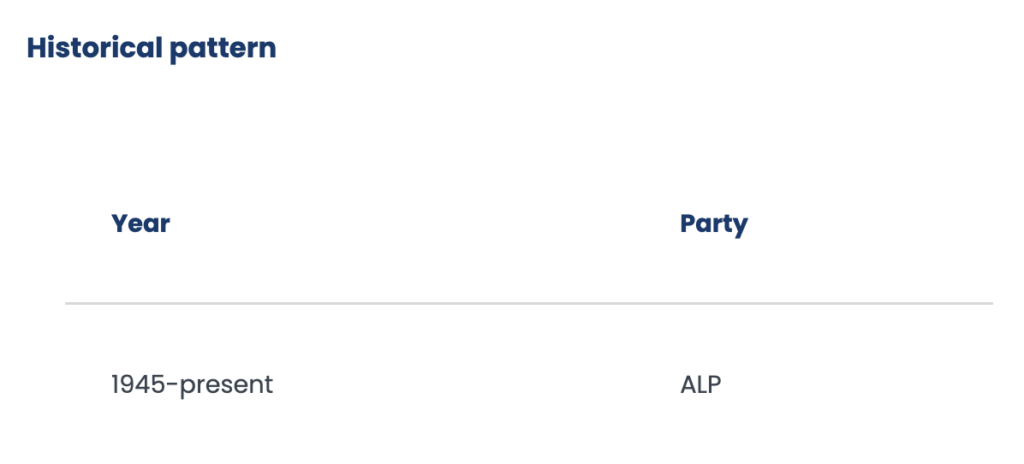
Just to draw the perspective, I googled after coming home. Preston has been with the Labor Party since 1945.
He laughed.
“That’s exactly why they’ll miss it,” he said.
“They think because a seat has cafes, migrants and renters, people won’t vote One Nation. They don’t understand how fed up people are.”
That sentence should terrify Labor strategists.
For years, Victorian Labor has governed as if multicultural suburbs were safely locked away. It assumed migrant communities would remain loyal because the alternative could always be painted as hostile. It was assumed that younger renters would stay with the left because the Liberals felt too distant. It assumed working families would keep voting Labor because they always had.
But the compact is breaking.
The Asian-born women I spoke with were not talking about abstract ideology. They were talking about safety.
One said she no longer felt comfortable letting family members move around at night.
“I came here because Australia felt safe,” she told me.
“Now I worry about shopping centres, train stations, streets. I don’t want speeches. I want my family to feel safe.”
The other nodded and added,
“Every time something happens, the government says it is doing more. But people don’t feel safer. If you don’t feel safe, nothing else matters.”
This is where Labor’s political problem becomes deeper than polling. Safety is emotional. Once voters believe a government has lost control, announcements rarely fix it. A press conference cannot undo the feeling of looking over your shoulder at a shopping centre or railway station.
Then came the Indian Australian man, born here, raised here, deeply invested in Victoria’s future, and furious about what he sees as the state’s decline.
“There is no growth here anymore,” he said.
“People work hard, pay taxes, run businesses, study, try to build something, and what do we get? Debt, red tape, crime, high costs and no confidence.
Victoria used to feel like a place of opportunity. Now it feels like a place people want to escape.”
He said his frustration was not about race or religion. It was about economic confidence.
“My parents believed Victoria was the best place to build a life,” he said.
“My generation is asking whether we should build somewhere else.”
That is devastating for a Labor Government that once sold itself as the builder of modern Victoria.
Daniel Andrews dominated Victorian politics with force, discipline and an ability to define his opponents before they could define themselves. But his legacy is now being judged by voters who are living with the bill: debt, infrastructure blowouts, a strained health system, housing pressure, crime anxiety and a political culture many see as arrogant.
Jacinta Allan inherited that legacy but has not escaped it. To many voters, she does not look like a fresh start. She looks like continuity without the command.
Recent polling suggests this anger is no longer anecdotal. A Freshwater Strategy poll reported by the Herald Sun had Labor on just 23 per cent primary vote in Victoria, behind the Coalition on 27 per cent and One Nation on 25 per cent. It also found 62 per cent of voters believed Labor should change leader before the November election.
That is not a wobble. That is a warning siren.
Roy Morgan polling earlier this year also showed One Nation competing strongly in Victoria, even moving ahead of Labor in one February survey and sitting within striking distance again in April.
Labor’s comforting theory is that One Nation’s vote is mostly regional, older and conservative. That may have been true once. But it is no longer enough. The new One Nation voter can be a migrant mother worried about safety. A suburban tradie crushed by costs. A small business owner sick of regulations. A young worker who cannot see a future. An Indian Australian angry that Victoria feels stagnant. An Asian Australian who came here for security and now feels the state is slipping.
That does not mean all these voters will end up voting One Nation. But it does mean they are willing to listen. And for Labor, that is the dangerous part.
For too long, the Victorian Government has treated voter anger as a communications problem. It is not. It is a lived experience problem.
People are not angry because they misunderstood the government’s message. They are angry because they understand their own lives.
They see bills rising. They see crime stories spreading. They see housing as out of reach. They see debt climbing. They see small businesses struggling. They see political leaders lecturing them about values while failing to deliver basic competence.
One Nation’s pitch is simple: the system is broken, and the major parties are not listening.
Labor’s response has been to call it dangerous. But moral panic is not a strategy. If anything, it confirms the voter’s suspicion that the political class is more interested in silencing frustration than understanding it.
What I heard on Lygon Street was not a formal poll, but it was politically revealing. When multicultural, suburban, working Victorians are openly talking about One Nation in the heart of Melbourne, something has shifted.
Labor can dismiss it as a protest. It can blame misinformation. It can attack Hanson. It can tell itself that Preston, Melbourne’s north, the migrant suburbs and the working-class belt will come home on election day.
Or it can finally accept the uncomfortable truth.
Victorians are not flirting with One Nation because they have suddenly changed who they are. They are doing it because they believe Labor has changed what Victoria is.
And unless Jacinta Allan understands that, the next election may not just be a contest between Labor and the Coalition.
It may become a referendum on whether the party that once owned Victoria has stopped listening to it.
Support our Journalism
No-nonsense journalism. No paywalls. Whether you’re in Australia, the UK, Canada, the USA, or India, you can support The Australia Today by taking a paid subscription via Patreon or donating via PayPal — and help keep honest, fearless journalism alive.
