

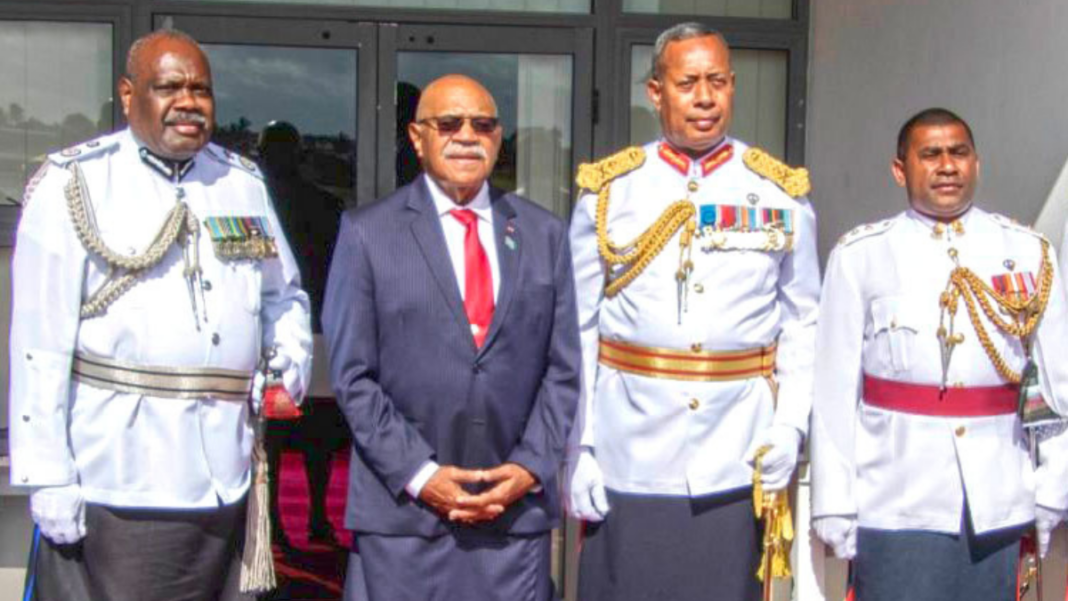
Fiji’s Government has moved to reassure the public that there is no need for a state of emergency at this stage, following a meeting of the National Security Council chaired by Prime Minister Sitiveni Rabuka, which reviewed national security risks, law and order, and economic conditions amid heightened concern over organised crime and drug trafficking.
The Council, attended by senior ministers and key security agencies, assessed international developments, fuel supply stability, financial conditions and contingency planning. Based on advice from the Fiji Police Force and the Republic of Fiji Military Forces, officials confirmed there is currently no recommendation for emergency powers and that the situation remains under control.
“The Government reassures the public that there is no cause for alarm,” an official statement said, noting the meeting was part of routine risk assessment and preparedness planning rather than an escalation of national threat levels.
On fuel supply, authorities confirmed shipments for May are secured and expected to meet normal demand, with further deliveries being arranged for June. While supply remains stable, officials cautioned that Fiji remains exposed to global price volatility driven by international conflict, shipping disruptions and refinery constraints.
The Council also reported that Fiji’s financial system remains stable, supported by strong foreign reserves, though inflationary pressures continue to be monitored. Agencies across transport, energy, water and maritime sectors are coordinating contingency planning to ensure resilience if global conditions worsen.
The clarification comes against a backdrop of escalating public concern over law and order, following earlier warnings from the Prime Minister that a state of emergency could be considered as part of a wider crackdown on drug-related gang activity.
Security forces have recently established checkpoints nationwide under a joint police–military taskforce aimed at disrupting organised crime networks. Fiji has increasingly been described as a transit point in the Pacific drug trade, with authorities alleging links between local activity and syndicates operating in Australia, including networks based in Sydney.

The crackdown follows reporting linking Pacific drug flows to transnational criminal groups, with Fiji positioned along trafficking routes supplying Australia and New Zealand. However, officials have insisted that the current security posture remains within normal operational parameters.
Former attorney-general Graham Leung previously cautioned that emergency powers should only be used in “extraordinary circumstances”, warning of potential impacts on civil liberties, tourism and public confidence.
“It is unprecedented, it’s an unusual step, and it’s not a decision to be taken lightly,” he said, noting that such measures must not be used to restrict democratic freedoms or media independence.
The security environment has also been complicated by controversy surrounding the death of alleged underworld figure Jone Vakarisi while in military custody, initially described as a medical emergency but later reclassified by police as a murder investigation. No charges have yet been laid, and the case has intensified scrutiny of military conduct and accountability.
Human rights groups, including Amnesty International, have raised concerns about allegations of mistreatment of detainees in military custody. Claims from farmer Kelepi Komaisavou, who alleges he was beaten and subjected to degrading treatment during interrogation, remain unverified, with authorities yet to respond in detail.
Police have rejected suggestions that the broader crackdown is a distraction from internal controversies, stating operations are focused on “disrupting, destroying and dismantling criminal networks” and are continuing despite what they describe as misinformation.

At the same time, Fiji’s Human Rights and Anti-Discrimination Commission has urged restraint, warning that any future consideration of emergency powers must meet strict legal thresholds and be used only as a last resort.
Director Loukinikini Lewaravu said any such measure must be temporary, evidence-based and proportionate. “The response must not come at the expense of democratic principles, human rights and dignity, and the rule of law,” she said.
She also called for a broader strategy that includes rehabilitation, education and community-based prevention, arguing that enforcement alone would not resolve the underlying drivers of the drug crisis.
Support our Journalism
No-nonsense journalism. No paywalls. Whether you’re in Australia, the UK, Canada, the USA, or India, you can support The Australia Today by taking a paid subscription via Patreon or donating via PayPal — and help keep honest, fearless journalism alive.
