

A new Sky News Australia YouGov Pulse national poll has highlighted a sharp shift in Australia’s political landscape, with Pauline Hanson’s One Nation recording a primary vote of around 27%, placing it level with the Australian Labor Party in the latest survey snapshot.
According to the poll, Labor also sits at approximately 27%, while the Coalition trails at around 20%. The Greens are reported at roughly 14%, with independents and other minor parties making up the remainder of the vote.
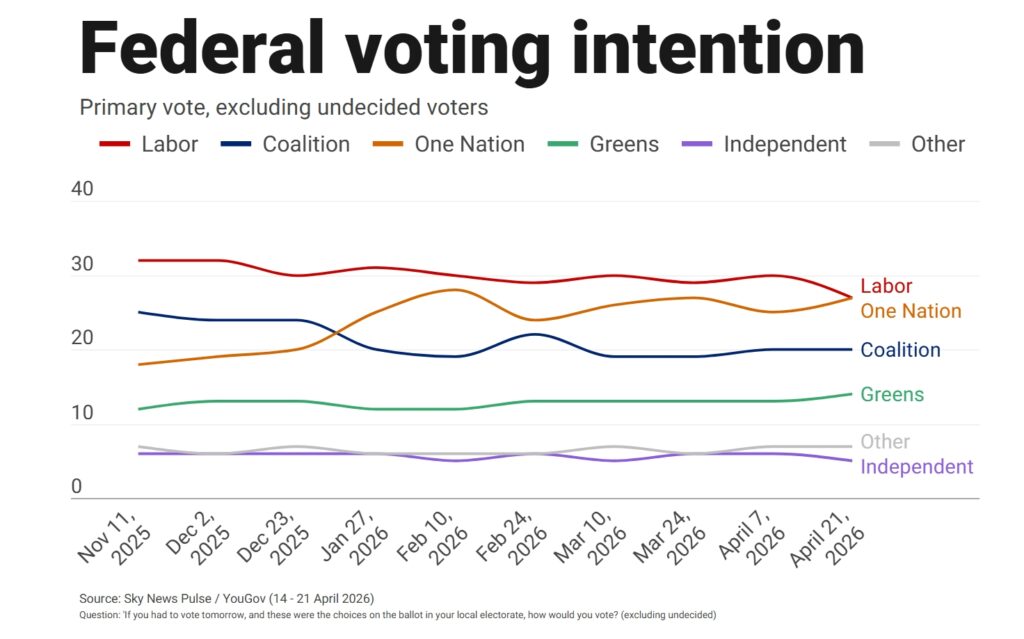
If sustained, the result would mark one of the strongest performances for One Nation in the Pulse polling series, reinforcing a broader trend of rising support for minor parties amid voter dissatisfaction with the major political blocs.
The polling comes against a backdrop of ongoing public concern over cost of living pressures, housing affordability, energy policy, and immigration debates. Analysts suggest these issues continue to erode support for traditional party structures, particularly among voters open to alternatives outside Labor and the Coalition.
The Coalition’s primary vote, sitting near the low 20s, reflects continued fragmentation on the conservative side of politics, where support seems to be increasingly spread across multiple parties and independents.
Despite the attention on primary vote shifts, Australia’s preferential voting system means the final election outcome remains dependent on two-party-preferred results and preference distributions.
In the same polling series, Labor continues to maintain a lead on two-party-preferred estimates over the Coalition, underscoring that primary vote parity does not directly translate into electoral victory.
Recording its lowest primary vote on record, the Australian Labor Party would still form government if an election were held today.
Labor leads the Liberal–National Coalition 53–47 on a two-party-preferred basis, while Pauline Hanson’s One Nation has surged two points to sit just behind at 52–48 according to the same poll.
However, One Nation outperformed Labor on a two-party-preferred basis among working-class, regional and older voters, and also holds a two-party-preferred lead in Queensland and South Australia.
While polling figures can fluctuate between surveys, the broader pattern points to a shifting political landscape.
The latest Pulse results reinforce that trend, even as the final impact on a future federal election will depend on how preferences flow closer to polling day.
Support our Journalism
No-nonsense journalism. No paywalls. Whether you’re in Australia, the UK, Canada, the USA, or India, you can support The Australia Today by taking a paid subscription via Patreon or donating via PayPal — and help keep honest, fearless journalism alive.
