

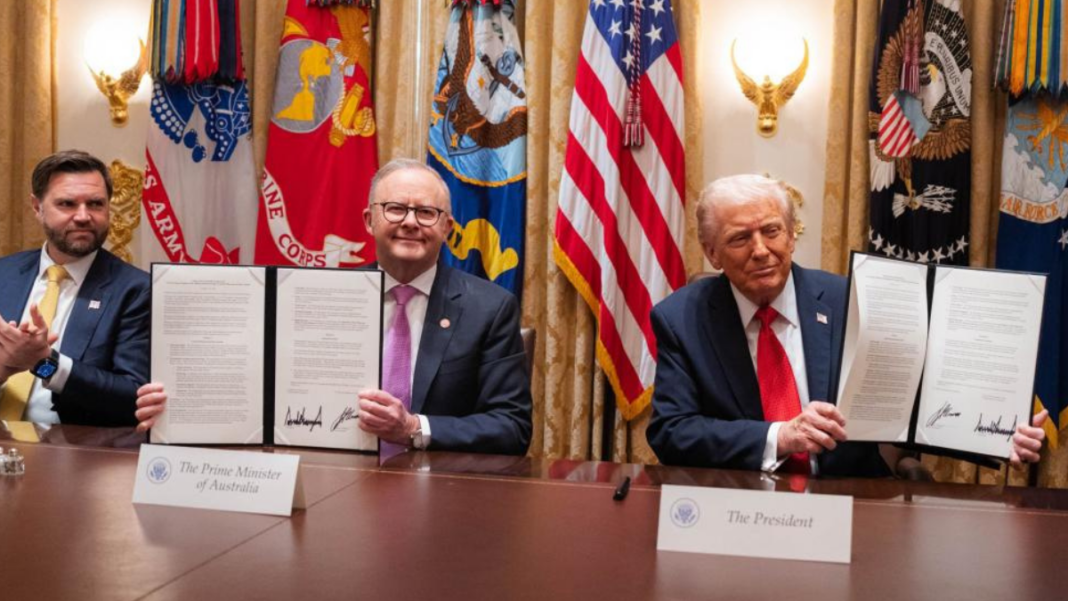
Australia has moved a step closer to joining a multinational effort to secure one of the world’s most critical oil and shipping corridors, as Prime Minister Anthony Albanese prepares to join urgent talks on the escalating crisis in the Strait of Hormuz.
The Prime Minister is expected to attend a late-night virtual meeting of a new maritime initiative led by Emmanuel Macron and Keir Starmer, aimed at restoring freedom of navigation through the strategic waterway. The talks come amid mounting global concern over disruptions to energy supplies and trade routes linked to the ongoing conflict in the Middle East.
The proposed coalition, driven by Britain and France, is separate from the United States’ unilateral blockade efforts — a move that has exposed tensions among Western allies. Donald Trump has repeatedly criticised countries including Australia, declaring he was “not happy” with their level of support.
Speaking at a press conference at Viva Refinery in Geelong, Albanese declined to directly engage with Trump’s claims that Australia had been asked to assist but failed to respond. “That’s a question for Donald Trump,” the Prime Minister said when pressed on the remarks.
“I’ve seen the footage… and there wasn’t an answer given.”
He reiterated that Australia’s position had not changed despite repeated assertions from Washington. “Day after day… there’s been no new requests at all,” Albanese said.
“And indeed, President Trump has himself said that he has got this… there’s been no change in Australia.”
When asked whether any informal request had been made by the United States, the Prime Minister maintained his stance. “I’ve answered that on a number of occasions,” he said. “The answer is the same.”
Despite the public friction, the Albanese government has continued to stress that it is engaging constructively with the US administration while weighing its own role in broader international efforts.
The UK-France-led initiative is expected to focus on stabilising commercial shipping and potentially coordinating mine clearance operations, as traffic through the Strait remains significantly reduced. The route carries a major share of the world’s oil and liquefied natural gas, making any prolonged disruption a serious risk to global markets.
Senator Penny Wong has reiterated that Australia will not commit ground forces, signalling a cautious approach as Canberra balances alliance expectations with regional stability concerns.
At the same time, Defence Minister Richard Marles confirmed Australia is in discussions with a broader coalition of nations exploring options to secure safe passage through the Strait. While no final decision has been made, he indicated Australia could contribute assets if required.
Security analysts say the situation reflects growing uncertainty around US coordination with allies. Rory Medcalf described the unfolding crisis as “a mess”, suggesting Washington initially sought broad support before shifting its stance.
Former ambassador Arthur Sinodinos said the US President’s criticism likely reflects frustration over the pace of the conflict rather than a breakdown in alliances.
Behind the scenes, Australia is weighing how it can support efforts to keep vital trade routes open without being drawn directly into the conflict. The presence of an Australian E-7 Wedgetail aircraft in the region, supporting Gulf partners, underscores Canberra’s current contribution.
Support our Journalism
No-nonsense journalism. No paywalls. Whether you’re in Australia, the UK, Canada, the USA, or India, you can support The Australia Today by taking a paid subscription via Patreon or donating via PayPal — and help keep honest, fearless journalism alive.
